Brixton never ceases to surprise us and throw up some hidden gems. The following are a few nuggets we have discovered in our research that you may not know about. We will add to them as and when we discover more.
Britain’s First Rock and Roll Club?
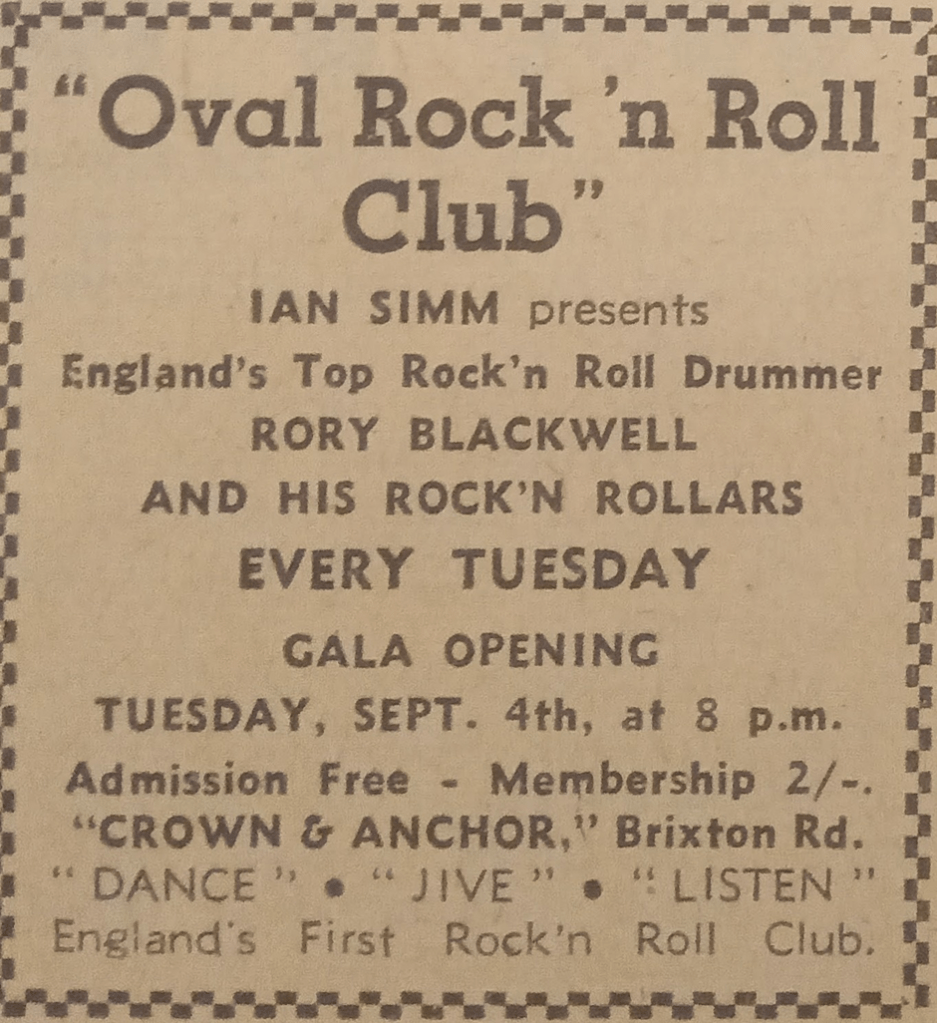
The title of Britain’s first Rock and Roll club could be hotly contested. Most people consider the 2I’s coffee bar in Soho to be the cradle of British Rock and Roll because of the plethora of talent that played there. Although the bar opened in April 56 its initial groups were skiffle groups, who didn’t start playing until July 1956. So it could be argued that the Oval Rock n’ Roll Club at the Crown and Anchor in Brixton Road was the first club to label itself as being specifically a Rock and Roll Club. Whoever was first, it is fair to say that the Oval club was certainly at the very least one of the first Rock and Roll Clubs, opening in September 1956, just weeks after the 2I’s put on their skiffle groups.
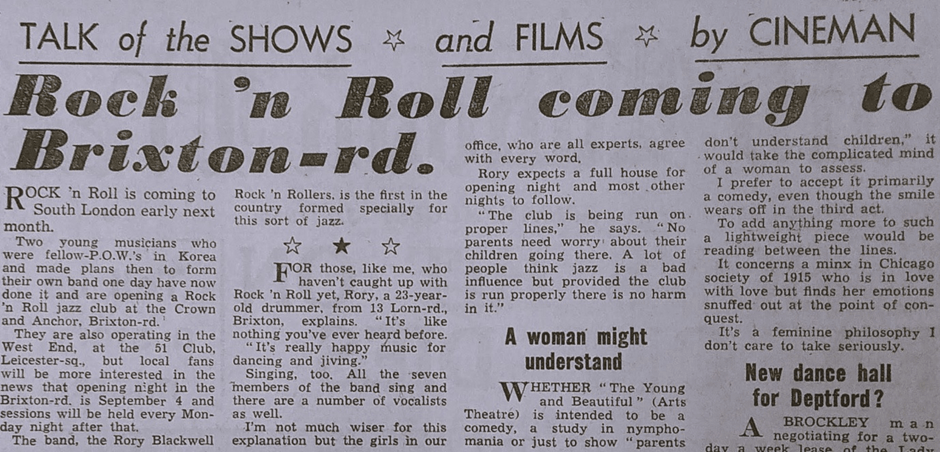
The opening night was a roaring success, with apparently 100s having to be turned away. You can see a photo here.

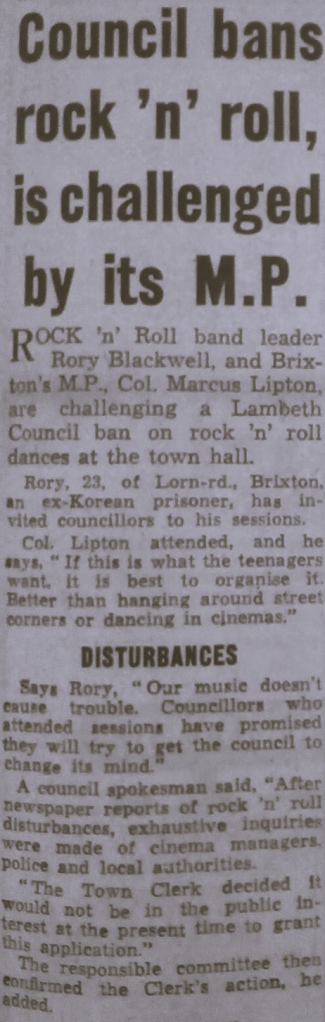
After the success of the opening night, promoter Ian Simm hoped to book Lambeth Town Hall. However, it was not to be. Teddy Boys were already the bete noire of the UK press but matters moved to a whole new level when just two weeks after the opening of the club at the Crown and Anchor, Billy Hailey and the Comets’ film “Rock around the clock” was shown across cinemas in South London. Following screenings in Elephant and Castle the South London Press headlines frothed “800 in rock ‘n’ roll riot”. The subsequent report revealed that the “riot” would be considered a minor disturbance by today’s standards. Nevertheless, the bad publicity scuppered plans to move the club to the Town Hall.
Local MP Marcus Lipton was in attendance at the first session and expressed his approval, so much so that he spoke out against Lambeth council, who very quickly moved to ban rock and roll events at the Town Hall.
Skirts Only Please
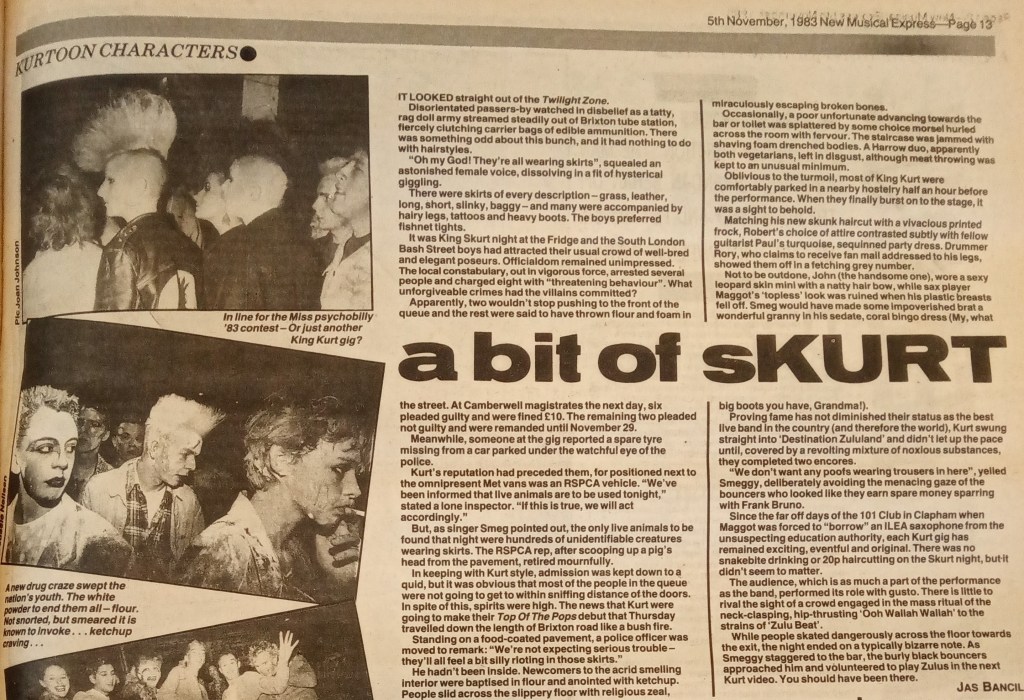
Psychobilly reprobates King Kurt chose the Fridge in Brixton for the launch of their “skirts only” tour in 1983, where the door policy dictated that men would only be allowed in if they were wearing a skirt.
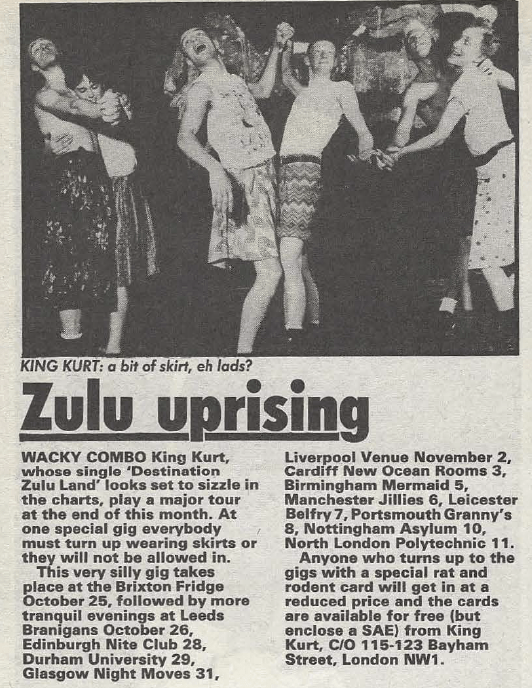
Not for the faint hearted, punters shouldn’t think about wearing their best party frock. King Kurt gigs got messy, very messy; as this clip filmed at The Fridge for the BBC’s Riverside show demonstrates:
Jas Bancil (who normally wrote for the South London Press) was seconded into the NME to capture the full horror:
Most venues nowadays would probably ban any band who tried behaving like that.
For something rather more sedate, try looking at this promo clip of the band in Brockwell Park:
Aerobics Instructor Needed-Unemployed Punks Only Need Apply
1982 and the latest craze to hit the world is aerobics. Leotards and leg warmers are de rigeur. Everyone of a certain age will remember Jane Fonda’s workout, which made aerobics world famous.
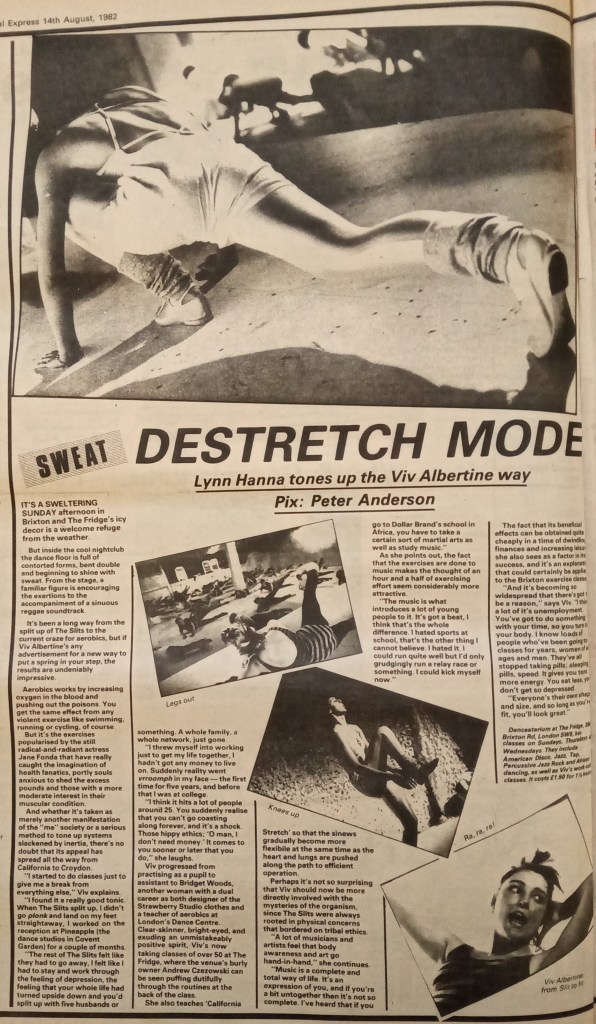
What we didn’t know was that Viv Albertine, guitarist with ground breaking punk band The Slits, used to teach aerobics at The Fridge in 1982. Still smarting from the break up of The Slits earlier in the year, Albertine threw herself into work. After a brief apprenticeship, she started aerobics class at the original location of The Fridge, 390 Brixton Road.
She told the NME “I started to do classes just to give me a break from everything else. I found it a really good tonic…the rest of The Slits felt like they had to go away. I felt like I had to stay and work through the feelings of depression, the feeling that your whole life had been turned upside down and you’d split up with five husbands or something. A whole family, a whole network, just gone. I threw myself into working just to get my life together.”
The Dancing Man of Brixton
Brixton old timers have told us “You must know about The Dancing Man of Brixton.” In the early 80s apparently the Dancing Man would stand outside a record shop in Granville Arcade and dance, day in day out, year after year. We managed to catch a quick glimpse of him at 0:36 in this archive footage from 1982:
A still of him is captured below:

We then came across a much better clip, where you can see him at 1:55:
We heard that he came to an untimely end and was murdered in a night-club. If anybody has any more information, we would love to hear from you.
The Sugar Puffs Connection
Effra Road in Brixton was home to Velvet Underground singer Nico and punk poet John Cooper Clarke during the 80s.
We have heard variously that they lived at Nr 23, Nr 25 or Nr 29. Whatever the address, you can see a photo of them sitting on the steps outside here and pictures of Nico outside the Effra Tavern here.
Both of them were in the clutches of heroin addiction. Whilst Nico was still making music and releasing records during the 80s, the heroin completely stunted Clarke’s creativity, with no commercial releases between 1982 and the early 2000s. In the mid to late 80s he was definitely yesterday’s man. So how to fund his heroin habit? Somehow, we can’t imagine how, John Cooper Clarke became the face of kid’s cereal Sugar Puffs in 1988:
We would be fascinated to know how an advertising executive managed to pitch the idea of a heroin addicted, has-been punk poet becoming the go to man to promote Sugar Puffs.
Who is the mysterious Philip U-Ming?
History, they say, is written by the victors. When it comes to the Brixton Academy, there certainly seem to be some unresolved strands as to how it sprung into back into life in 1983. The official story is that entrepreneur Simon Parkes bought the Academy for £1 from Watneys brewery and brought this wonderful venue back into use.
However, our research has shown that it might not be quite as simple as that. The Academy’s predecessor, The Fair Deal had collapsed in September 1982. At the same time as its collapse, there were reports of a rescue operation, headed by someone that the NME described as a Ugandan Asian tycoon named U-Ming. U-Ming was apparently head of a business consortium that planned to save the venue by paying off The Fair Deal’s creditors to the value of 50%. The consortium’s plan was then to substantially increase the number of concerts, as well as opening a pool hall below the stage and using the foyer for discos. According to the NME at the time, U-Ming was 95% certain that the deal would go through, despite a “somewhat tepid” counter-bid by local community leaders.
The music press was always susceptible to printing unsubstantiated rumours, so some of their news stories have to be taken with a pinch of salt. In November 1982 Melody Maker was reporting a potential rescue deal, spearheaded by Virgin Records and The Fair Deal’s leaseholders Watneys.
However, by February 1983 the NME was reporting that U-Ming was resuming negotiations to take over the venue.
By June 1983 Black Echoes was reporting “The ill-fated Fairdeal concert venue in Brixton…is to re-open under a new name and with new management. Now known as “The Academy” the venue is run by East West promotions, under the directorship of Mr Philip U-Ming. The Academy hosts a pool hall and disco and has already opened to provide rehearsal facilities. It is due to open for concerts in September, when it will adopt a broad music policy, including reggae.
The NME fleshed out the detail in its 11th June 1983 issue: “local business man and master builder Philip U-Ming has been trying to take over the venue, and his discussions with the owners (Watneys the brewers) have finally come to fruition-he took control two weeks ago.
Mr U-Ming told NME: “We can’t open The Academy to the public until September, because the place was left in a shocking state by Mr Briggs, and a great deal of refurbishment is necessary-besides which we want to make some improvements of our own. But when we do open there will be regular concerts and a disco every night-plus a pool hall, which will also feature The Golden Cue competition, which Watneys are sponsoring.”
The NME went on to explain that several top bands, including Iron Maiden, The Thompson Twins, Motorhead and Genesis had either already rehearsed or were booked to rehearse at The Academy. It also mentioned that The Academy offered live in accommodation (including canteen) for bands’ road crews. The team went as far as advertising in Music Week:

Two weeks later Philip U-Ming submitted the planning application to carry out modifications to The Academy, including for the creation of the pool hall.
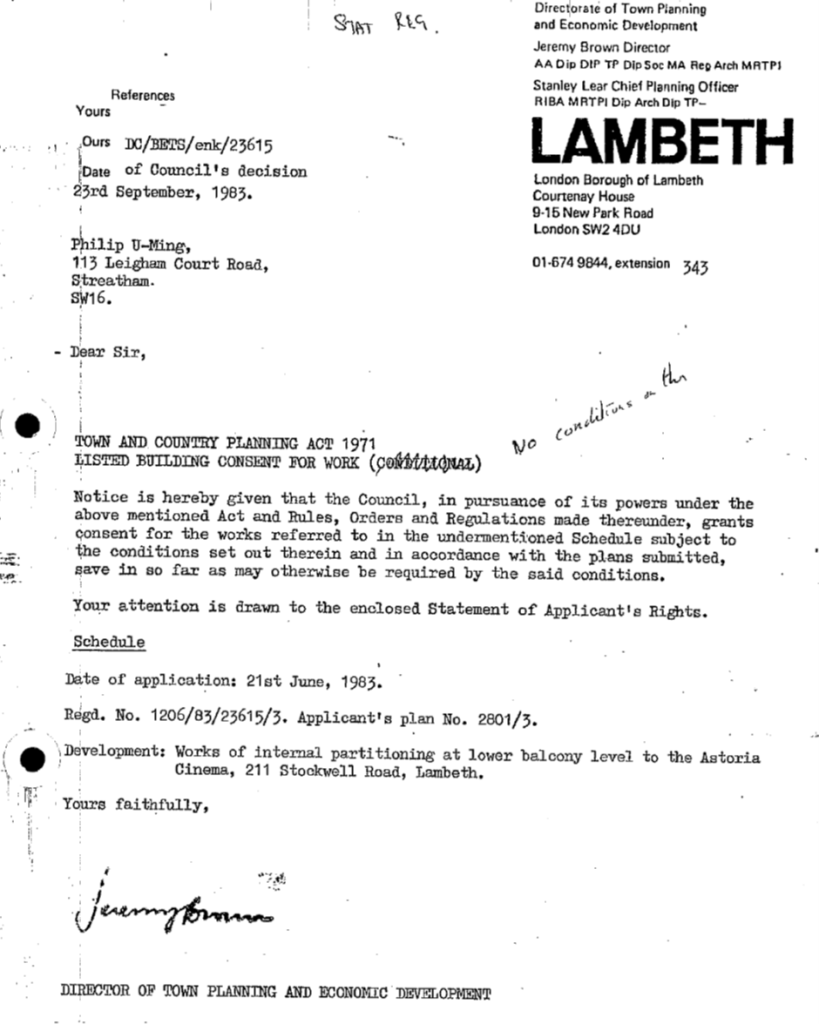
Philip U-Ming wouldn’t be submitting planning applications just three months ahead of the intended opening date (The Academy actually put on it’s first concert at the beginning of October) if he wasn’t fully involved in the running of The Academy. Yet there is no mention of him in Simon Parkes book “Live at the Brixton Academy”. Similarly, there is no mention of Simon Parkes in contemporary reports in the music press. Simon Parkes also mentions in his book that when he was negotiating with Watneys to buy The Academy “They also let slip that aside from the crooks behind Fair Deal, I was the first person in two years to express any interest in the place”. That statement is at odds with what we know was going on-you only had to read the music press at the time to know that.
So what went on here? Why has Philip U-Ming been written out of the history books and what was his role in the creation of the Brixton Academy? If anyone has any clues, please get in touch.
The Charmed Life of the Brixton Academy
Most people know of the Brixon Academy’s rejuvenation in the early 80s. Simon Parkes’ “Live at the Brixton Academy” is the book to read for his story on how the Academy sprang back to life.
However, you may not know about the Brixton Academy’s charmed life up until then. Even as early as the early 1960’s the owners were looking to offload the Academy (then known as the Astoria). Planning applications in 1961 and 1962 to turn the Astoria into offices, shops and showrooms were both rejected by Lambeth council.
The venue enjoyed a brief respite from the developers in the early 70s, when it became a gig venue, the Brixon Sundown, which hosted gigs by the likes of T-Rex, Hawkwind and Deep Purple.
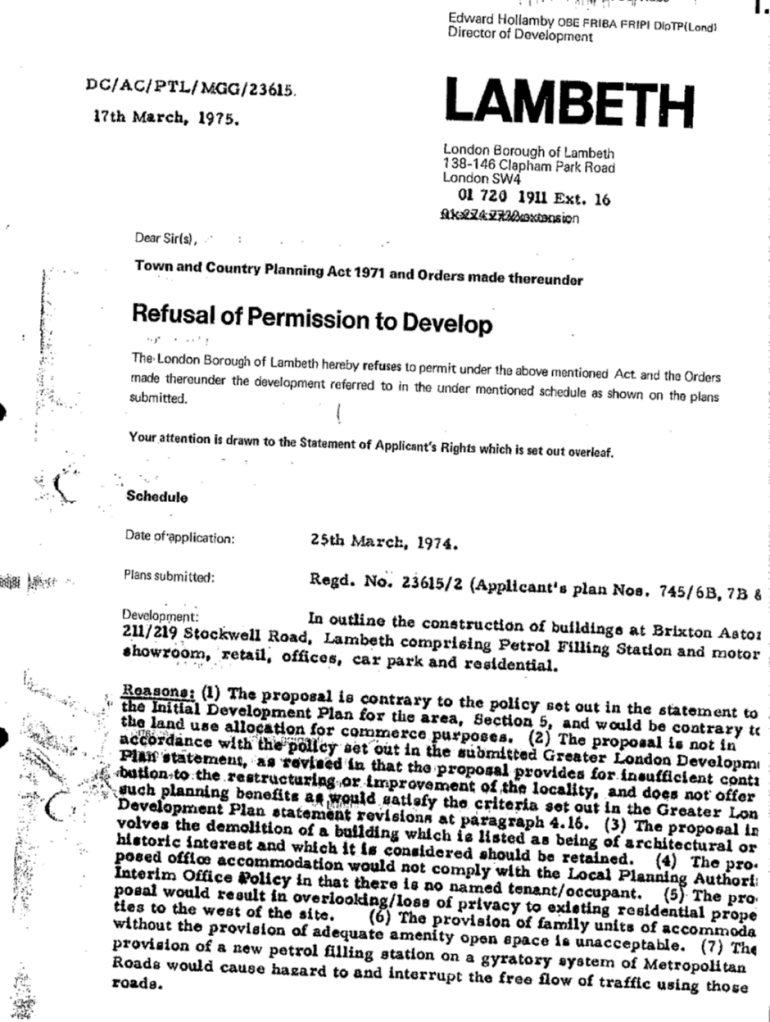
The Sundown was short lived and before too long, in March 1974 an application was made by the owners, Rank, to demolish the venue and replace it with a petrol station, car showroom, retail, offices, car parking and residential. Fortunately the venue had been given Grade II listed status just three months earlier, which put a stop to the wrecking ball.
In April 1976 planning permission was granted to turn the venue into a dining and cabaret venue. This venture came to nothing.
In April 1978 planning permission was granted to turn the venue into a skateboard park. The owners must have no doubt been peeved that in 1978 Lambeth council built a free skatepark literally right next door to the Academy, which nixed that plan.
The venue briefly became a music venue again in February 1982 when it was renamed the Fair Deal.
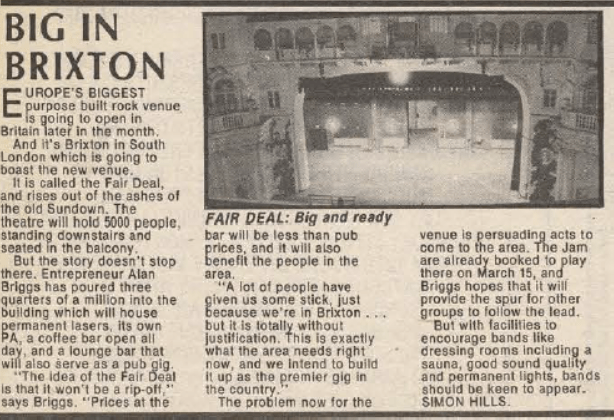
Sadly by August 1982 the music press was already reporting that the venue was in financial trouble and it closed soon afterwards.
Then the Brixton Academy came along and hopefully saved the venue for many, many years to come.
 brixtonmusicmemories