The Ace, situated at the site of the current Electric club, existed for a short while between late 1982 and early 1984. In our opinion its role in revitalising Brixton as a music destination is much underrated.
The venue had a packed programme that managed to combine the best of the UK alternative scene, drawing in visitors who might not normally come to Brixton, as well as putting on plenty of reggae nights that would appeal to the local population. The Ace was pitched as a competitor to The Venue in Victoria, offering to cater for a similar audience as well as putting on a broader selection of acts.
The venue lasted barely more than a year but during that time hosted the very best of the UK alternative and pop scene (for example The Smiths, Depeche Mode, Sisters of Mercy) as well as some fantastic reggae acts such as Gregory Isaacs and Sugar Minott.
The venue had been operating as a cinema since 1913, going through a number of name changes before it was renamed as the Ace cinema-well known locally for its late night kung fu movies.
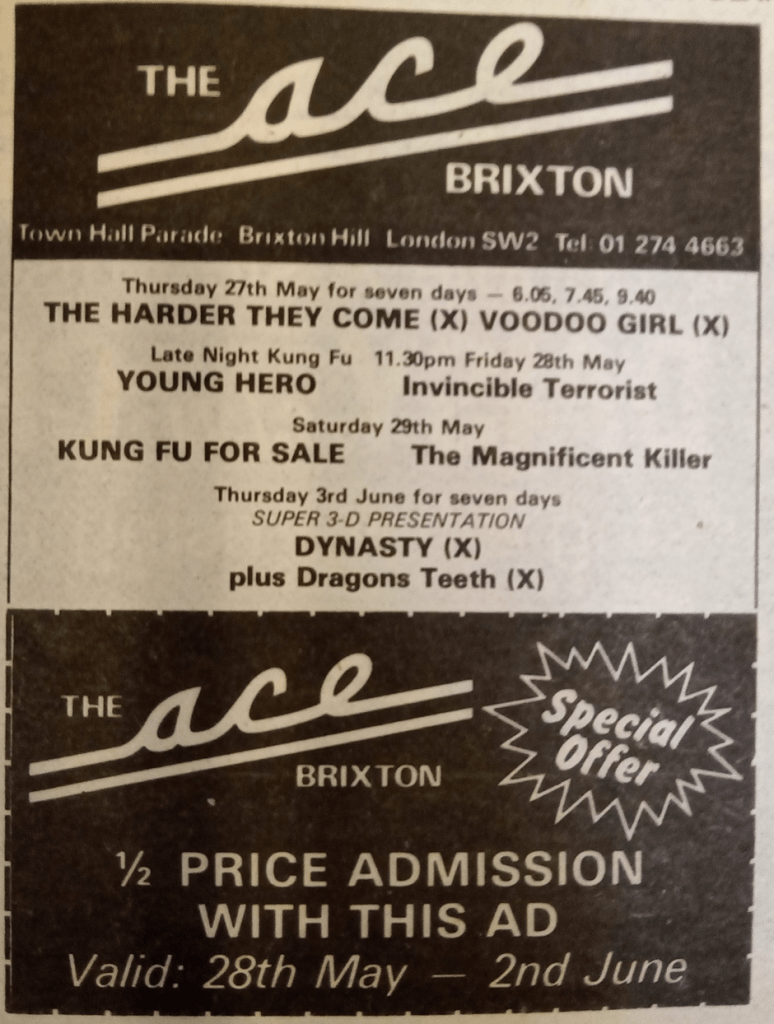
There had been occasional one-off gigs at The Ace cinema, such as this gig in 1978:
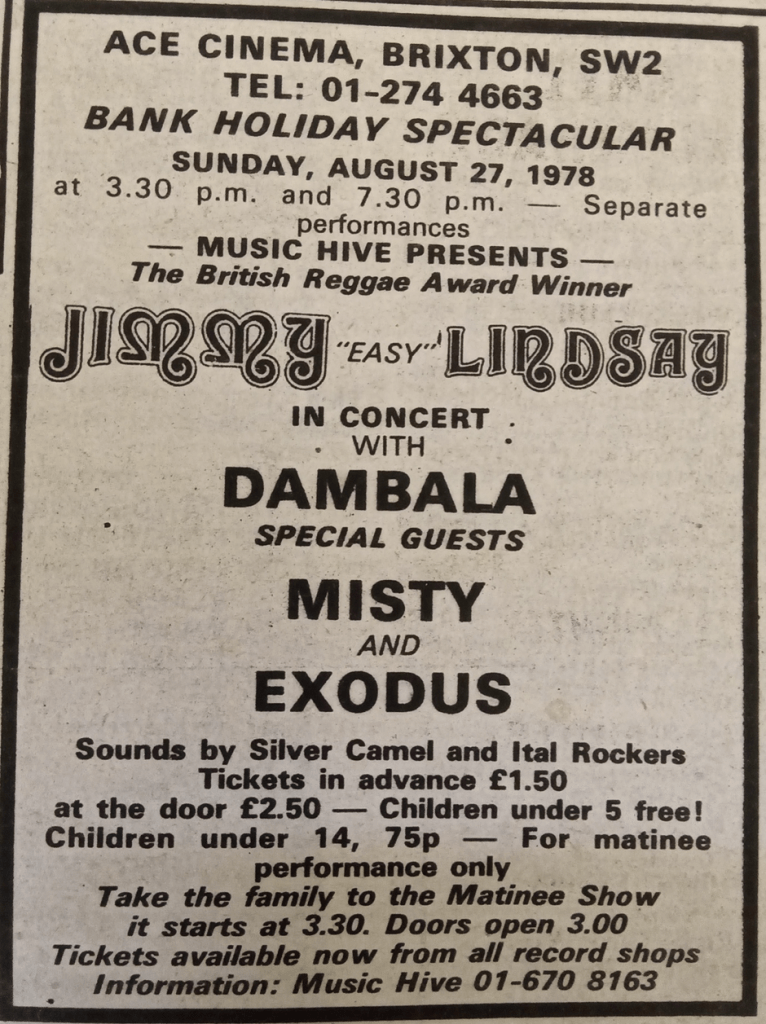
Black Echoes reported that the Jimmy Lindsay gig above was to the first of a series of monthly events promoted by Jimmy Lindsay, that would include Burning Spear, Louisa Mark and Delroy Wilson. However, we could not find any record of any of these events taking place
A few years later, the decision was made to concentrate more heavily on musical events. The venture was announced in the music press in January 1982. It was due to open in March but then did not open its doors until November. Local businessmen David Style and Eddie Taubman were behind the project and ploughed over £250,000 into converting the cinema into a venue that would still host cinema, theatre and wrestling as well as music and a roller disco.
Channel 4 had just started in November 1982 and was a lot more alternative and cutting edge than it is today. So what could be more cutting edge than presenting a show from Brixton, still seen by the mainstream as a no-go area after the previous year’s riots. Many of the initial gigs were filmed for a Channel 4 series called “Whatever you want”, which filmed gigs held on a Thursday. This has provided plenty of archive footage. In addition, there are several reviews of these gigs in the music press of the time.
What follows is a brief run-down of the gigs that took place.
1982
October
Early October saw a gig by Urban Shakedown, which according to the NME was to be free. Perhaps a trial run for the gigs to come. Support came from the Southern Death Cult. It looks like the Southern Death Cult gig was captured by Channel 4. This footage was broadcast on 29th November 1982:
November
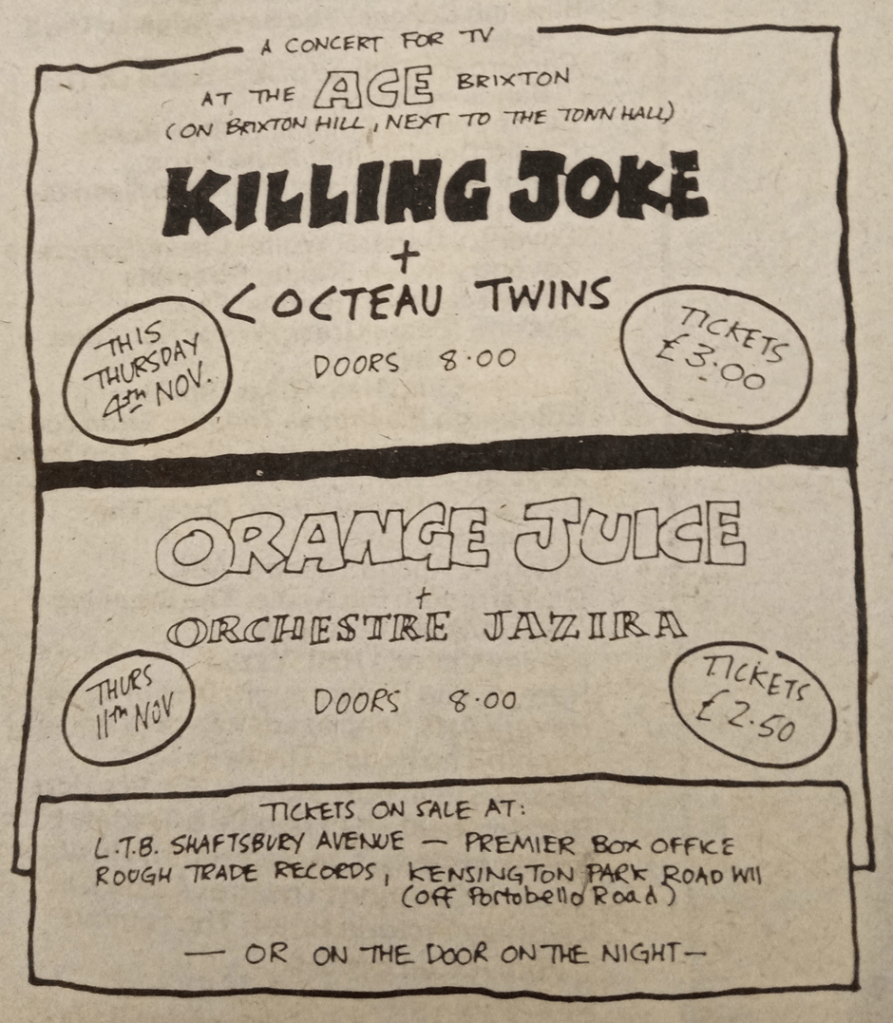
Opening night featured Killing Joke. Their set is captured here:
Support on the night came from the Cocteau Twins:
The 11th November saw a gig by Orange Juice and Orchestra Jazira:
https://licensing.screenocean.com/record/130875
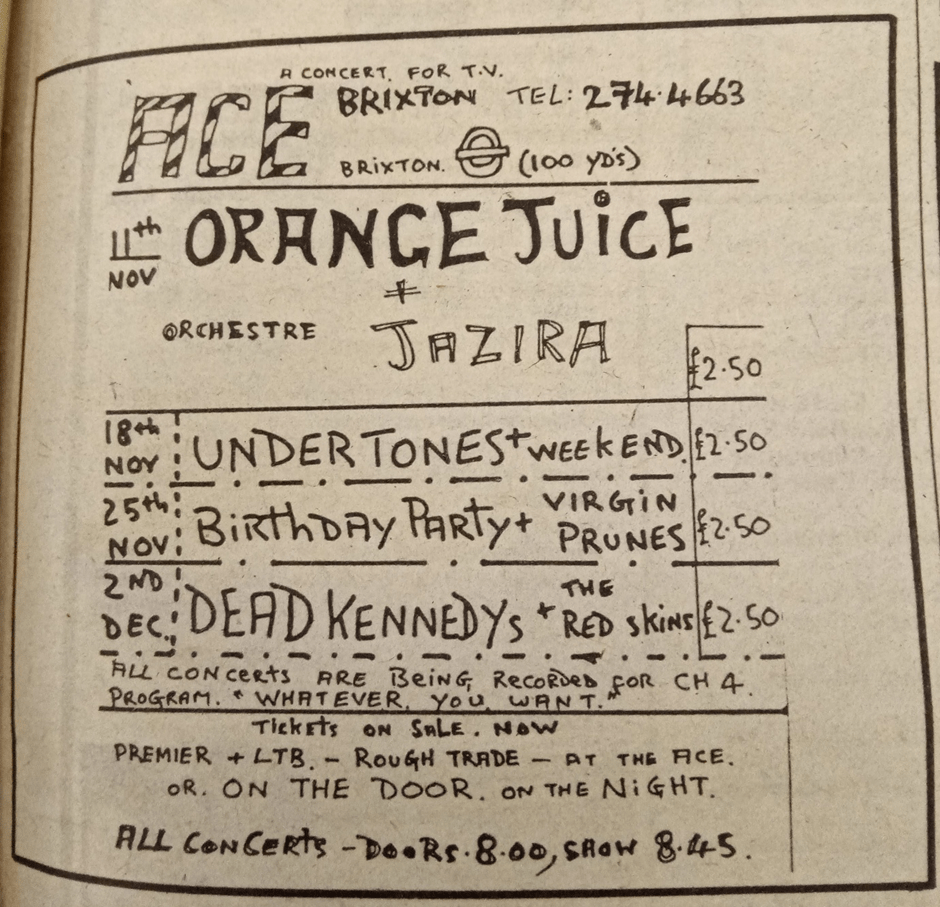
The Undertones played on the 18th November:
The gig got a favourable review in the NME: “with this football mob of an audience, The Undertones can do no wrong”.
Finishing off November was a gig by The Birthday Party and The Virgin Prunes.
The Birthday Party would break up 6 months later, the tension in the band very much evident from this review in the Melody Maker:
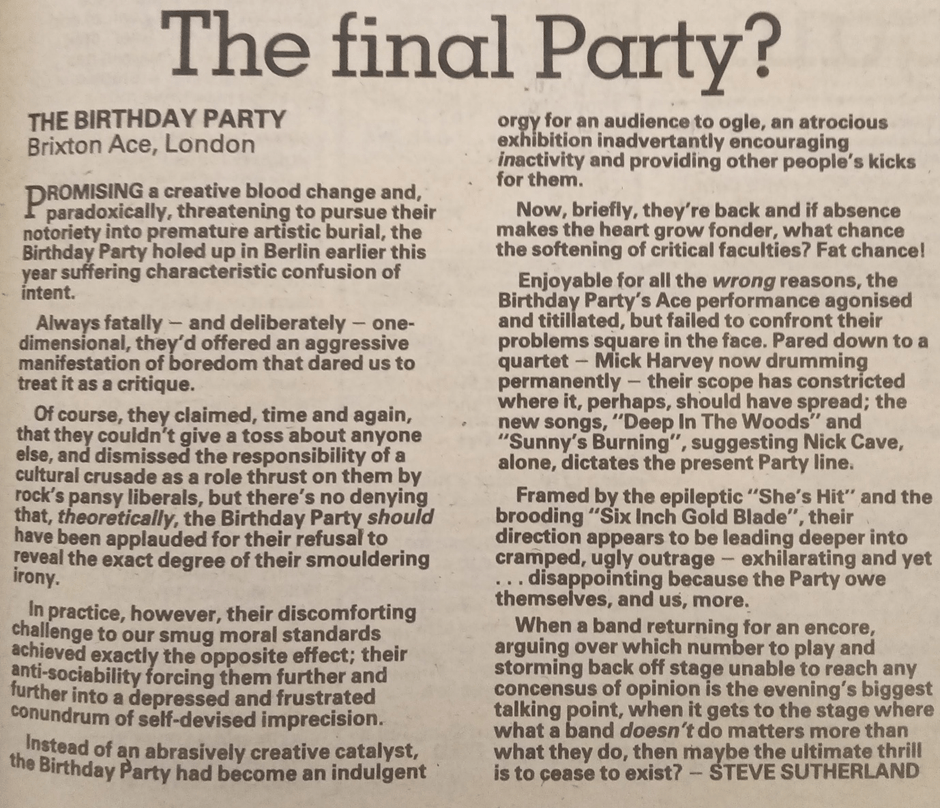
The NME’s take on the gig was completely different: “The Birthday Party are, in that quaint old phrase, maybe the Greatest Rock ‘n’ Roll Band in the World” said reviewer Mat Snow.
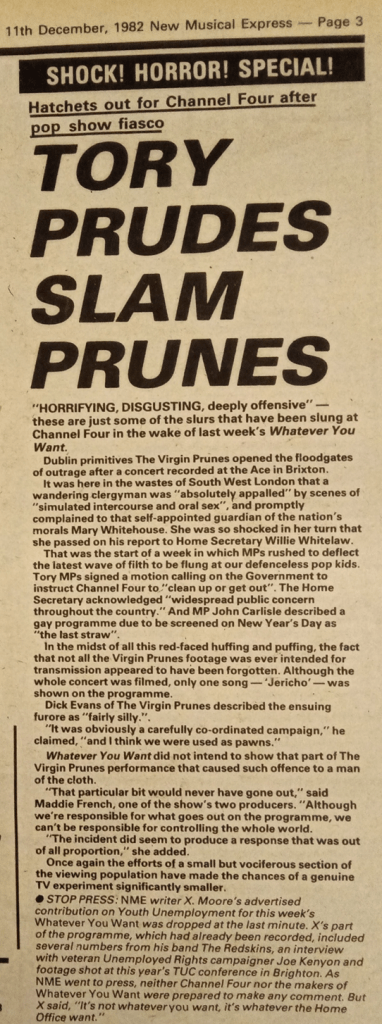
Only one song by The Virgin Prunes was broadcast:
Cue outrage from the establishment:
December
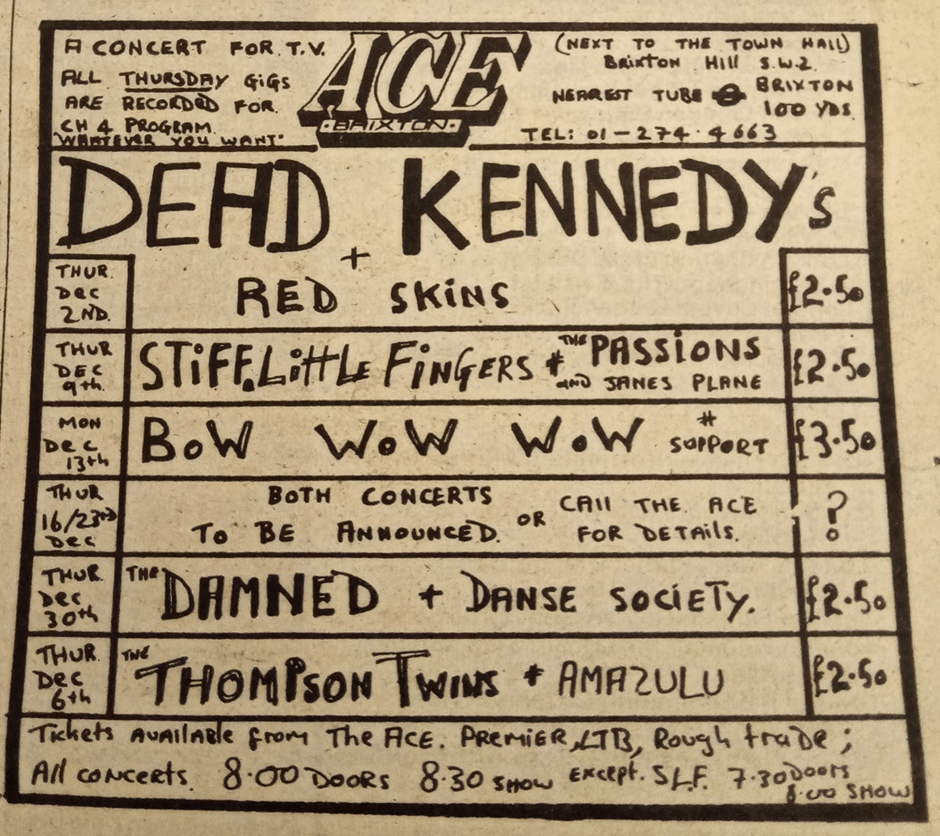
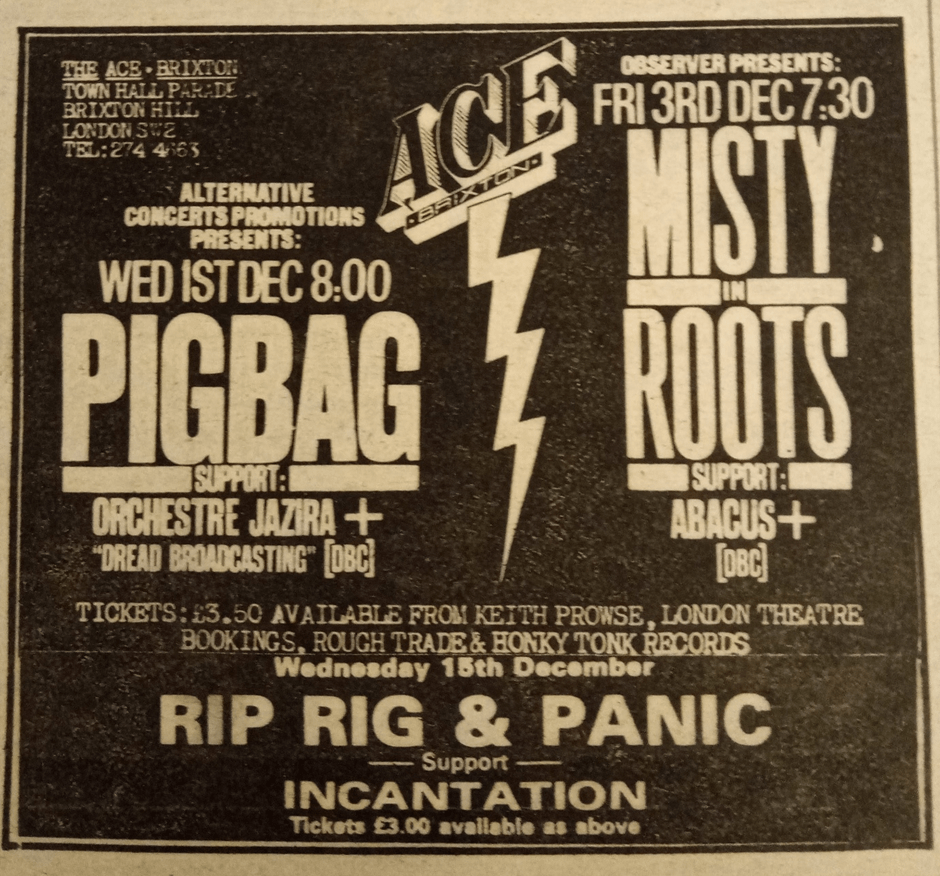
December didn’t start auspiciously. Pigbag were due to play on 1st December but had to cancel due to illness.
Proceedings therefore kicked off on the 2nd December with Dead Kennedys, whose full set is captured here:
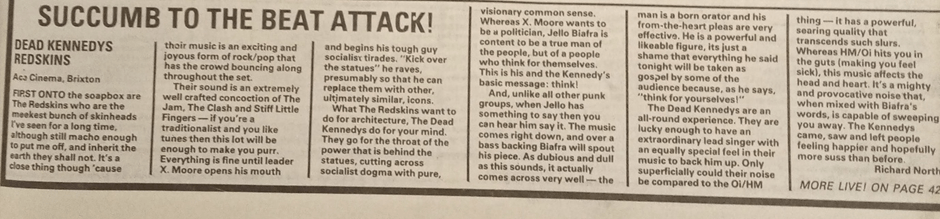
Support on the night came from The Redskins:
Both bands got the thumbs up from the NME:
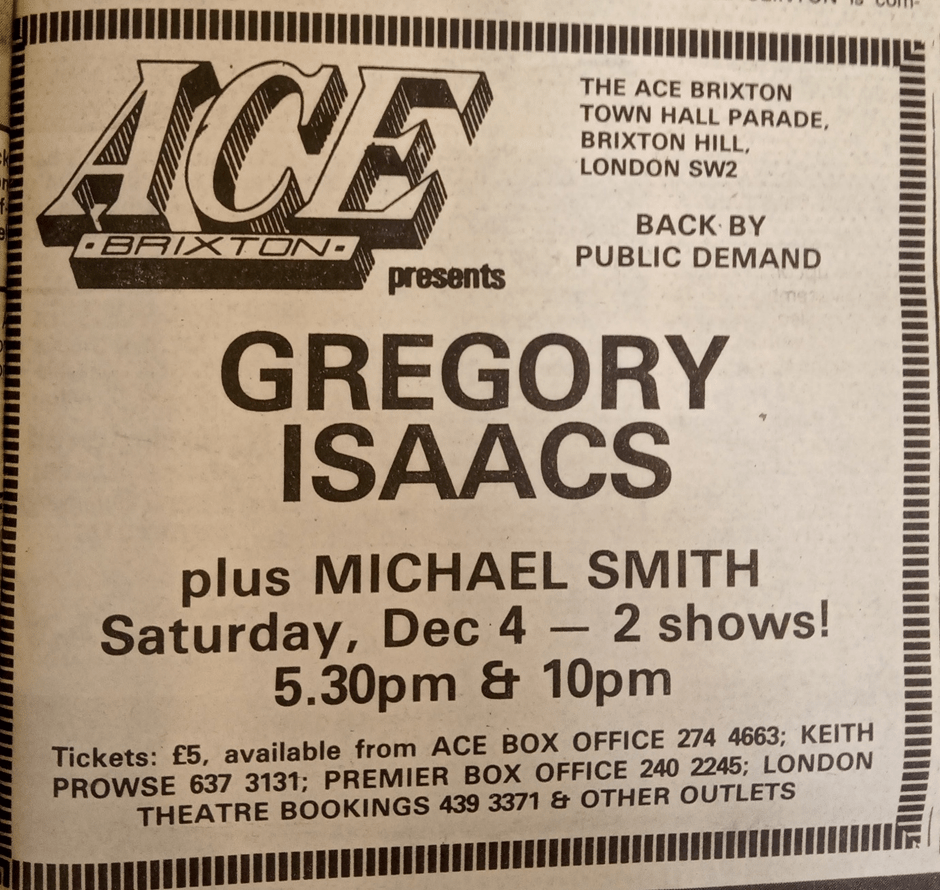
Misty in Roots played on the 3rd December with support from Abacush, followed by Gregory Isaacs on the 4th December. Playing support to Isaacs was Jamaican dub poet Michael Smith, who would be tragically murdered just months later.
The 5th and 6th December saw a production of the reggae opera “Mack the Knife” directed by Michael Armitage and performed by the L’Ouverture Theatre company.
The Twinkle Brothers and Sister Nancy played on the 8th December.
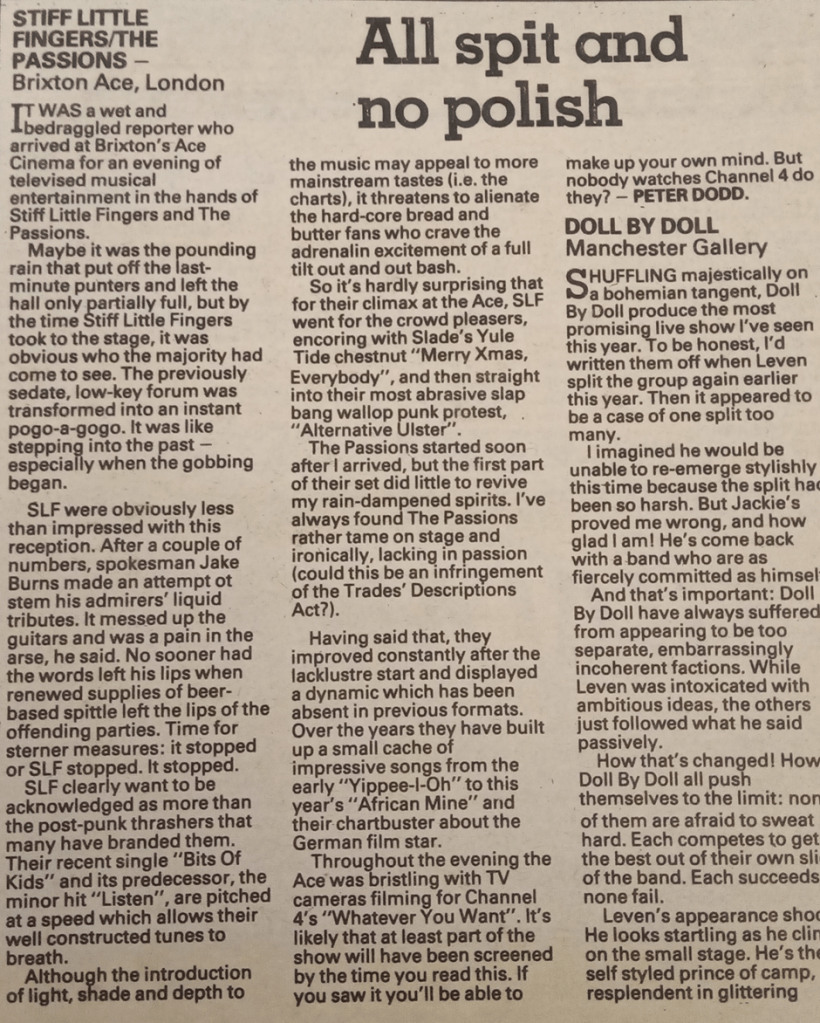
Stiff Little Fingers played on the 9th December. The band would split up shortly afterwards. Part of their performance is captured here:
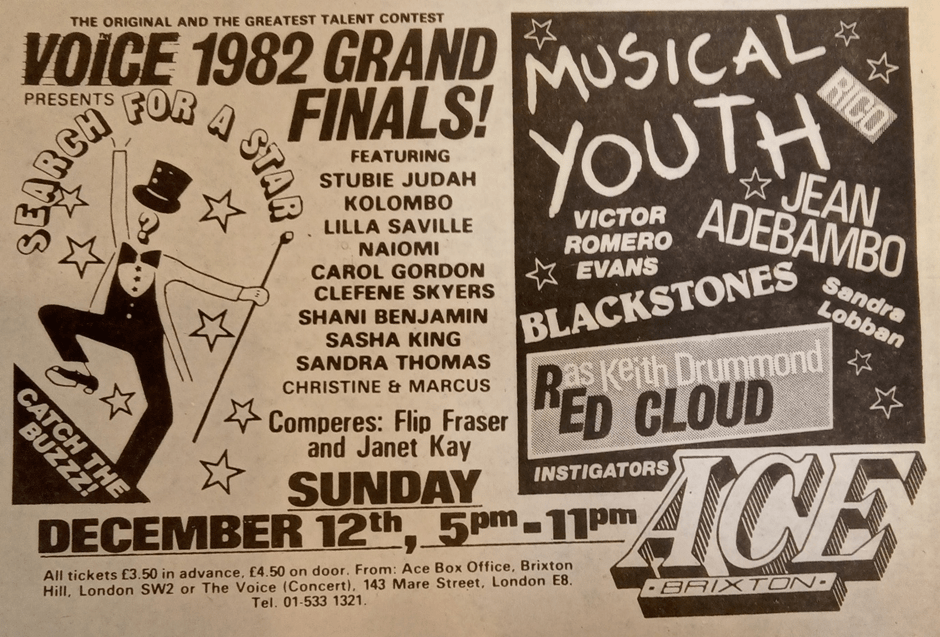
Musical Youth, who had hit the Nr 1 slot in the pop charts with “Pass the Dutchie” in September, headlined a Voice talent competition on the 12th December.
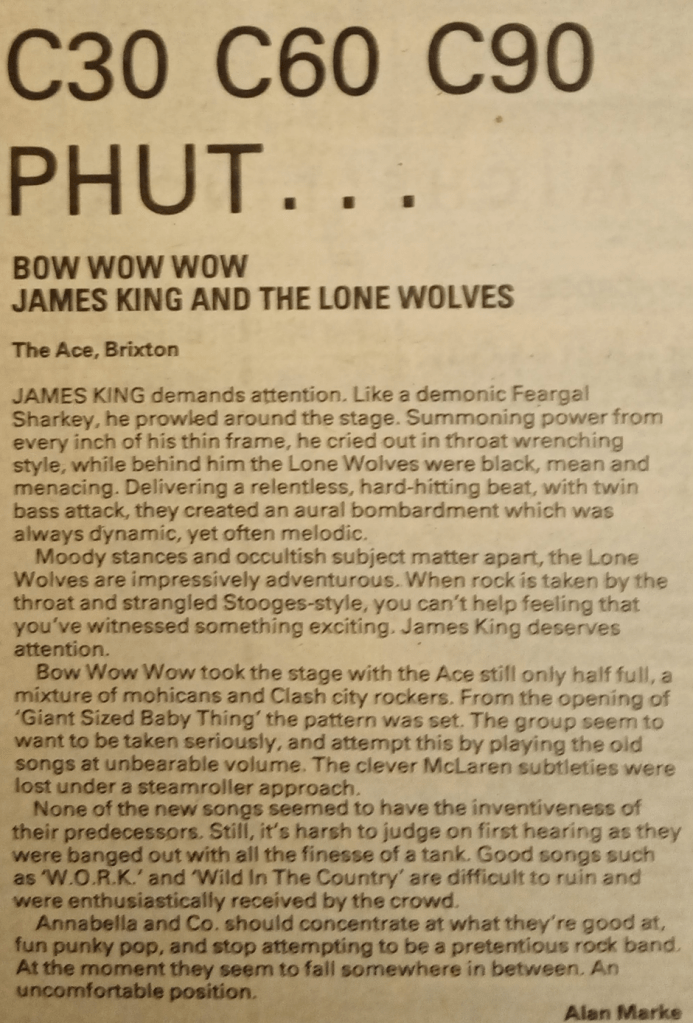
Bow Wow Wow played on the 13th to a less than enthusiastic response from the music press:
Rip Rig and Panic played on the 15th, supported by Incantation. Could that really be the same Incantation that had just entered the charts with that awful pan pipes song “Cacharpaya” that never seemed to be off Top of the Pops? Stranger things have happened.
The Beat were slated to play on the 16th at one stage. However, they were replaced by Spear of Destiny and Big Country, captured here:
The whole Spear of Destiny gig was released commercially.
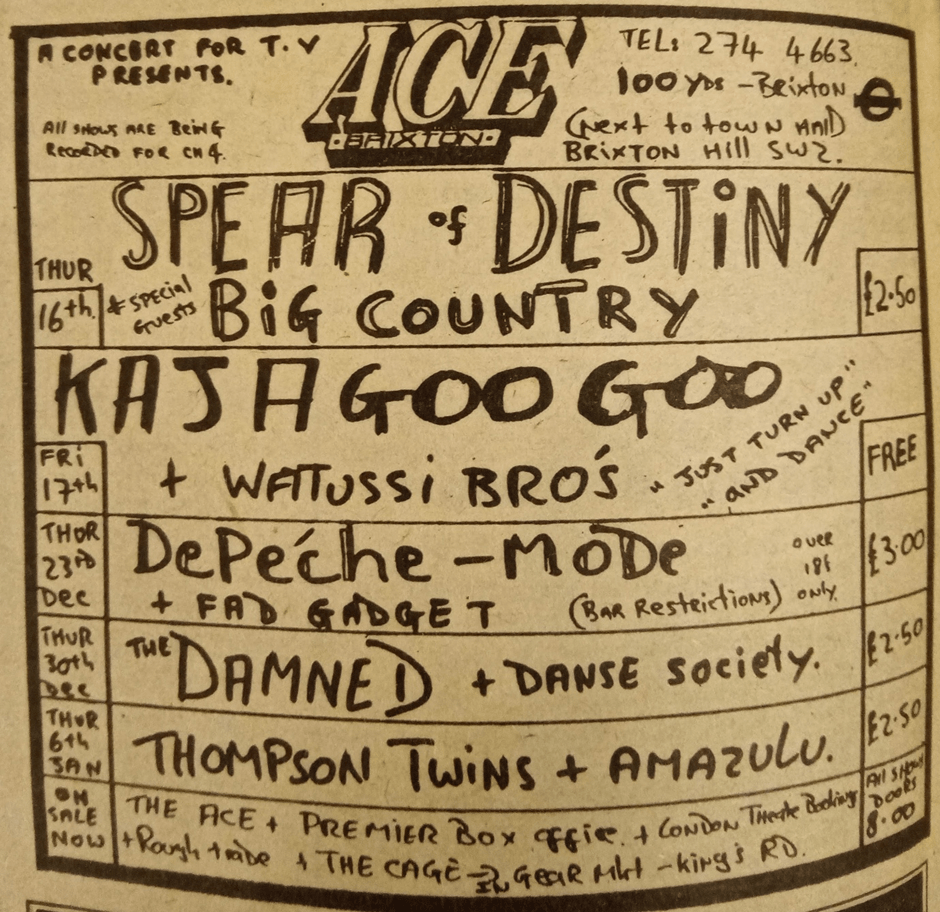
Kajagoogoo played for free on the 17th. No comment.
Of more interest was the Afro-Caribbean festival on the 18th, featuring Gasper Lawal, Ekome, Spartacus and the Ebony Steel Band. The gig was recorded for broadcast on Capital Radio.
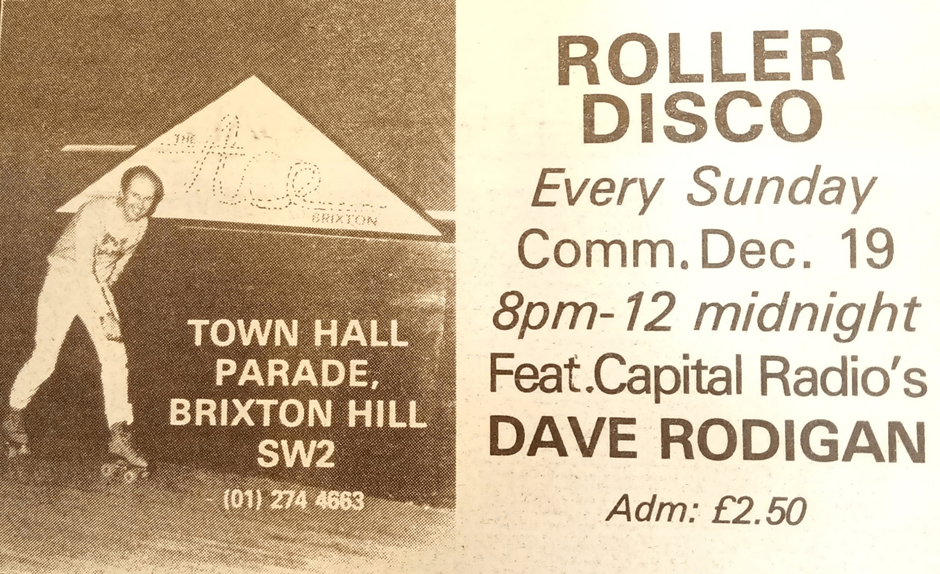
19th December saw the start of the Rodigan Roller Disco (murderation on the dance floor, as it was styled). The evening session proved to be so popular that they instigated an afternoon session as well, with entry pegged at £1.50 and £0.50 for hire of skates. We always thought that roller disco went out of fashion in the 70s, but obviously not.
Securing Depeche Mode on the 23rd December was a real coup. As regulars on Top of The Pops and children’s TV they were much more used to playing larger venues. The previous October they had played two nights at the Hammersmith Odeon as part of their latest tour.
The year ended in fine style with the Damned on the 30th December.
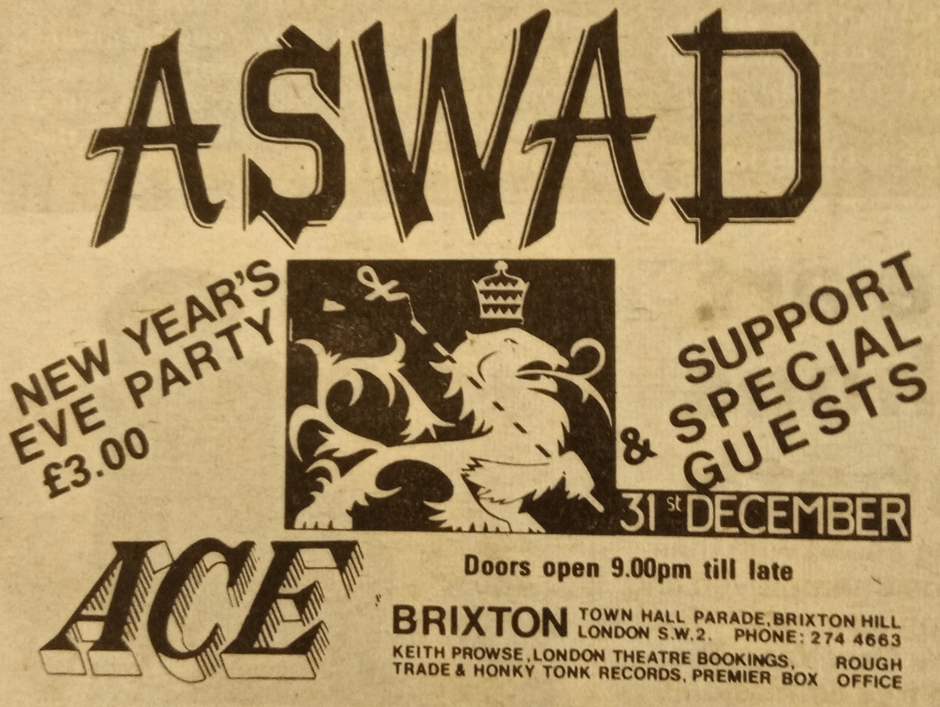
Followed by Aswad on New Year’s Eve.
1983
January
Sounds reported in January that The Ace had received a blow to its ambitions as it had been refused a 3AM license. This decision came despite the support of the council leader Ted Knight and the head of the Amenities Committee, Ian Pickton. Apparently the opposition had come from a GLC solicitor.
1983 started a more formalised set of gig listings for The Ace, which were published every week in the NME. As well as the flyers no longer being hand drawn, the adverts tended to include all genres. Previously Black Echoes had advertised all the reggae gigs and the NME all the rock gigs.
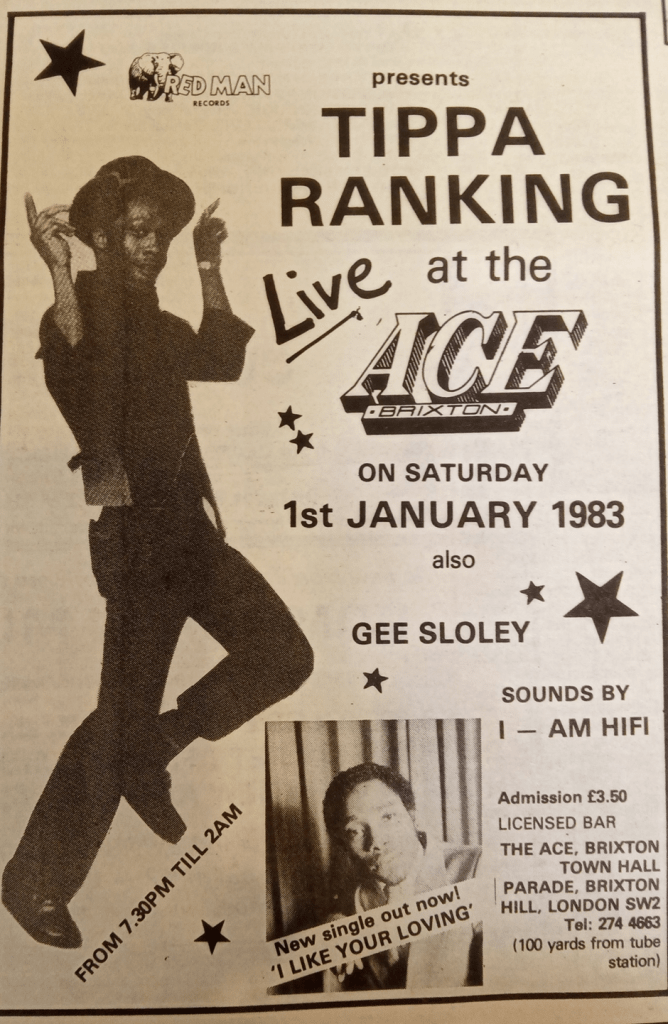
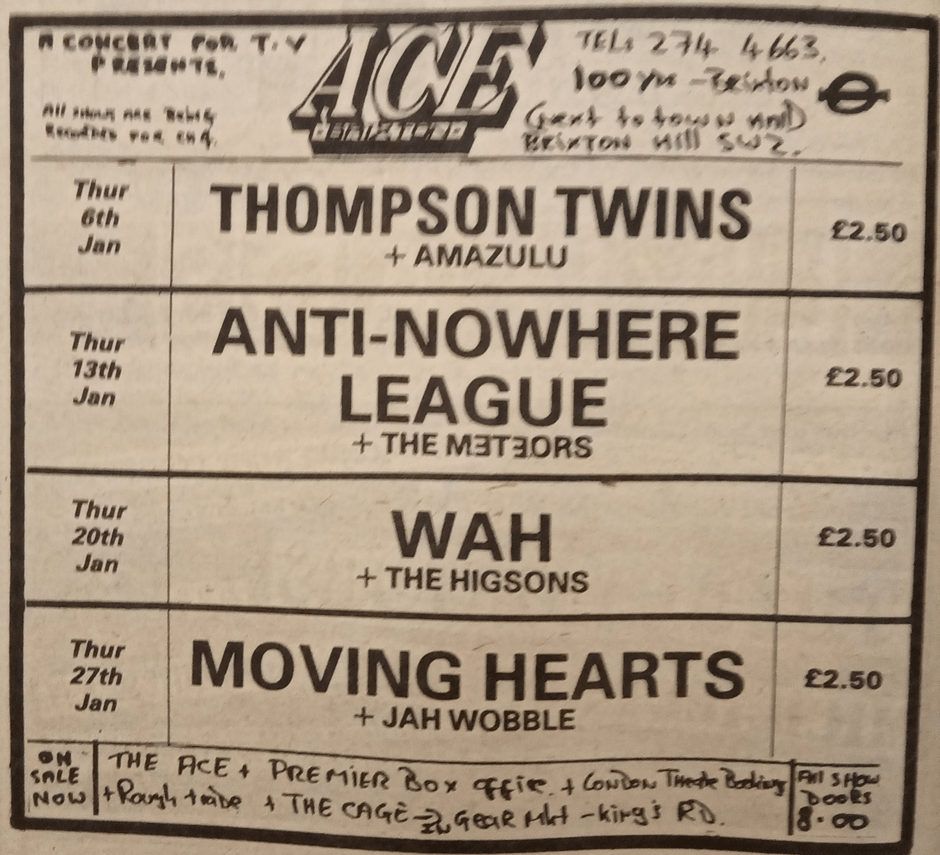
After the Tippa Ranking gig on New Years Day, the Thursday night gigs which were filmed for Channel 4 continued.
The Thompson Twins kicked off the rock gigs in January. Having previously been a large leftfield group that was formed out of the Clapham squat scene, they would eventually trim down to a 3 piece. Within two months of their gig at The Ace they would have a top ten single. Their performance, as well as that of Wah and Fad Gadget from 1982 is captured here:
https://licensing.screenocean.com/record/130873
Other bands playing included the Anti Nowhere League supported by The Meteors:
Moving Hearts and Jah Wobble also played, adding something quite different to what had previously been broadcast on the show:
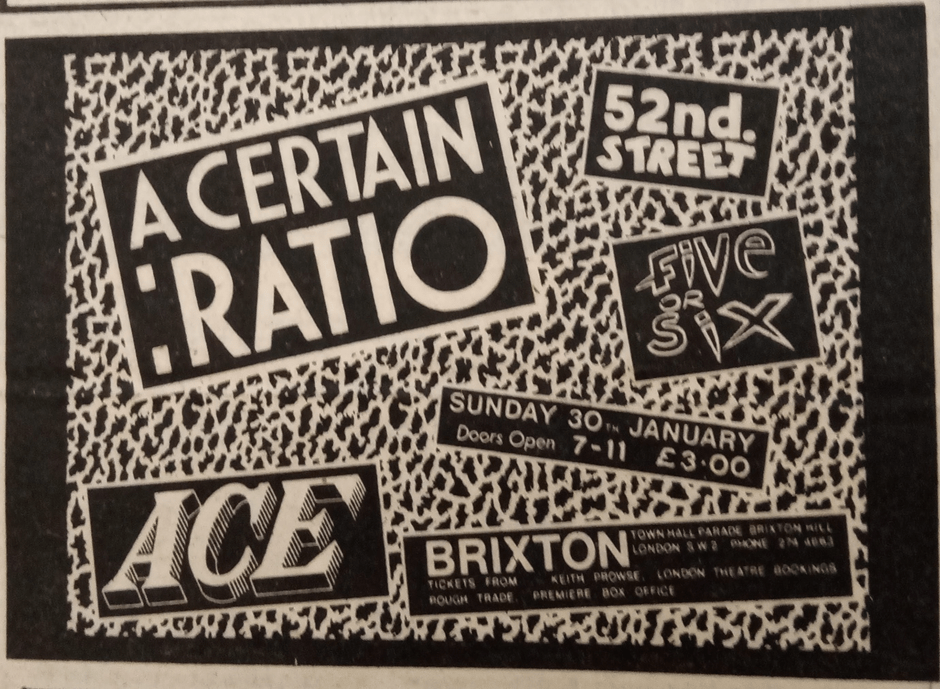
A Certain Ratio played a non Channel Four gig at the end of the month.
February
February saw The Ace settle into a groove, with Monday night being Reggae Night and Thursday being set aside for filming for the Channel 4 show.
Sounds magazine announced that it was The Ace’s intention to also highlight up and coming bands such as Funkapolitan as well as keeping up The Ace tradition of showing two Kung Fu movies on Friday nights.
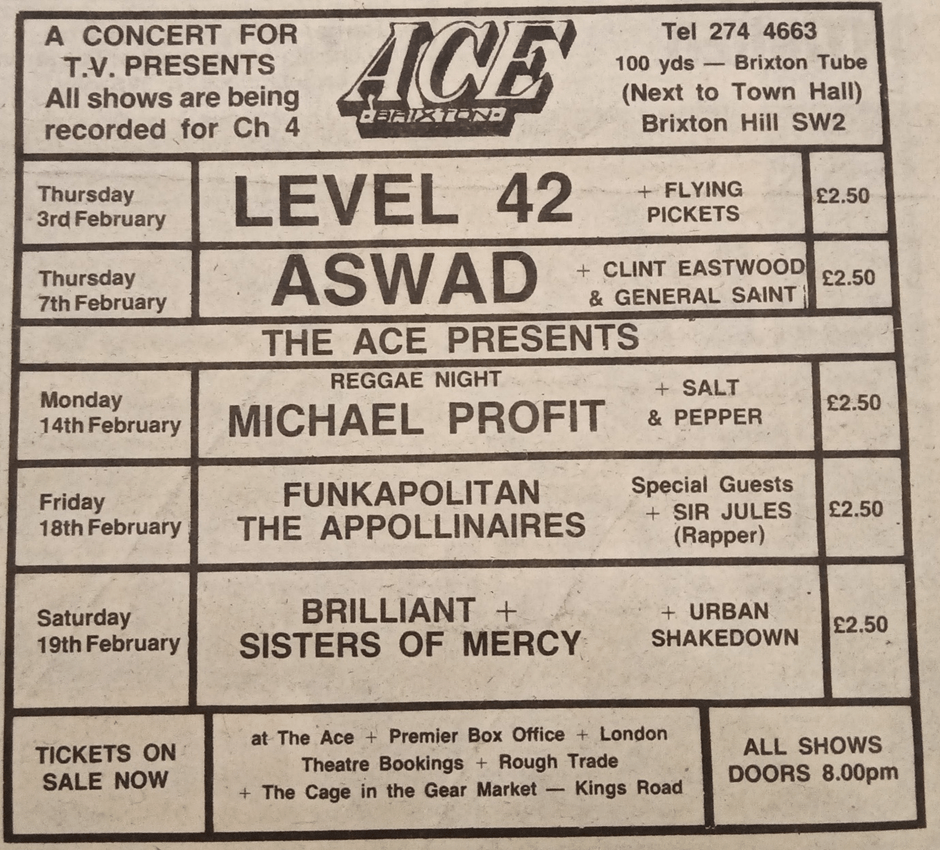
Thursday night Channel appearances in February commenced with an appearance by Level 42, who had just broken into the Top Thirty for the first (but not the last time) with their song “The Chinese Way”. Support on the night was from acapella group The Flying Pickets, who would achieve an unlikely Christmas Nr 1 hit at the end of the year with their version of “Only You”. You can see the whole programme here:
https://licensing.screenocean.com/record/131065
Aswad, supported by Clint Eastwood and General Saint played on the 17th February. This was to be the last concert filmed by Channel 4: https://licensing.screenocean.com/record/131067
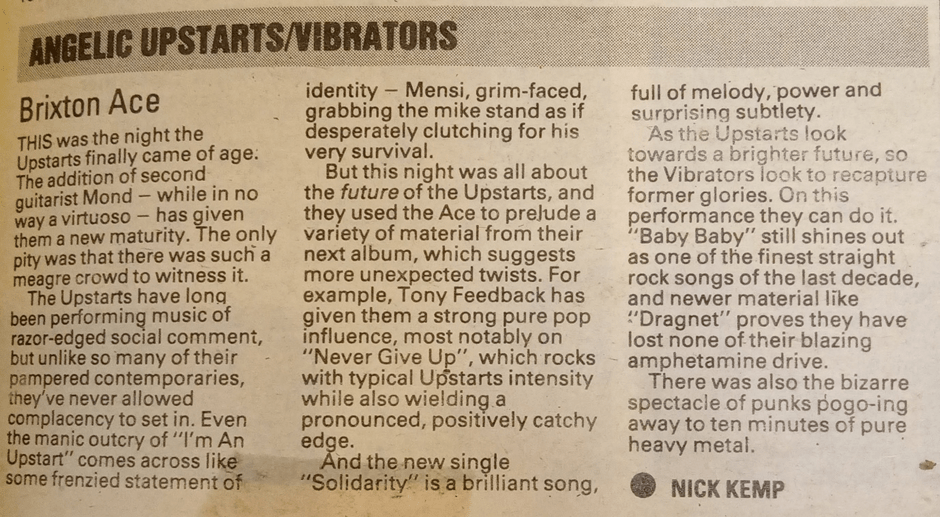
Punk was undergoing a revival in 1982, so most months at The Ace had gigs by second wave punk bands. The Angelic Upstarts headlined in February.
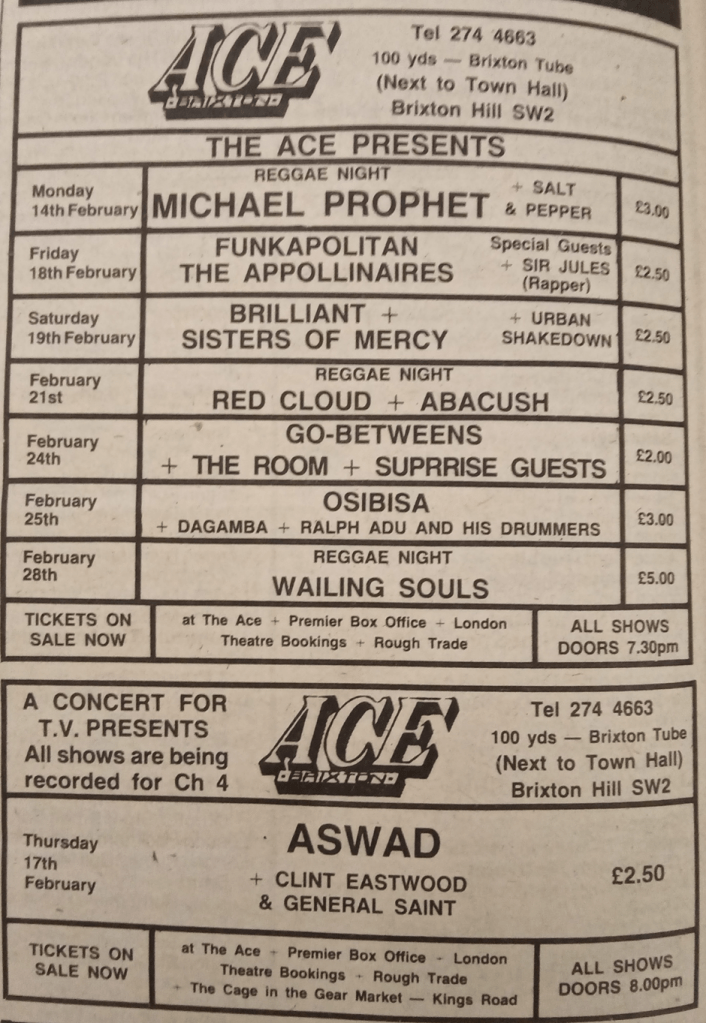
The Go Betweens gig was cancelled and rescheduled for April.
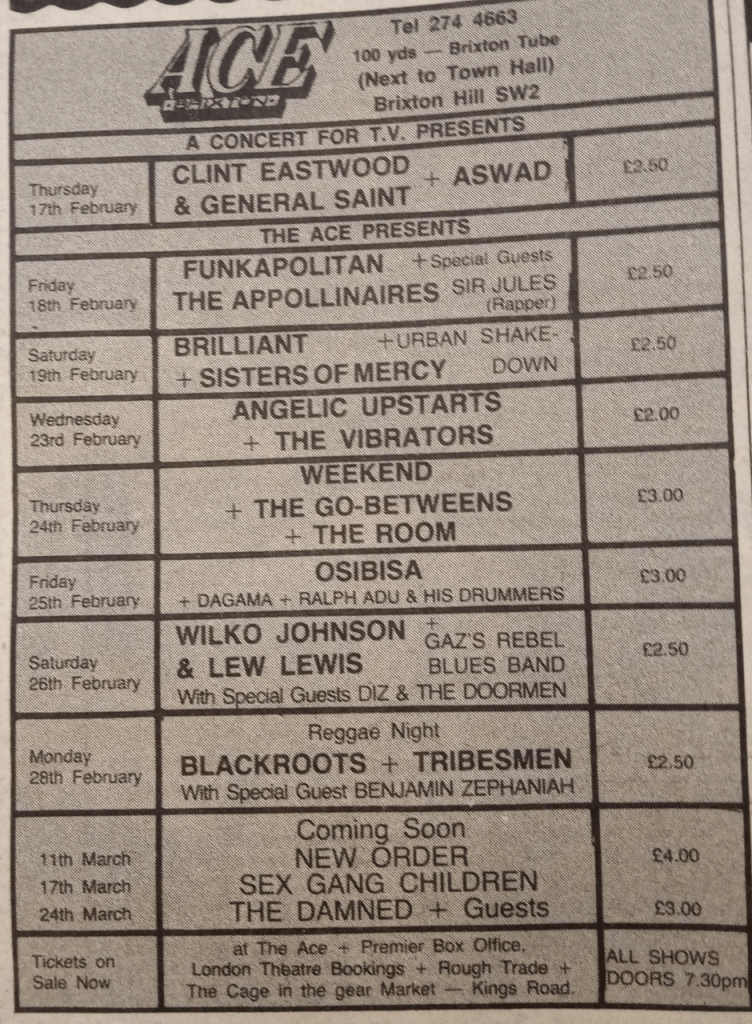
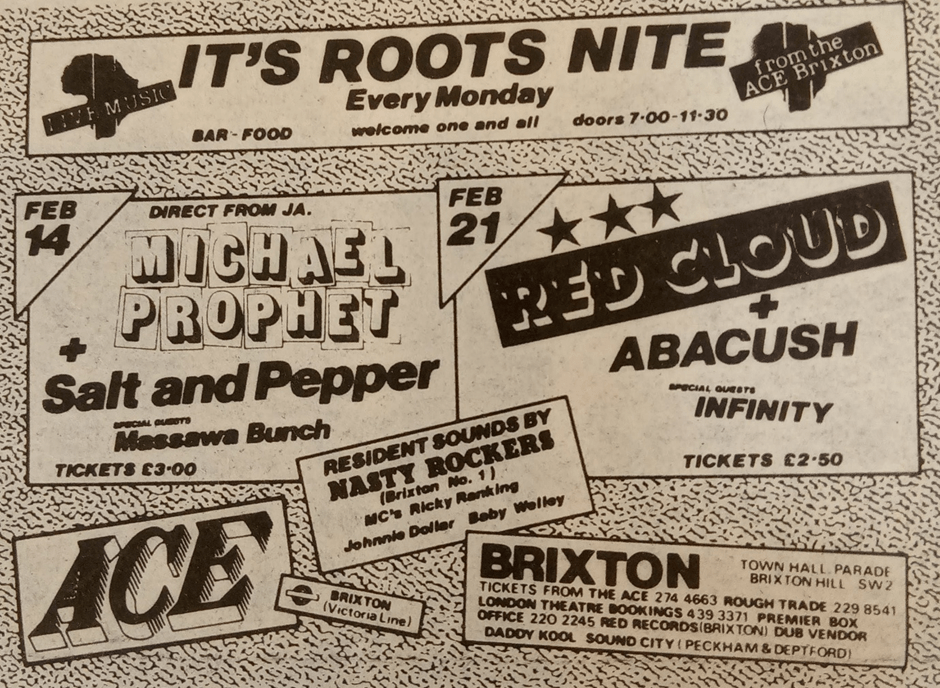
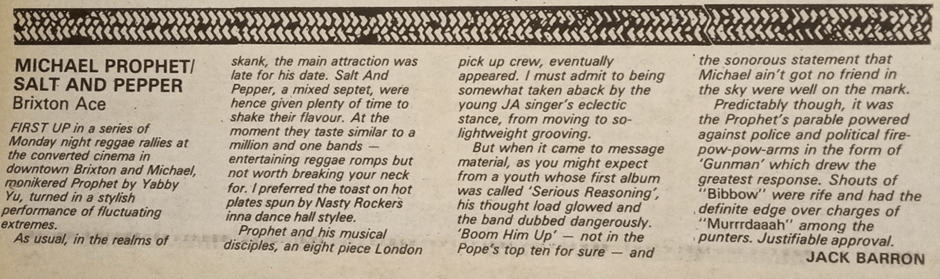
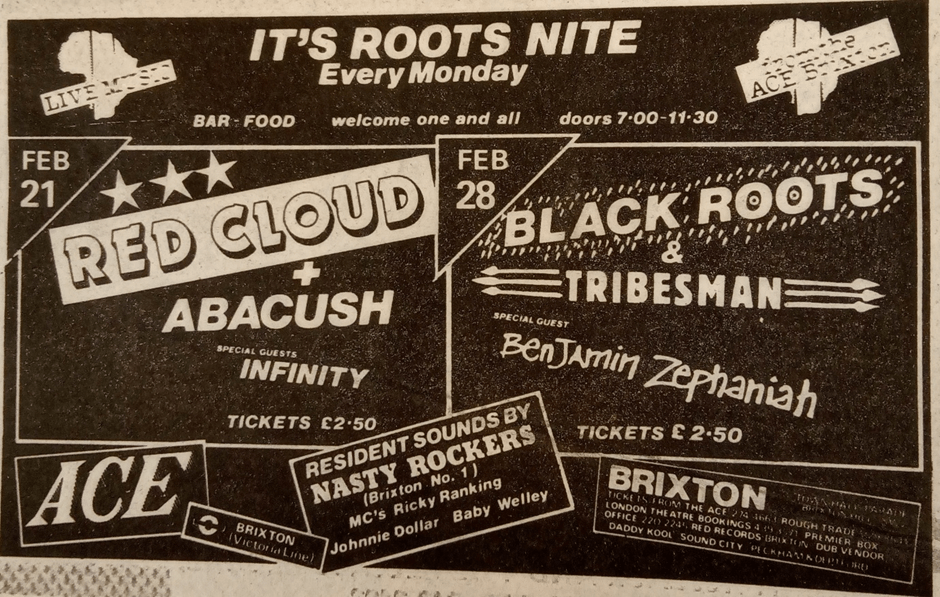
Monday Reggae nights included performances by Michael Prophet, Red Cloud and Black Roots.
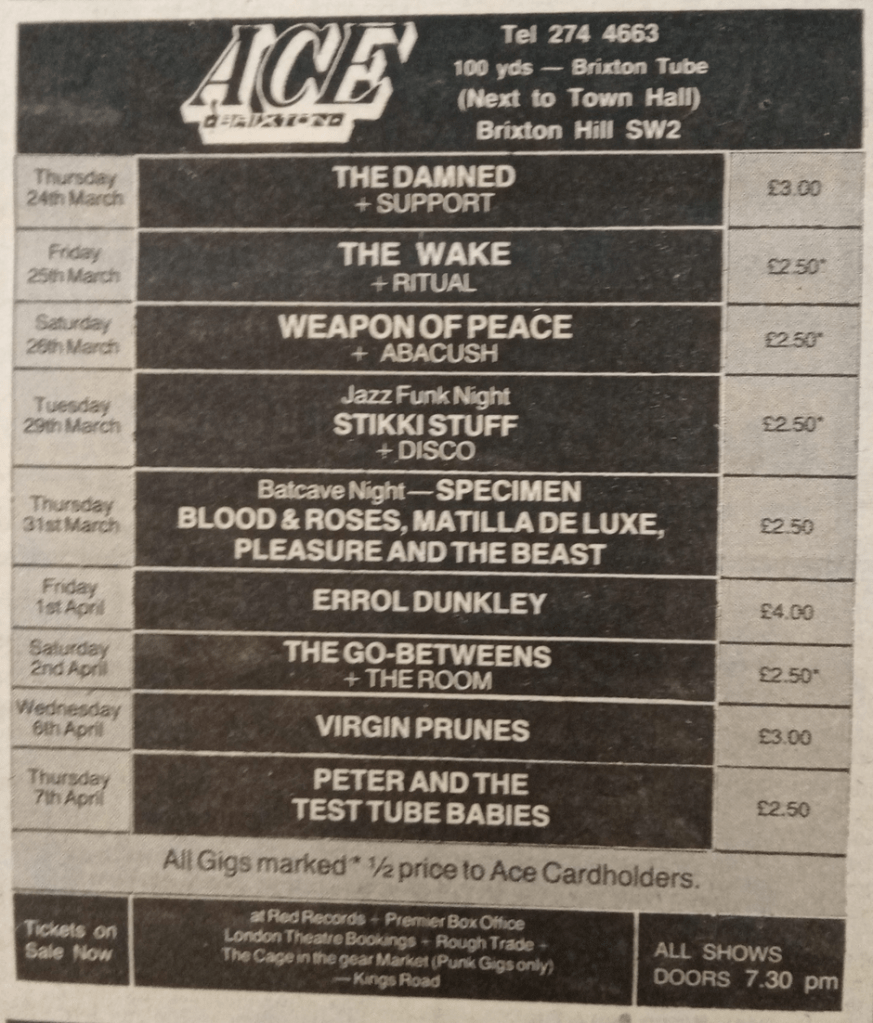
March
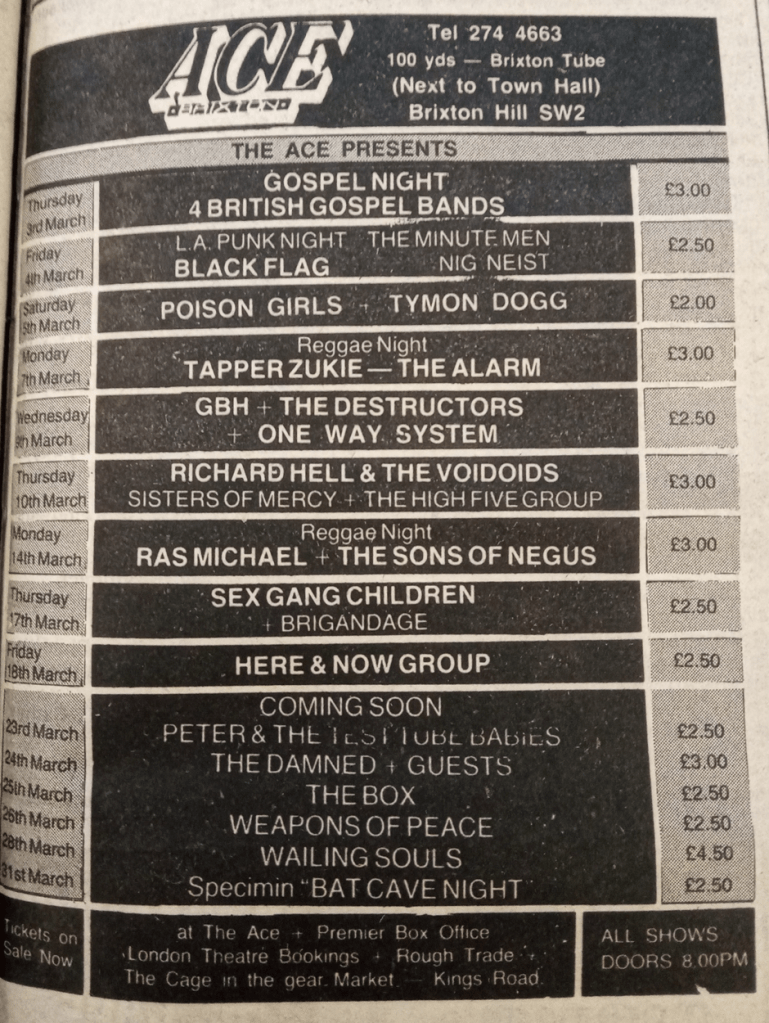
March began with a gospel concert featuring The Challengers, The Zionites, Sister Lavine and the New Testament Assembly Crusade Choir. Gospel was very popular in the 80s, with Brixton having its own gospel record shop in Acre Lane. There was also a weekly gospel show on Radio 1.
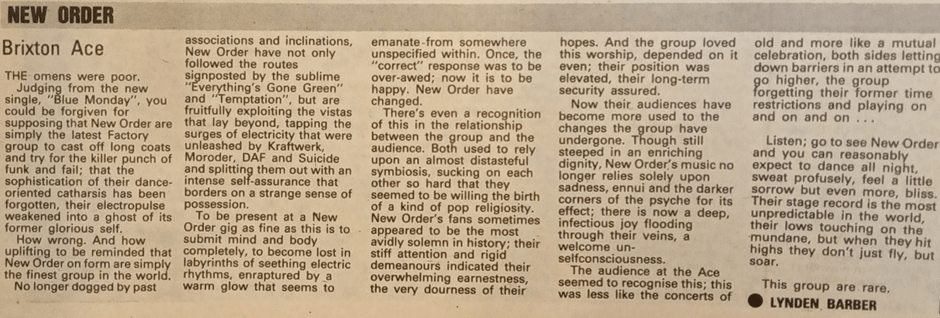
Other highlights included New Order. The gig probably sold out as it quickly disappeared from adverts. New Order played the gig the same week as the release of their classic “Blue Monday”, which propelled the group to another level. Nine months later they would be headlining the Brixton Academy.
Iconic cult punk acts also had a field day during March. American hardcore punks Black Flag and the Minutemen were swiftly followed by Crass associates The Poison Girls (with support from The Cravats and Tymon Dogg) .
Second Wave punk band played GBH played, with the gig receiving a commercial release:
Support bands The Destructors and One Way System were also filmed on the night:
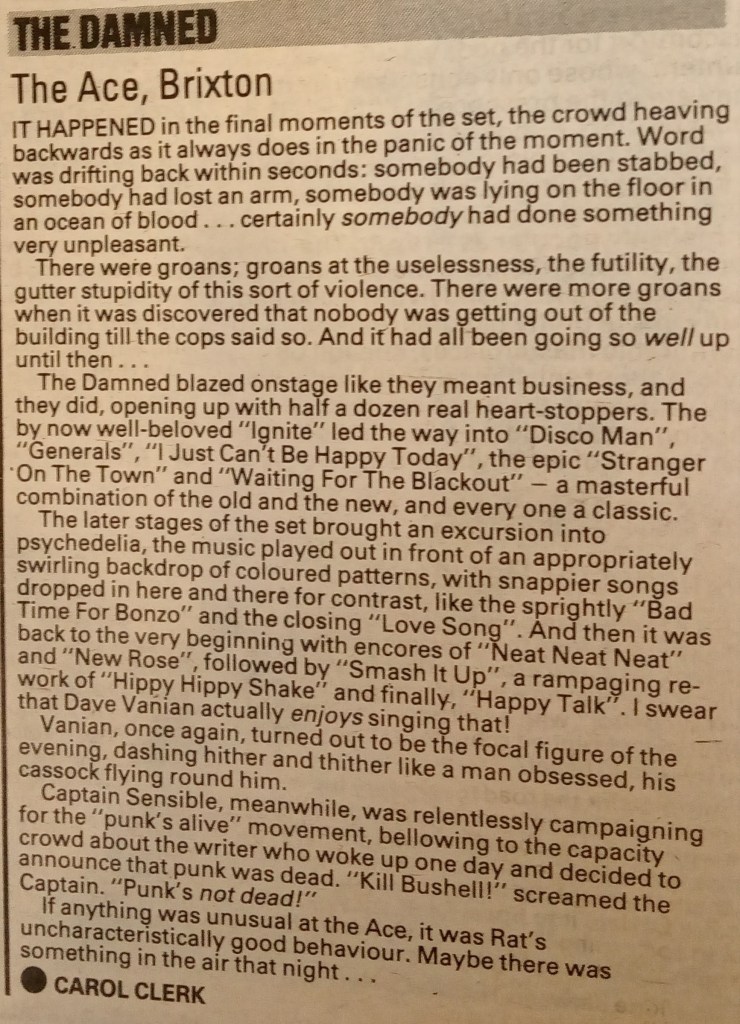
New York punk originator Richard Hell played (supported by The Sisters of Mercy) as did UK punk pioneers The Damned. Their review in Sounds magazine was very typical of the bitchiness inherent in the music press at the time: “The majority of the material is completely worthless, loose and trivial heavy rock”. The Melody Maker put a very different spin on events:
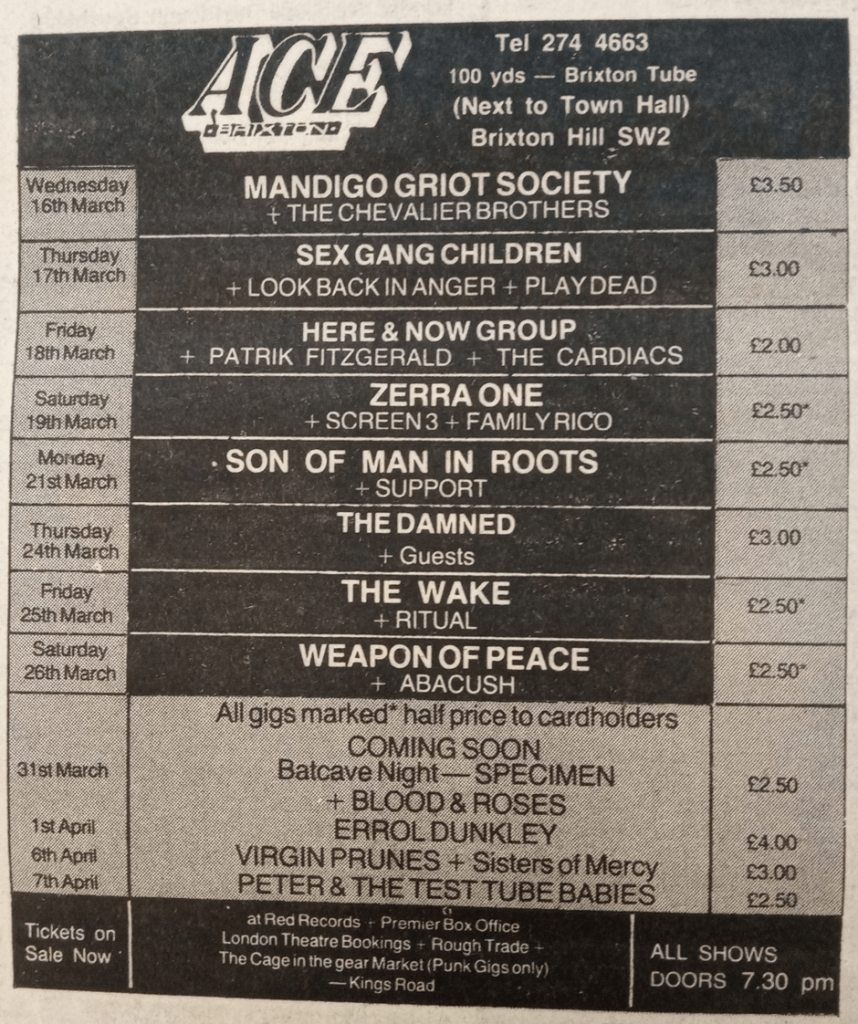
The nascent goth scene, which circulated around The Batcave club in Soho was also represented, with the Sex Gang Children (whose members were based in Brixton) playing as did Specimen, who brought the Batcave experience to The Ace on the 31st March.
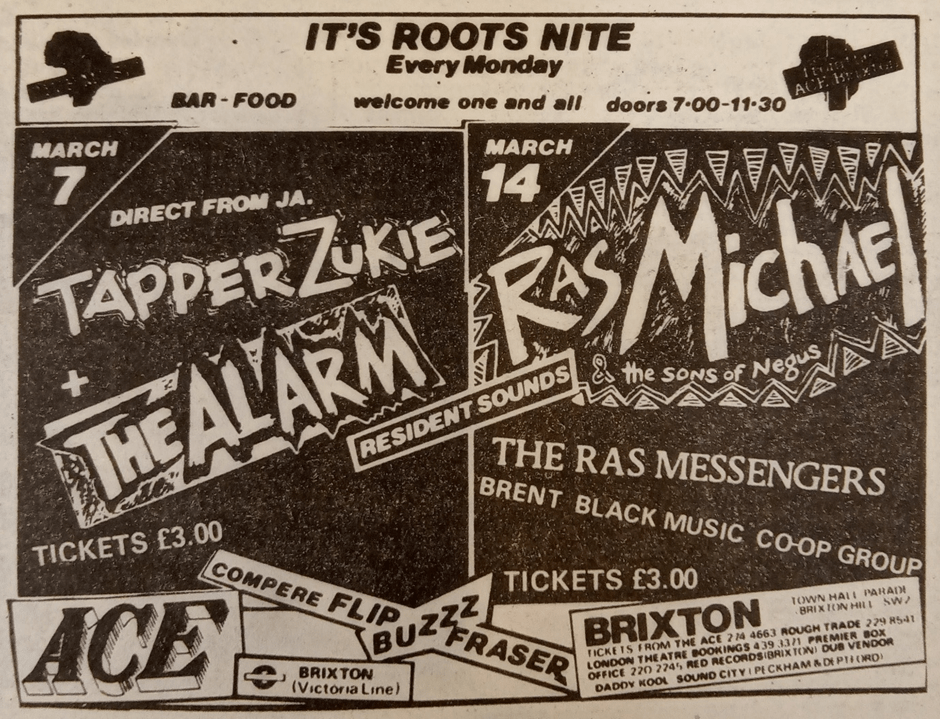
Reggae was represented by veteran Jamaican DJ Tapper Zukie. Support on the night was from The Alarm. Whilst reggae acts and punk acts sharing a bill was not uncommon, this seemed a strange pairing as The Alarm weren’t really an out and out punk band.
Ras Michael also played.
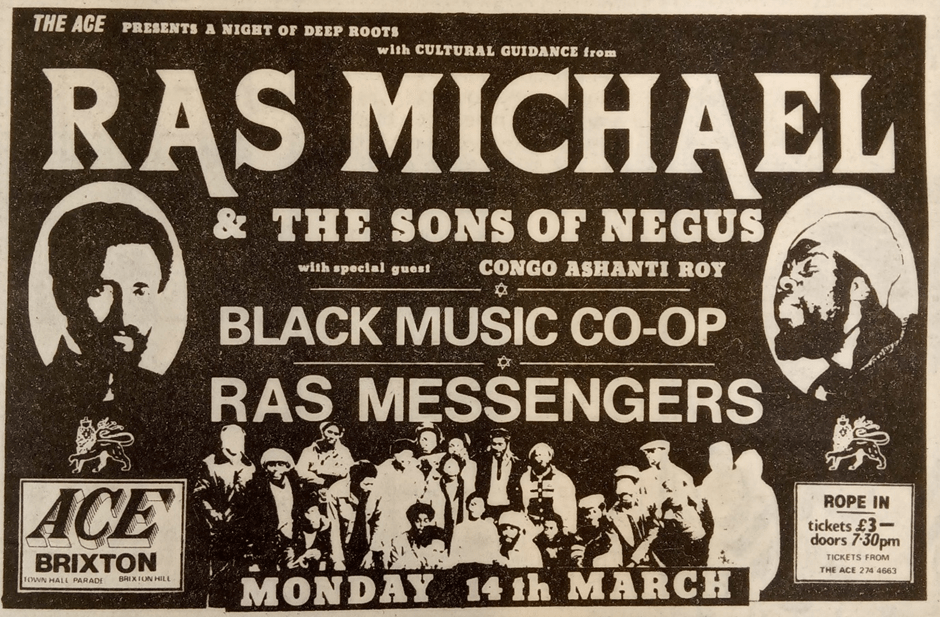
From the 25th to the 29th March The Ace introduced a new ticketing scheme to encourage people to see less well know bands, whereby the ticket holder could get three friends in for half price.
April
The 4th April edition of the Melody Maker reported that The Ace, as well as other London venues such as the Lyceum and the Hammersmith Palais, had fallen victim to a forged ticket scam. Apparently 300 Damned fans had turned up to The Ace with forged tickets. All of them were eventually admitted, something that would never happen today.
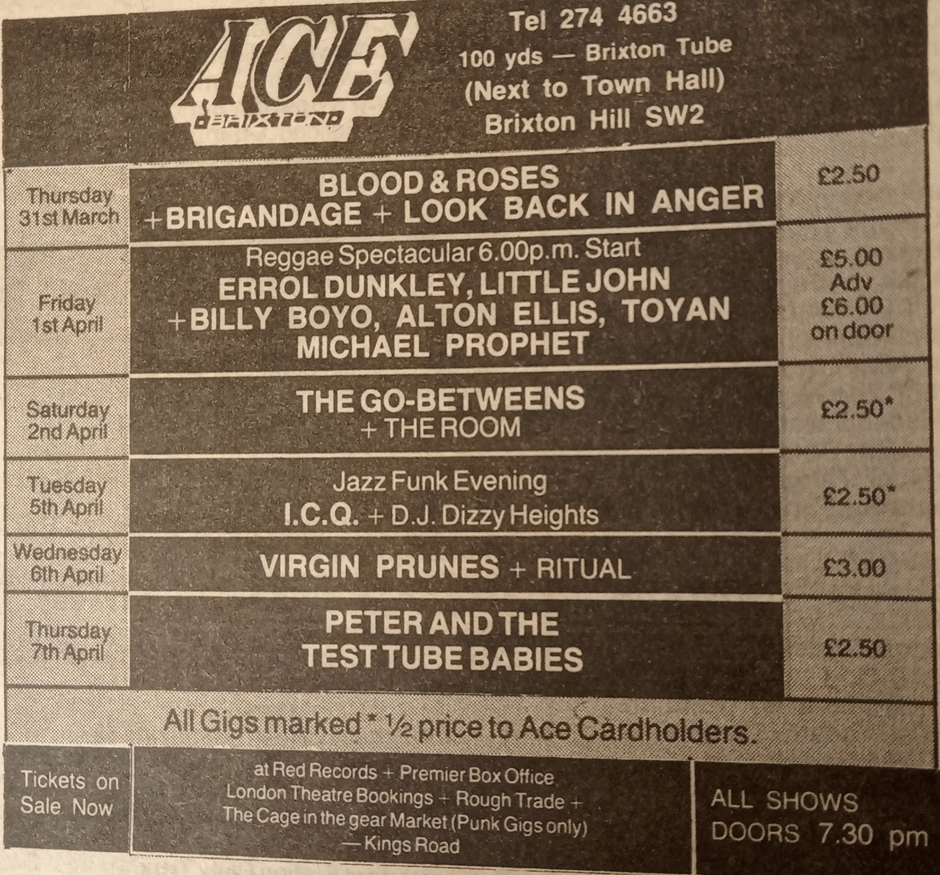
Errol Dunkley organised a reggae festival on Good Friday. Artists playing included Errol Dunkley, Alton Ellis, Little John, Billy Boyo, Michael Prophet, Trinity, Ranking Trevor and Toyan. The gig was recorded for a live album:
Other reggae acts playing during April included Dennis Bovell, Come Natural, Horace Andy, Aquizim and Blackheart.
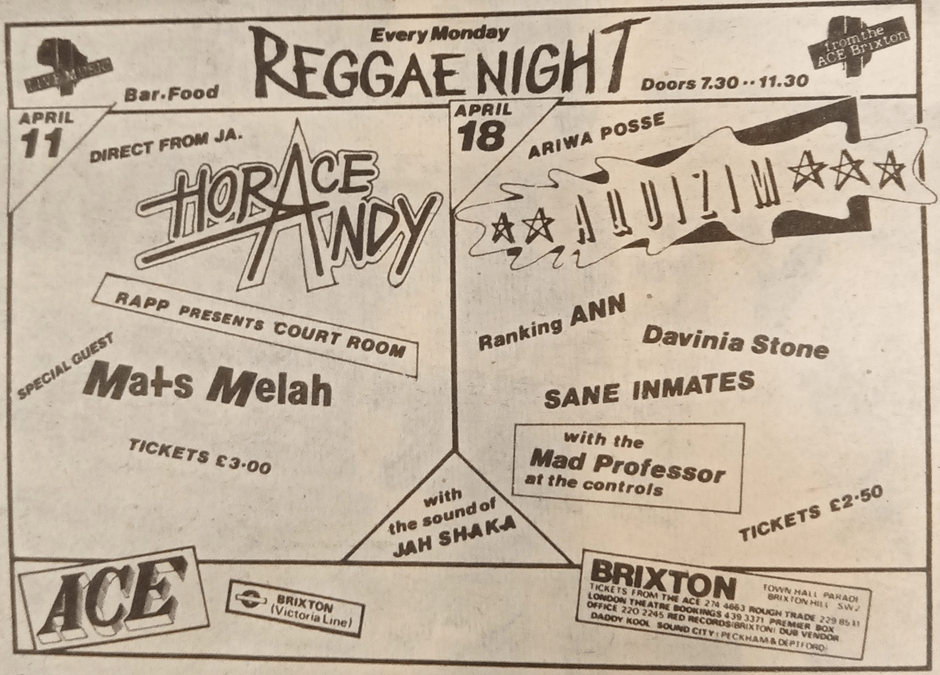
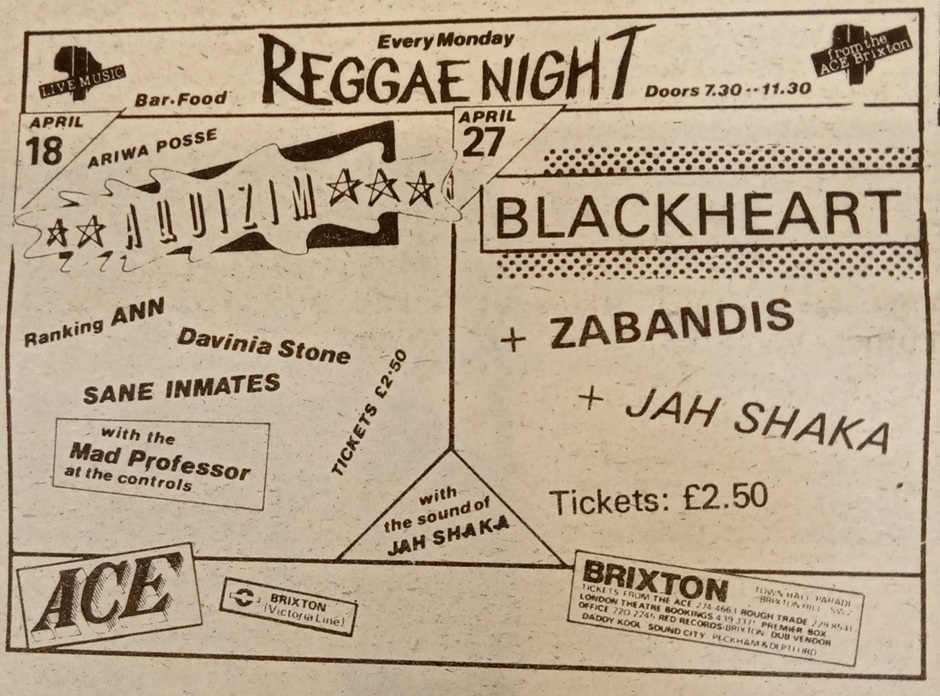
As well as the regular Monday night reggae gigs, Black Echoes reported that Tuesdays would be a soul and jazz funk night, although this didn’t seem to materialise. Black Echoes also announced that the Sunday afternoon roller disco had been taken over by the now disgraced DJ Tim Westwood. Westwood would soon take over the evening roller disco session as well.
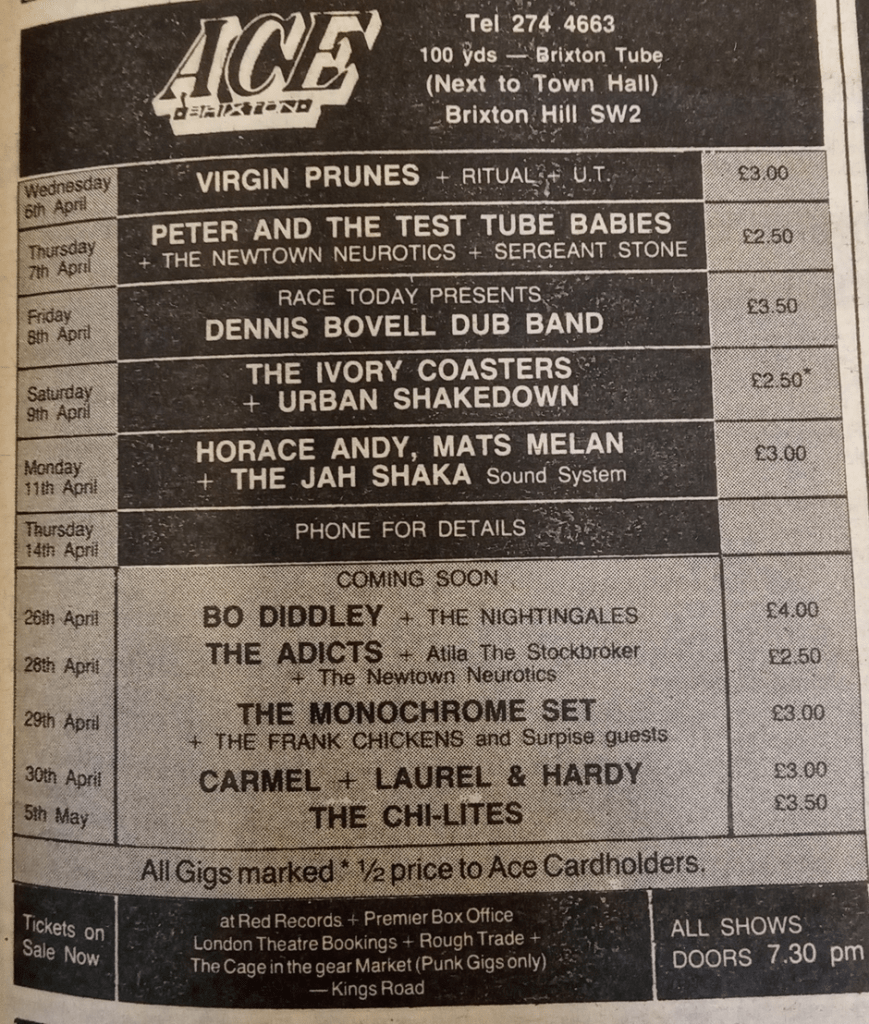
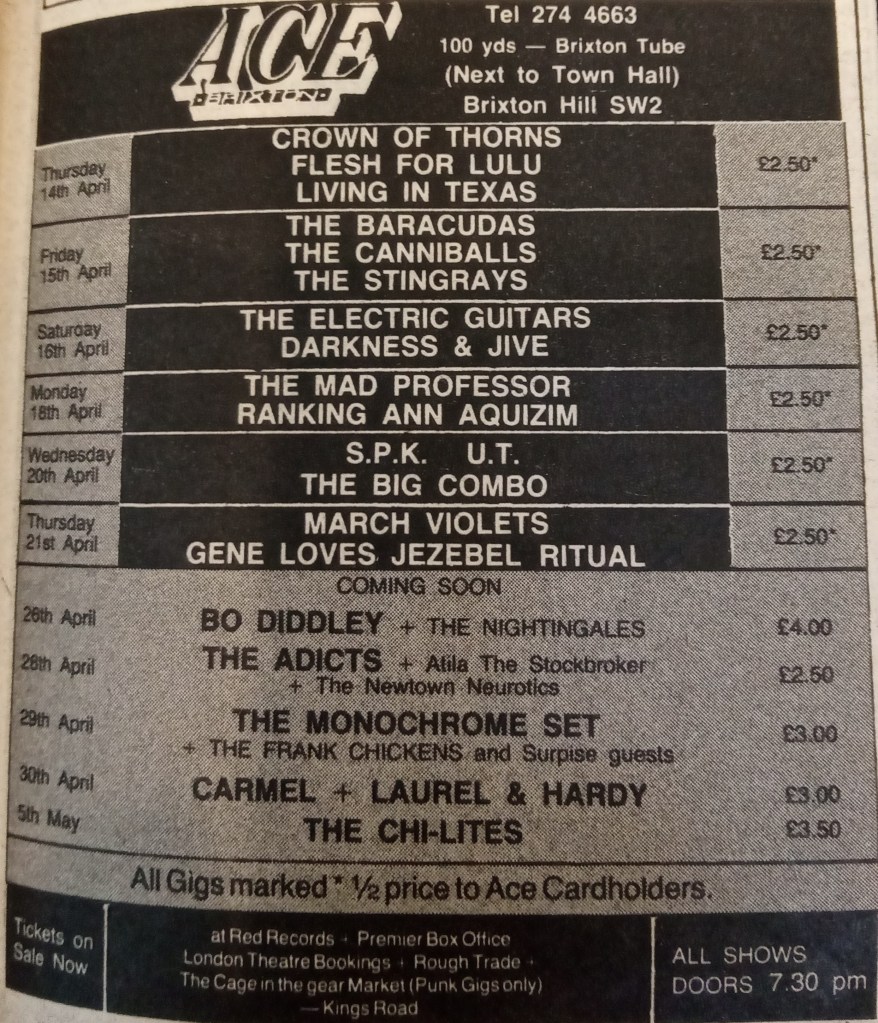
The rest of the month was a very eclectic mix-The Go Betweens played their rescheduled gig and there were plenty of alternative bands such as Virgin Prunes, March Violets and The Monochrome Set, punk bands Peter and the Test Tube Babies and The Adicts. Rock and Roll pioneer Bo Diddley also played.
A one off “Taste of festival” event on the 22nd April showcased the different styles of music that would be on show at the forthcoming Brixton festival to be held in July.
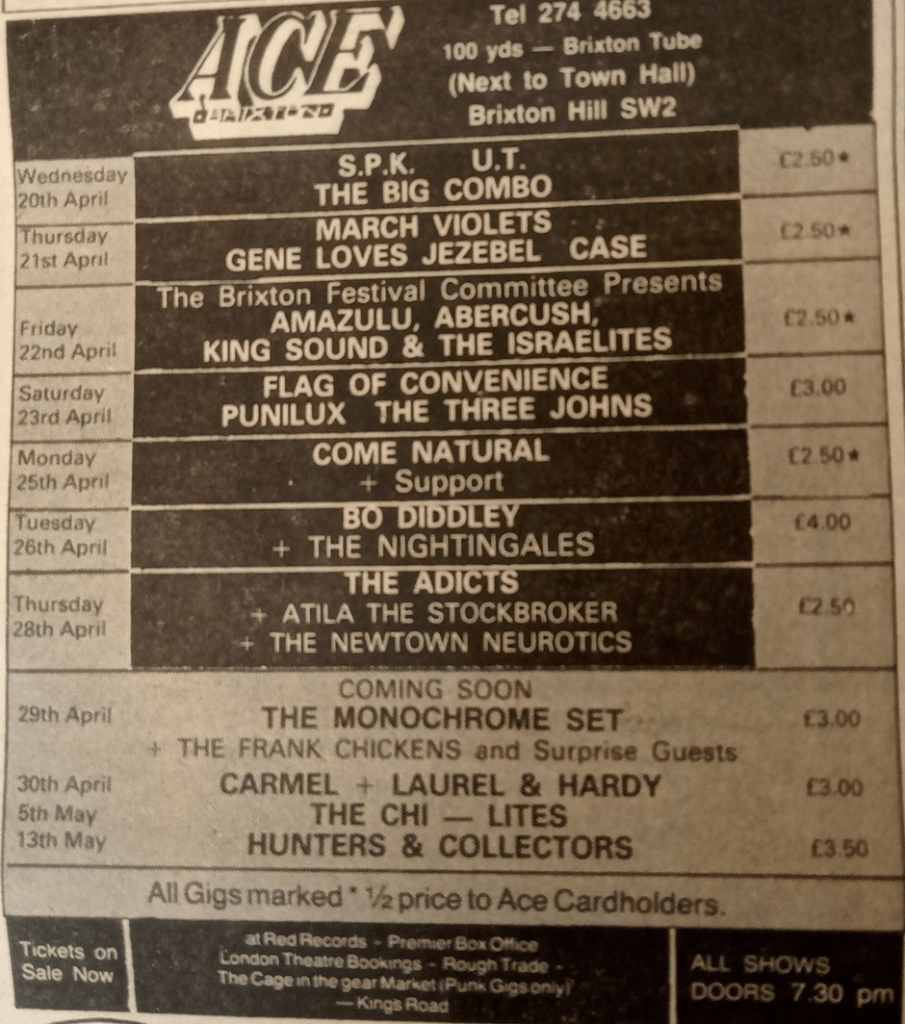
Liverpool band A Flock of Seagulls, who had scored a top ten hot at the end of 1982 with the evergreen “Wishing (If I had a photograph of you)”, rounded off April’s gigs on the 30th April (see listings under May below). Promoting their newly released “Nightmares” single, the entire show was filmed for commercial release:
May
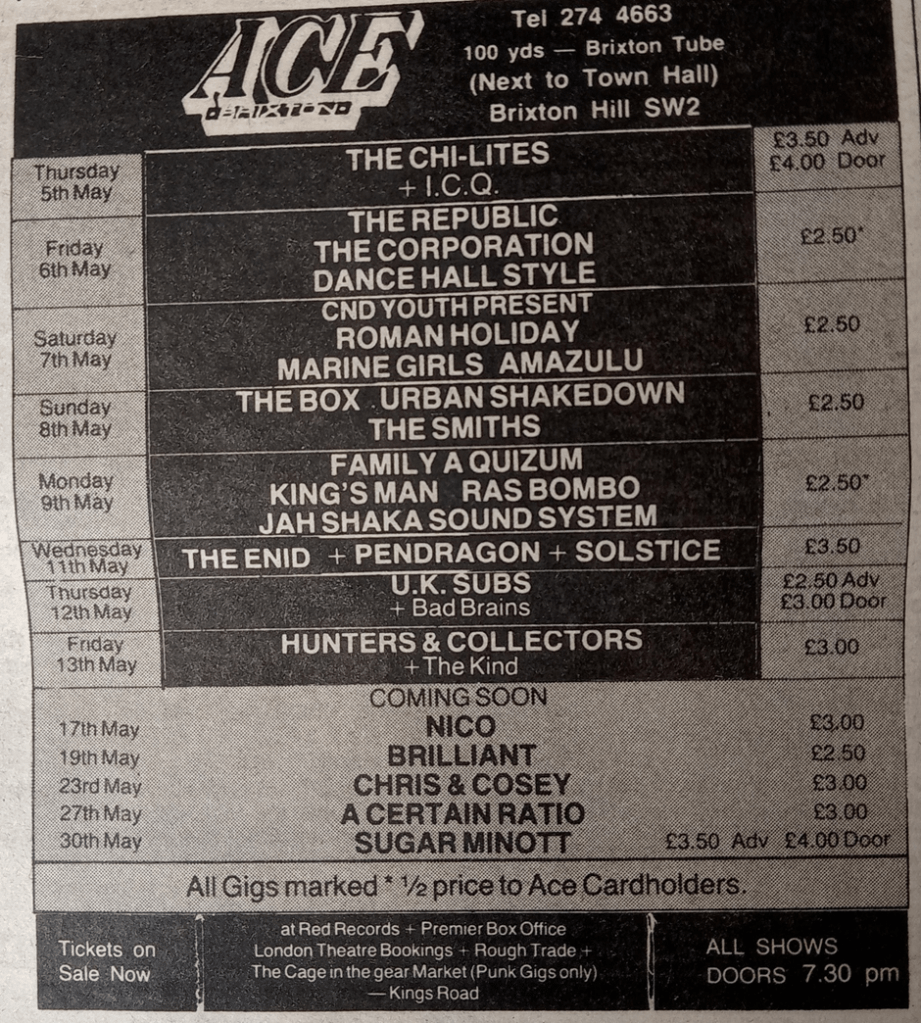
Highlight of the month (although you wouldn’t have known it at the time) was a very early appearance by the Smiths at the bottom of the bill on the 8th May. The Smiths had only played their first gig just over 6 months previously and had played less than a dozen gigs by the time they played The Ace. All the music press missed them. Sounds reviewed main acts The Box and Urban Shakedown instead.
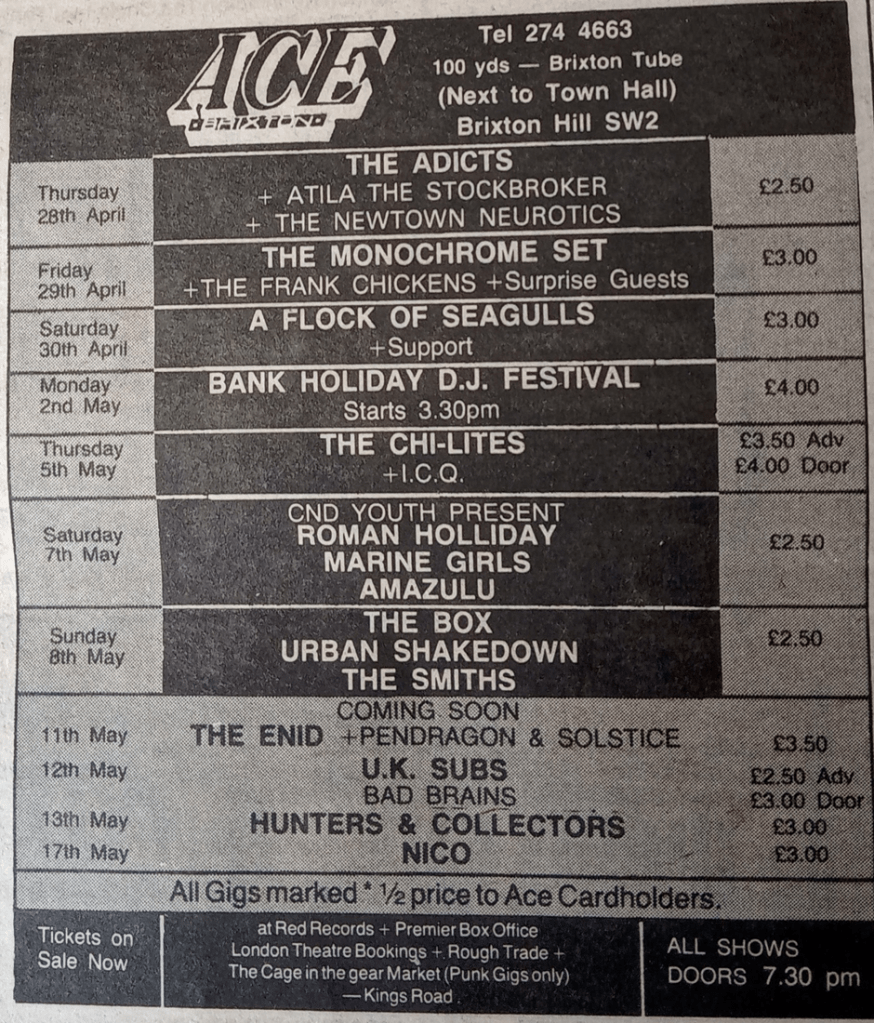
The Ace was nothing if not eclectic. Where else could you see soul from The Chi-Lites, prog rock from The Enid and hardcore punk from Bad Brains, all in the space of the same week.
Then the next week provided the dark experimentation of ex Velvet Underground singer Nico, the pop grooves of Brilliant (who gave away 500 free tickets to the gig) and the synth driven music of Chris and Cosey.
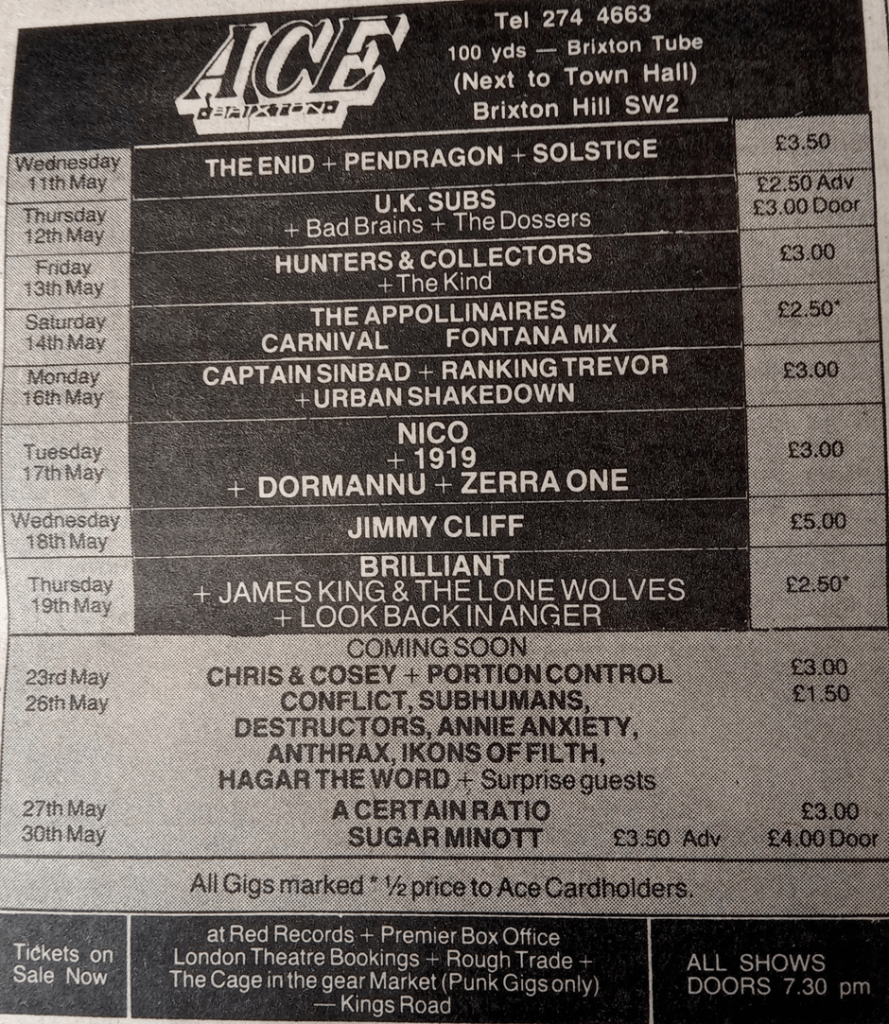
The bank holiday Monday DJ festival featured live sounds from Come Natural plus DJs Mr Palmer, Welton Youth, Colonel Floxley, Lorna Vincent, Ricky Ranking, Baby Welly and Champion, Jah Black, Prophet Ranks, General Morphey, Nightlife and Daddy Willy.
Reggae legend Jimmy Cliff also played. This was quite a coup for The Ace as he had recently played two nights at The Dominion Theatre in Tottenham Court Road.
Less successful was the DJ night on the 16th featuring Captain Sinbad, Ranking Trevor. Black Echoes berated its readers about the poor turnout: “I must express my disappointment at the disgusting turnout at The Ace, Brixton, where the good Captain Sinbad and the man called Ranking Trevor were in concert, along with the sound called Jah Shaka. Wha’ appen posses? Yuh no rave no more? Cha!”
Sugar Minott rounded off reggae proceedings on the 30th May.
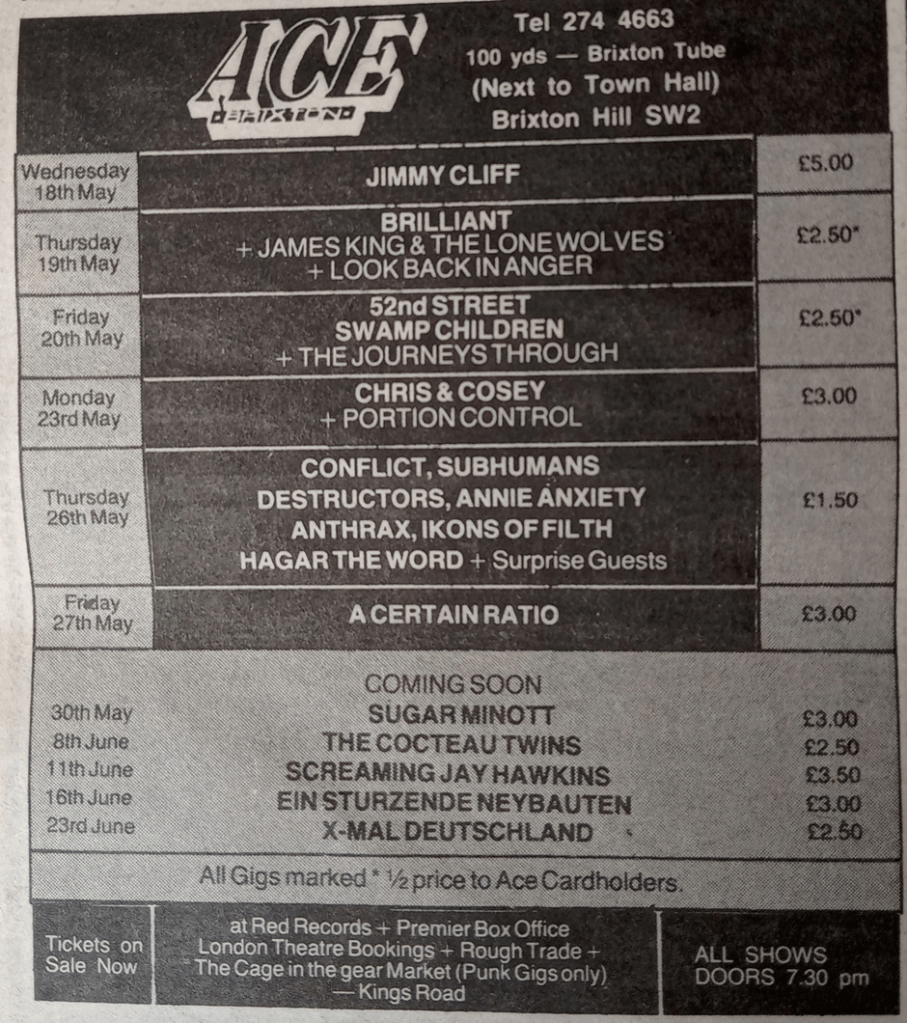
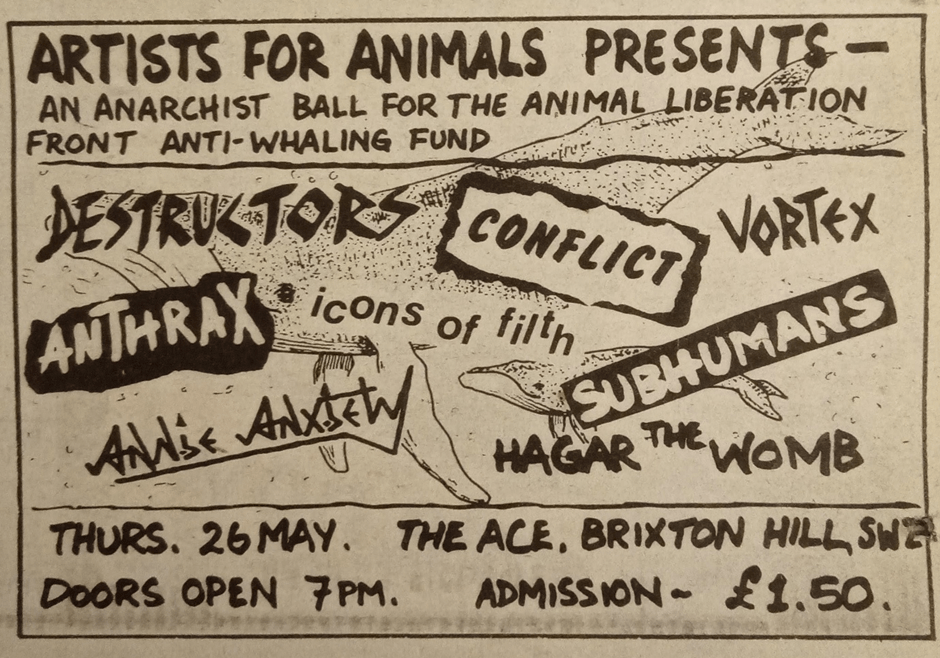
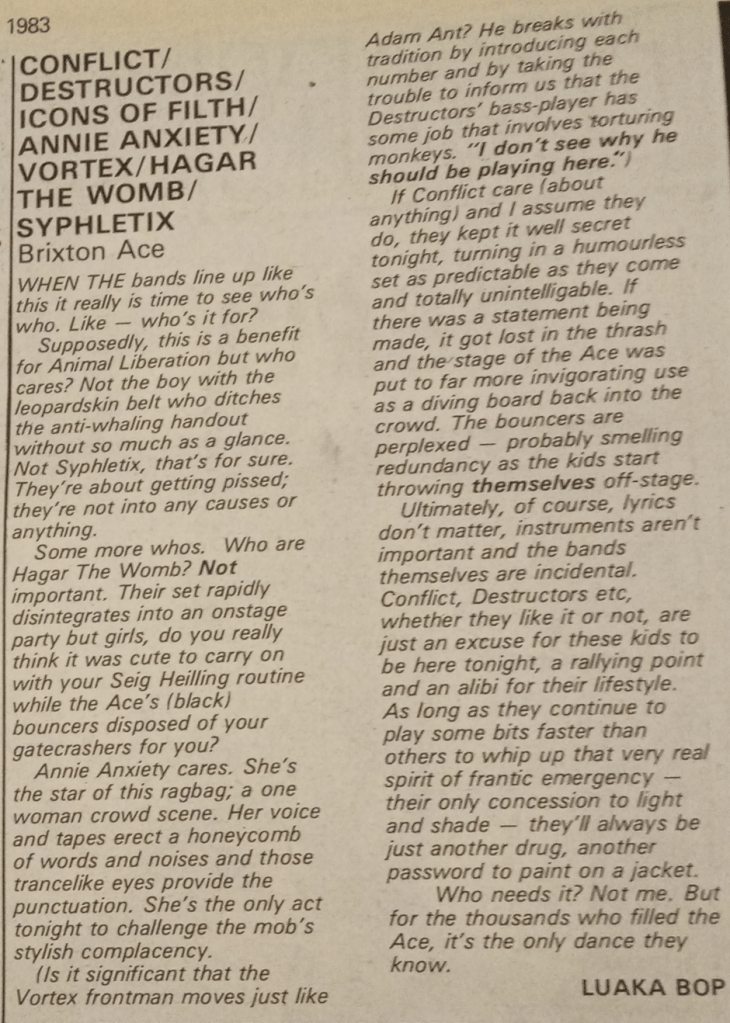
A punk benefit gig for the Animal Liberation Front was held on the 26th May.
June
The Smiths played twice in June-again to a disinterested music press and again as a support act, once supporting The Decorators and once supporting The Sisters of Mercy (imagine the egos in that dressing room!).
Someone with a bit more foresight than the music press managed to catch The Smiths and Sisters of Mercy gigs on film:
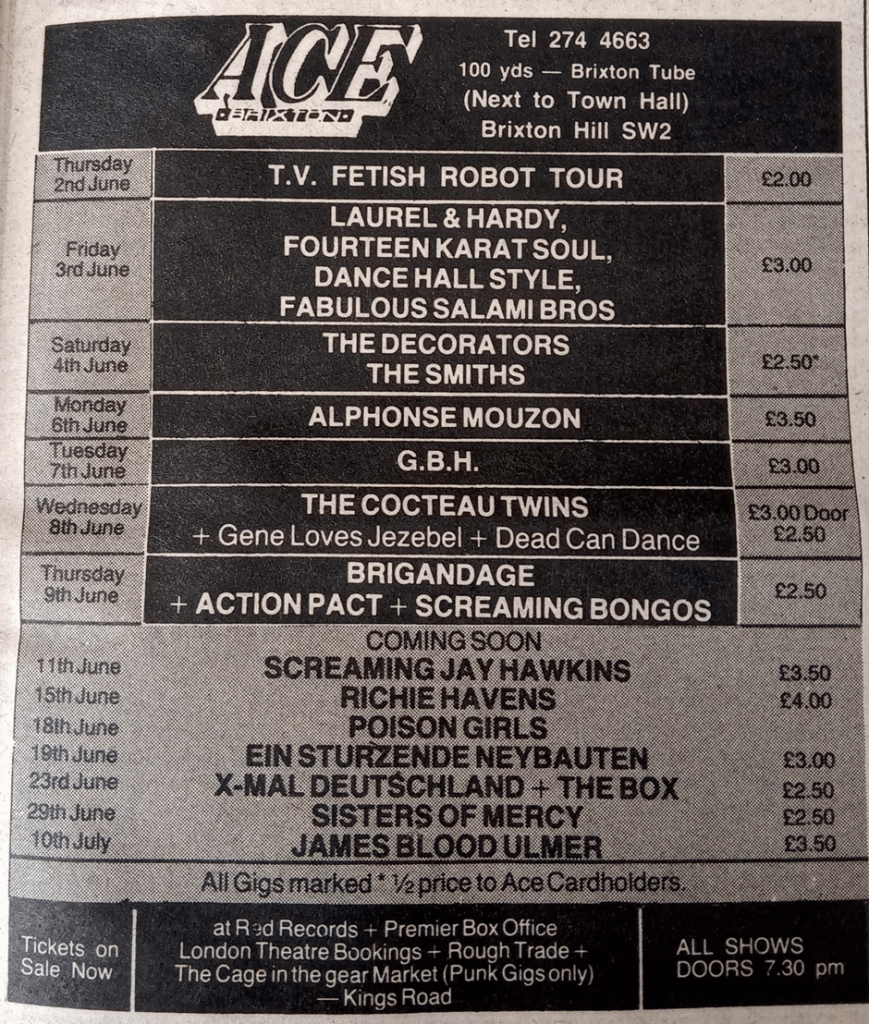
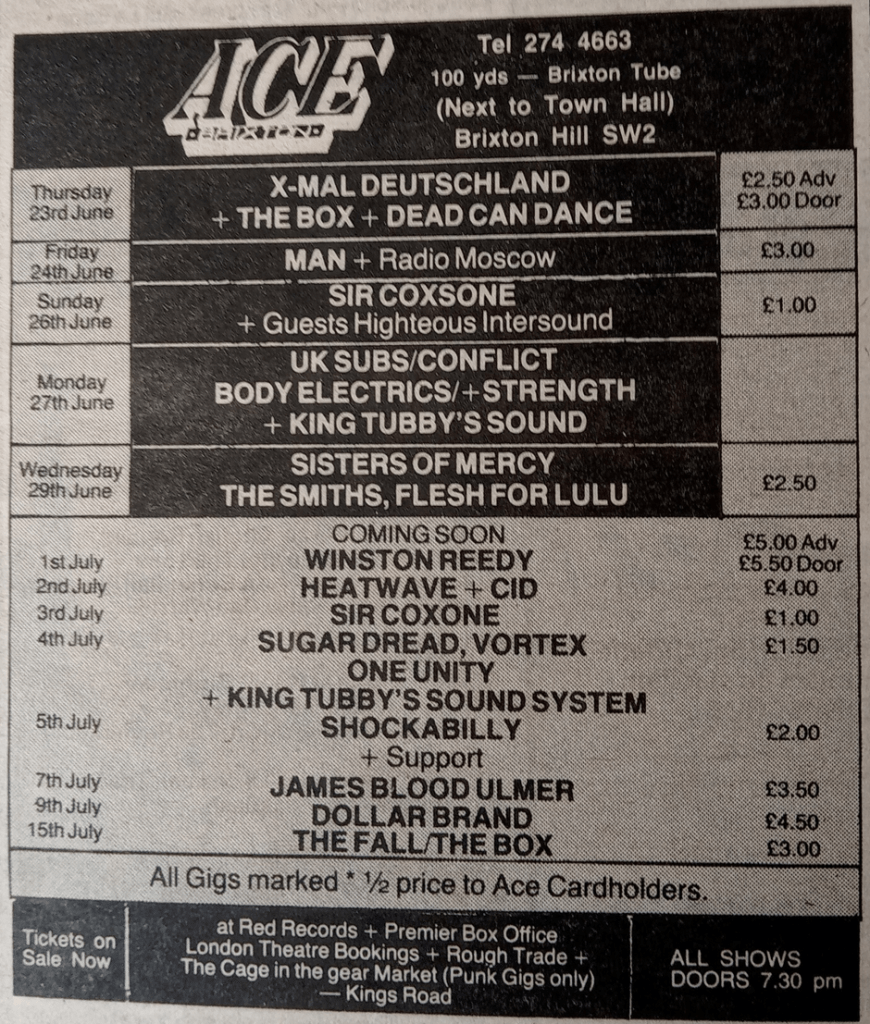
The wonderful eclecticism of The Ace continued throughout June with the ethereal Cocteau Twins being followed by 50s RnB star Screamin Jay Hawkins, Woodstock veteran Richie Havens, punk galore from the Adicts, New Model Army, Poison Girls and Einstursen de Neubaten, reggae from King Tubbys Sound System, goth from Xmal Deutschland and prog rock from Man.
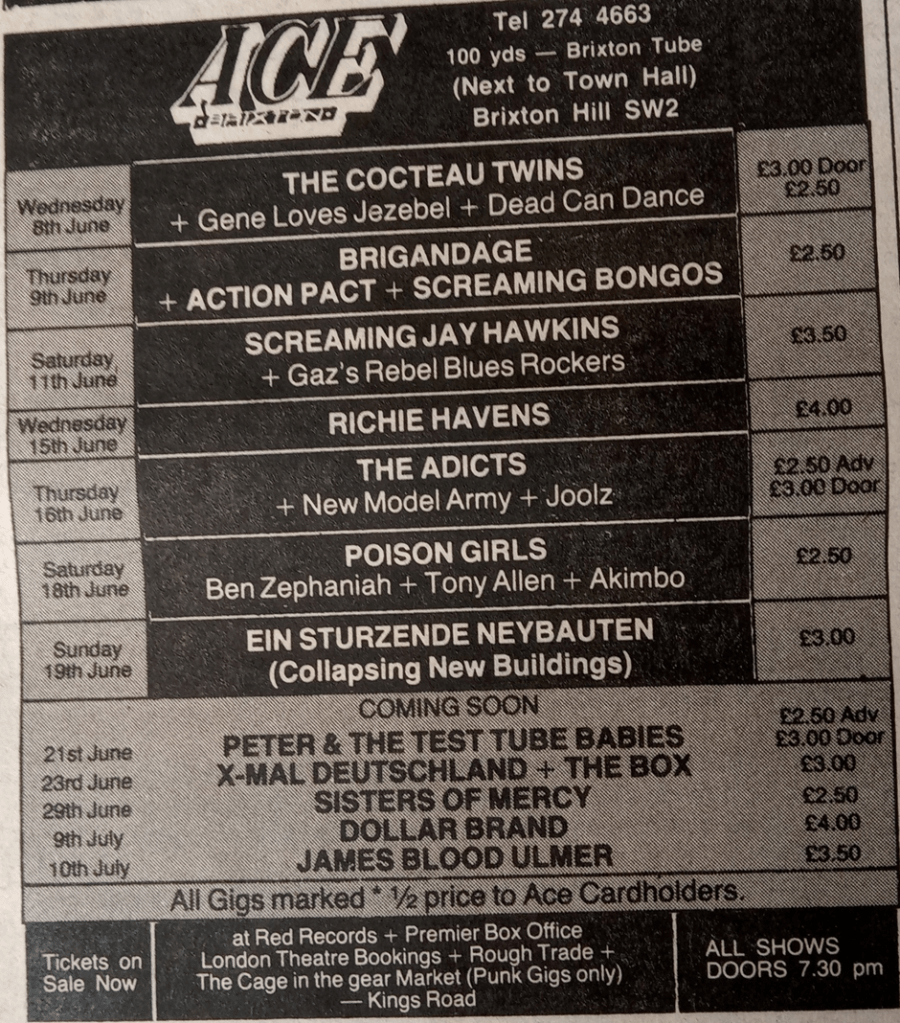
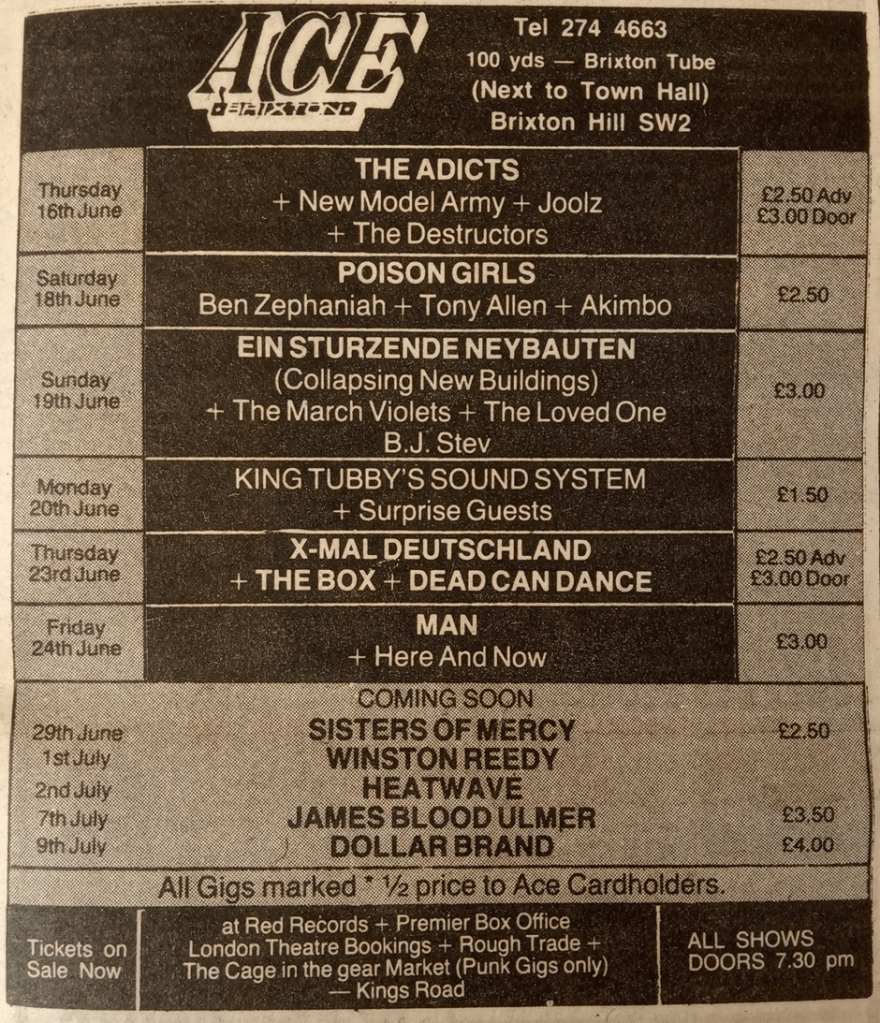
A new innovation was a poetry evening, featuring Poison Girls, Benjamin Zephaniah, Tony Allen and Akimbo. According to The Sounds review the event was artistically successful but the venue was only half full.
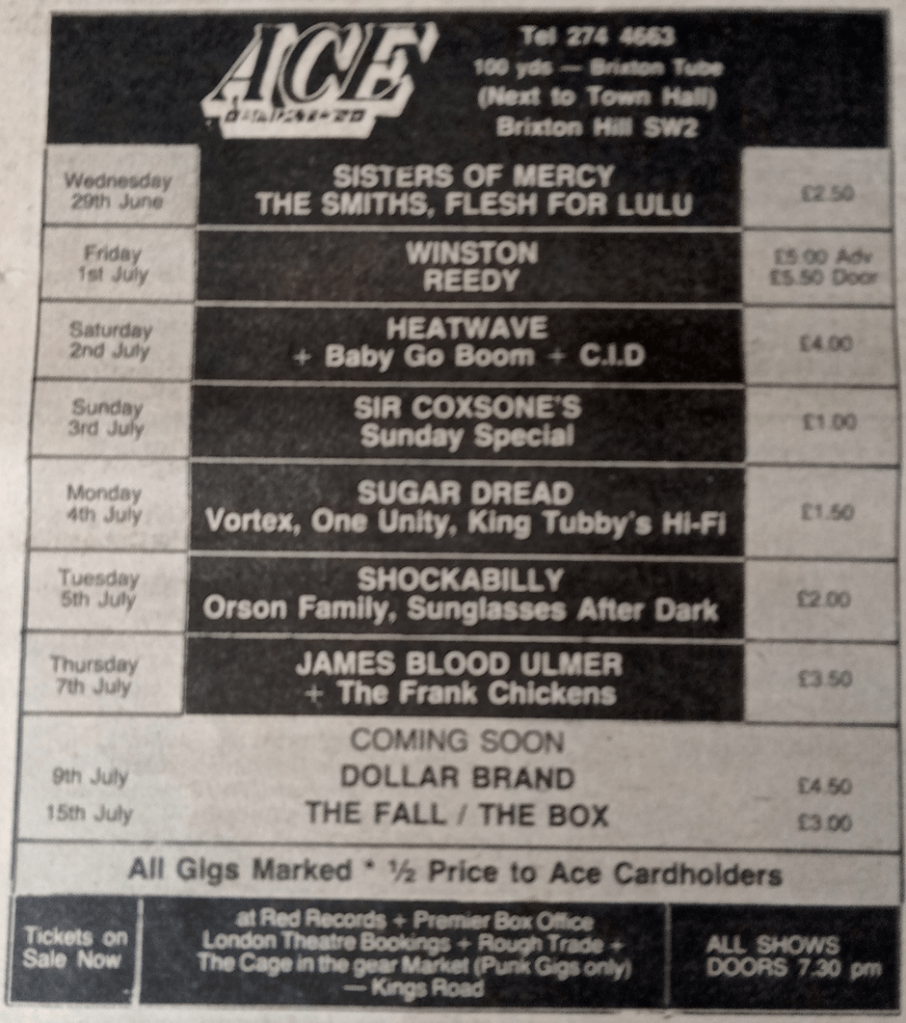
Two regular new features also started at the end of June-the “Sunday Special “ sound system night, led by legendary sound system operator Lloyd Coxsone and the “Punk-Rock-Reggae-Party-Mix” on Monday nights.
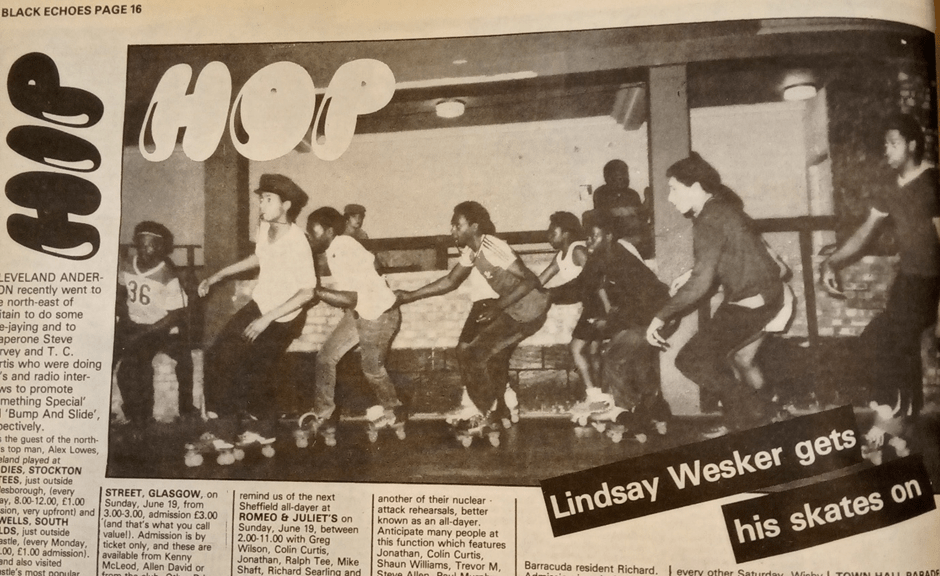
Black Echoes reviewed the Sunday night regular roller disco sessions: “Tim Westwood…plays a rhythmic mixture of soul and reggae while the populace of South London hurtle around the perimeter of this concert venue. Between you and me it looks bloody dangerous.”
July
In July the types of acts playing The Ace solidified into a pattern that would be repeated in the following months, with punk and reggae dominating. Punk was represented by acts such as Rubella Ballet, Tenpole Tudor and The Exploited, whereas reggae gigs included Winston Reedy, the regular Sunday Coxsone sessions and Lone Ranger.
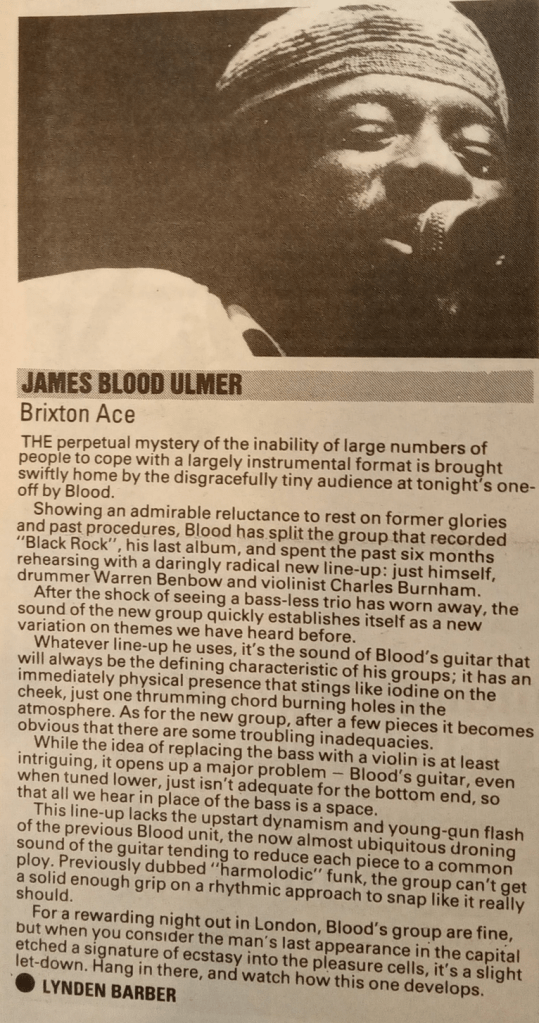
The music press would often get behind acts that they were the next big thing, so there was plenty of publicity for Shockabilly and James Blood Ulmer. Perhaps this review was a sign of things to come.
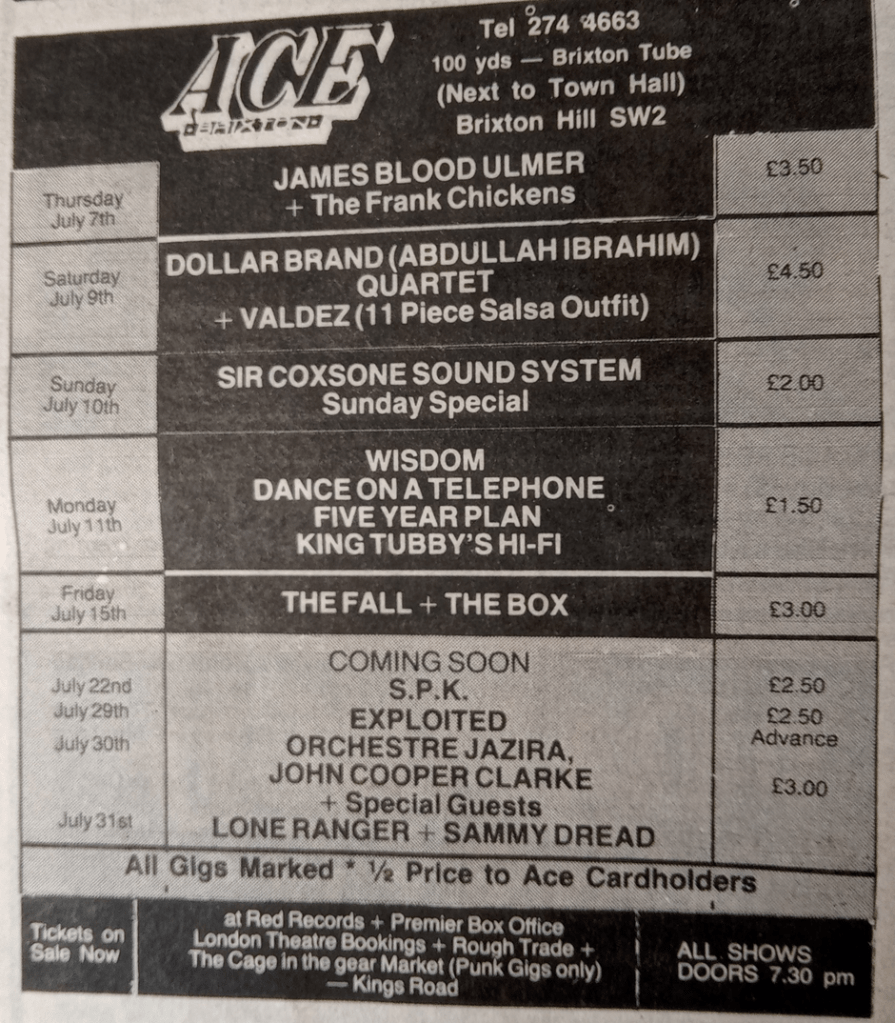
Abdullah Ibrahim and perennial music press favourites The Fall also played and received favourable reviews in the music press. The Fall gig was captured on film:
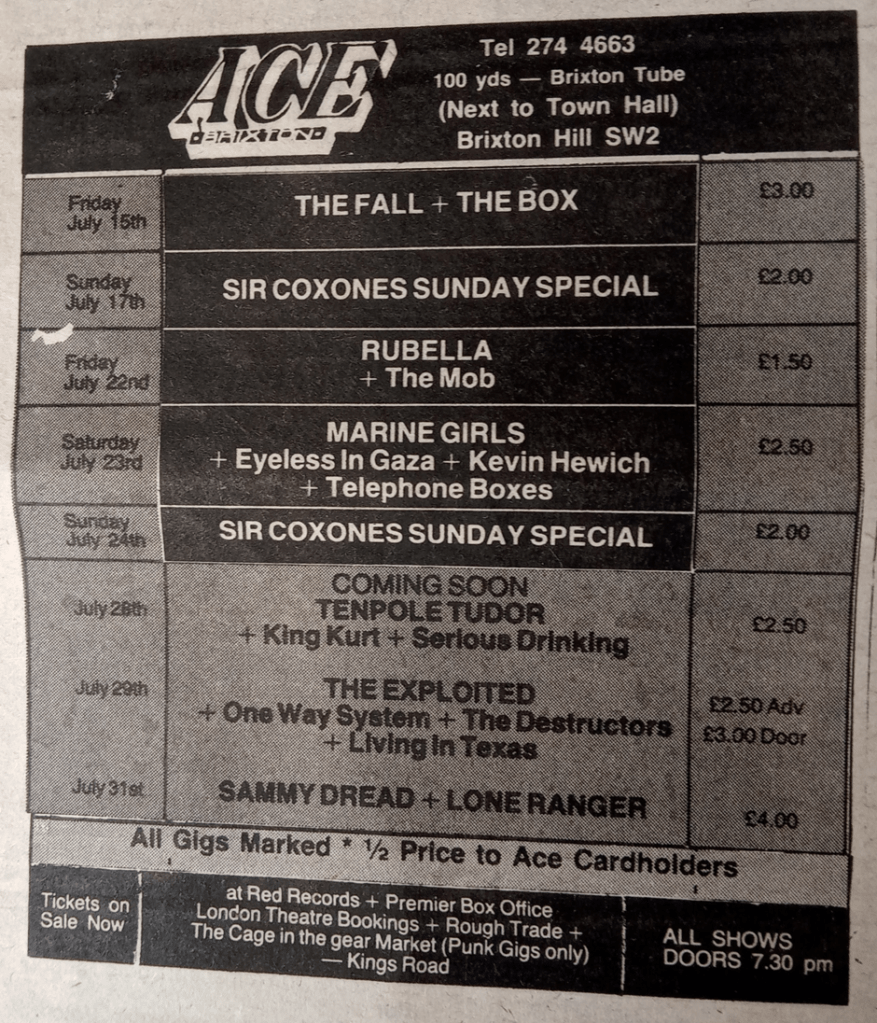
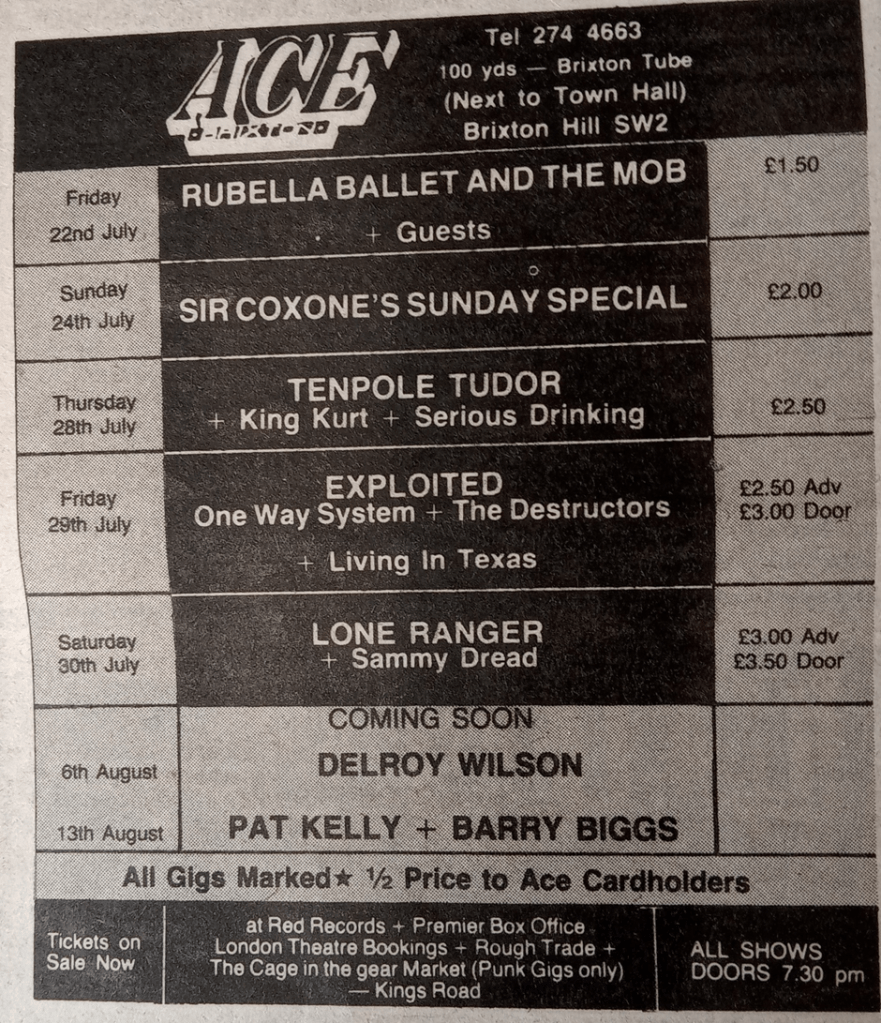
August
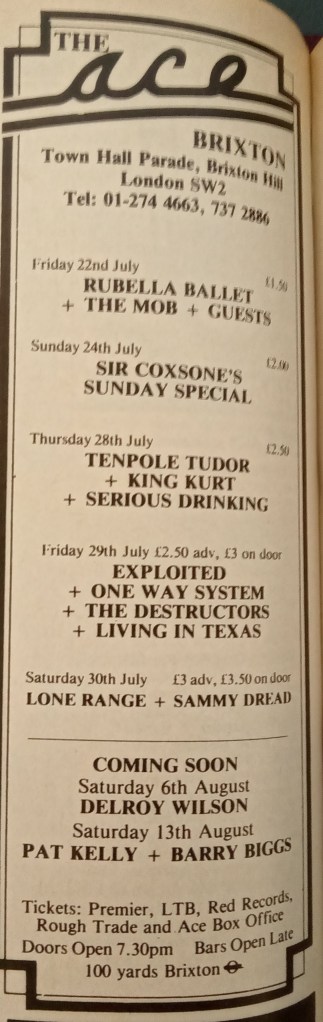
In August the NME suddenly stopped publishing the weekly listings for The Ace. The number of gigs being put on dropped dramatically. Black Echoes was ahead of the rest of the music press in reporting “Contrary to rumours currently circulating, Brixton’s Ace has not closed down. However, the venue has cancelled it’s regular events, except Coxsone’s Sunday Special, and will be hiring the venue out on the other nights.”
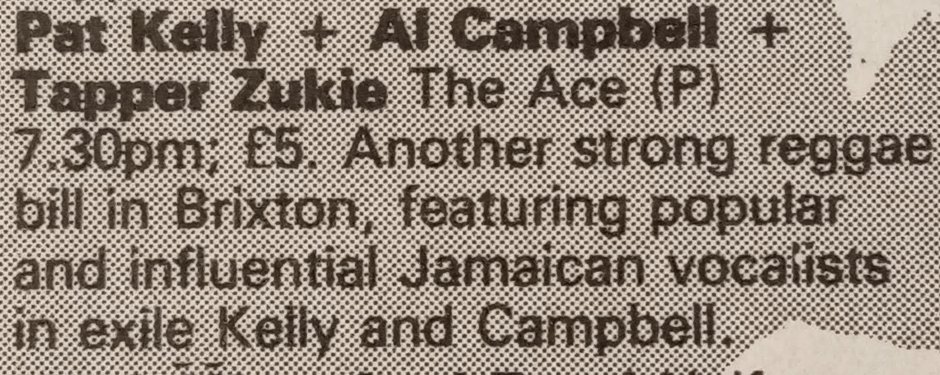
Consequently the only concerts that we know were scheduled for September were the Coxsone Sunday Specials, a Delroy Wilson gig on the 6th that was announced in Black Echoes and Pat Kelly, Al Campbell and Tapper Zukie on the 13th.
September
In September more details began to emerge in the music press as the owners of The Ace announced that they would be cutting back the number of shows they would put on, following financial difficulties. “It’s not so much that we’re losing money, it’s just that we’re not making what we should be”, a spokesperson told Record Mirror. They stressed to Record Mirror that they were definitely not closing but that all future shows would be promoted by outsiders rather than The Ace management.
The Melody Maker put a more downbeat spin on the news. Under a headline of “ACE CUTS ITS LOSSES” it stated:
“The Brixton Ace-one of the more adventurous venues in London in terms of booking policy-has called a halt to almost all of its live shows, following a series of financial difficulties. The owners of the Ace, who promoted their own gigs, say that they weren’t getting back enough money from the shows to continue as they’d hoped. They’re now offering the venue out to hire to other promoters, record companies, video producers and anyone else that wants to use it. The Death Cult gig on September 17 is going ahead as planned and the reggae evenings on Sundays are to continue for the time being. But otherwise, the building will remain closed until more promoters move in.”
There were no particular reasons given as to why The Ace was suffering financial difficulties. Perhaps after the huge financial outlay of £250,000 the eclectic and adventurous programming wasn’t pulling in enough people to make it financially viable. Whatever the reasons The Ace management started advertising in Time Out for promoters to hire the venue out.
Again gigs were fairly thin on the ground, with goth bands Alien Sex Fiend and The Death Cult being listed as playing in the NME on the 8th and 17th September respectively.
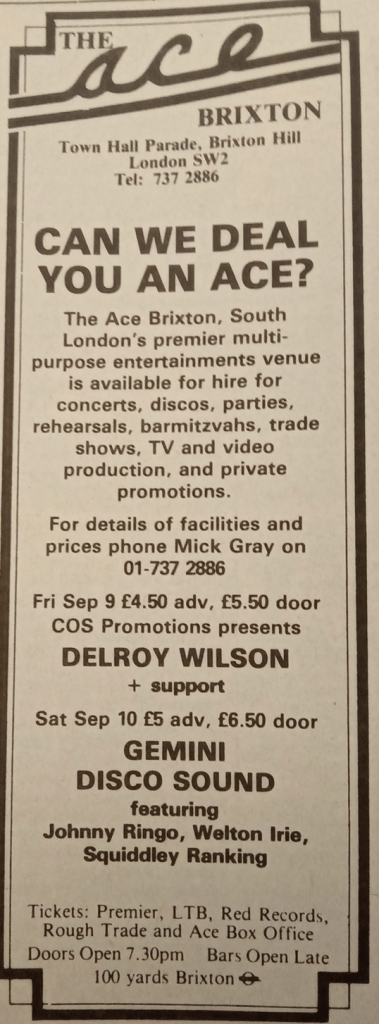
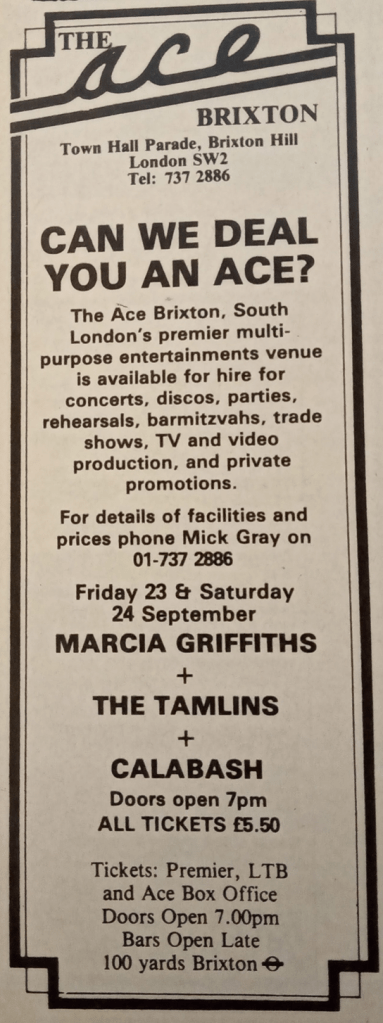
Reggae was supplied by Delroy Wilson, Gemini Sounds and Marcia Griffiths. The Delroy Wilson and Gemini Sound gigs were reviewed by Black Echoes.
October
Gigs were also thin on the ground in October. Some gigs were probably not advertised.
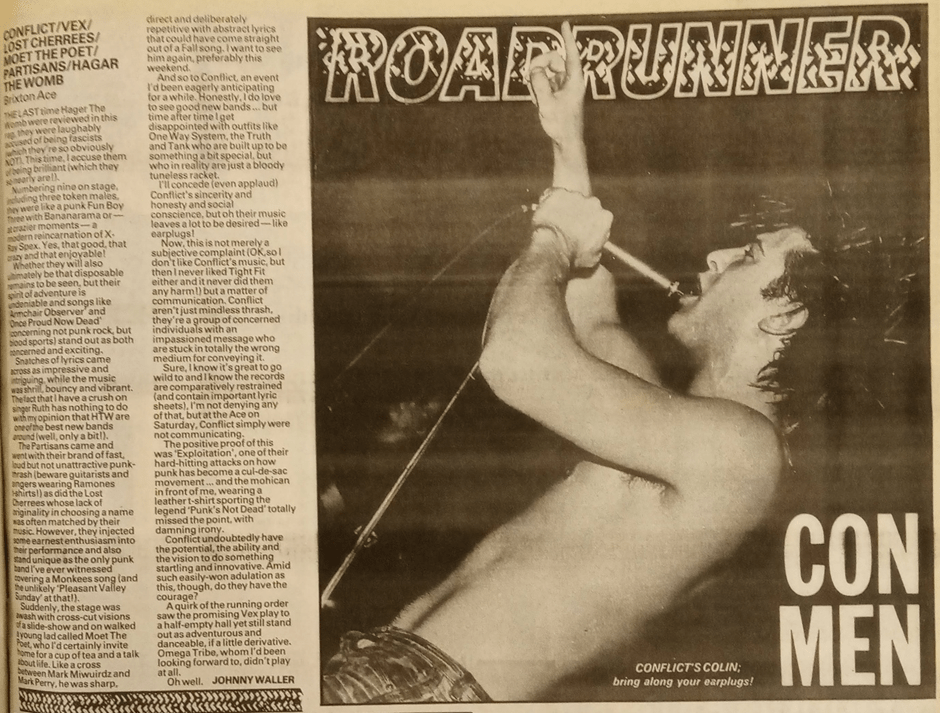
Conflict played on the 8th.
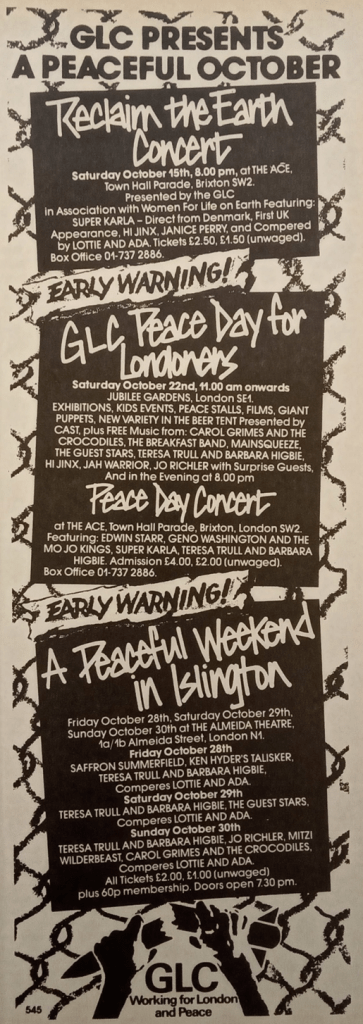
Super Karla, Hi-Jinx, Janice Perry and Lottie and Ada played on the 15th October according to the Melody Maker listings.
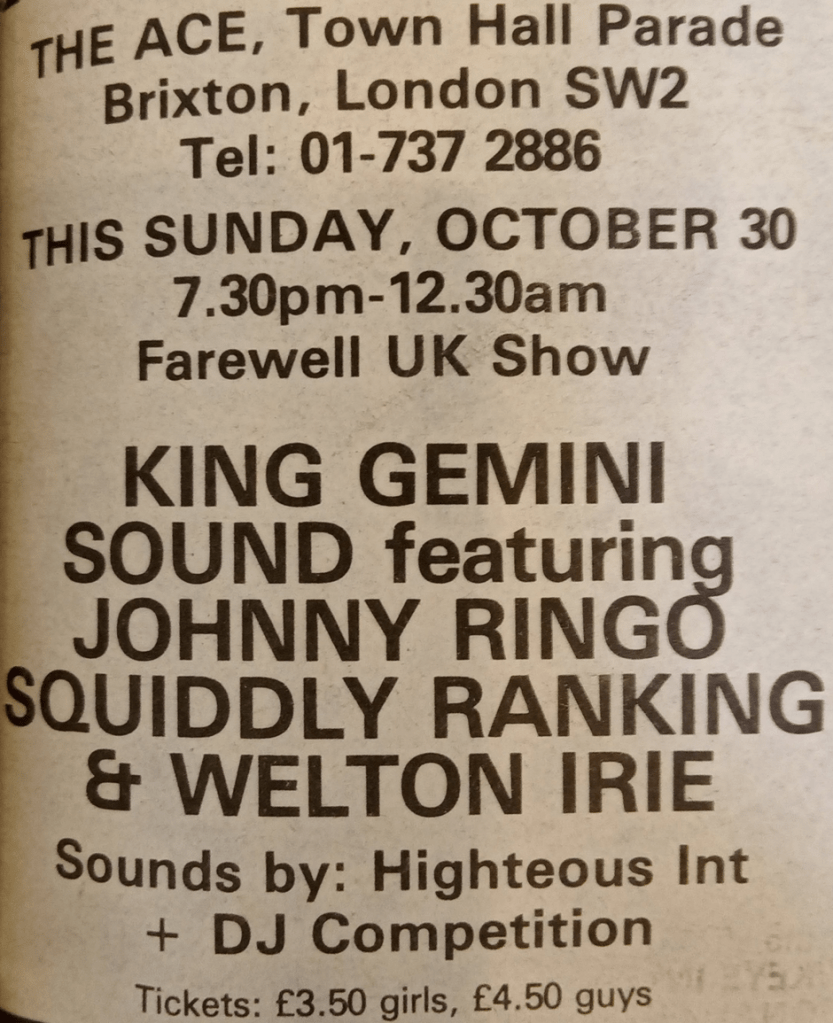
King Gemini were due to return on the 16th, which then seems to have been postponed until the 30th.
GLC peace concerts were also staged on the 15th and 22nd, featuring the likes of Edwin Starr and Geno Washington.
November
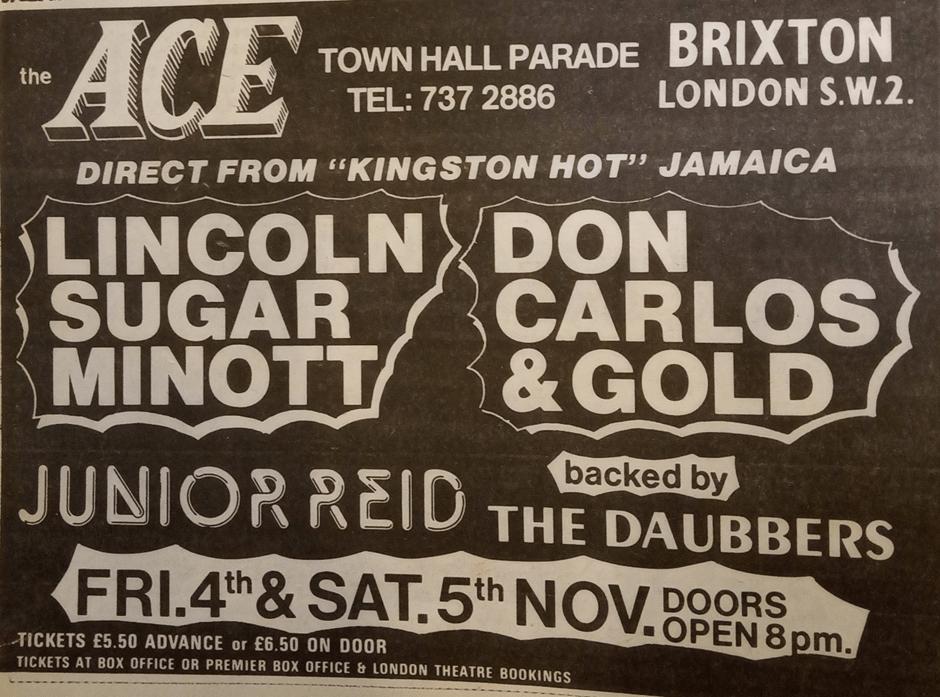
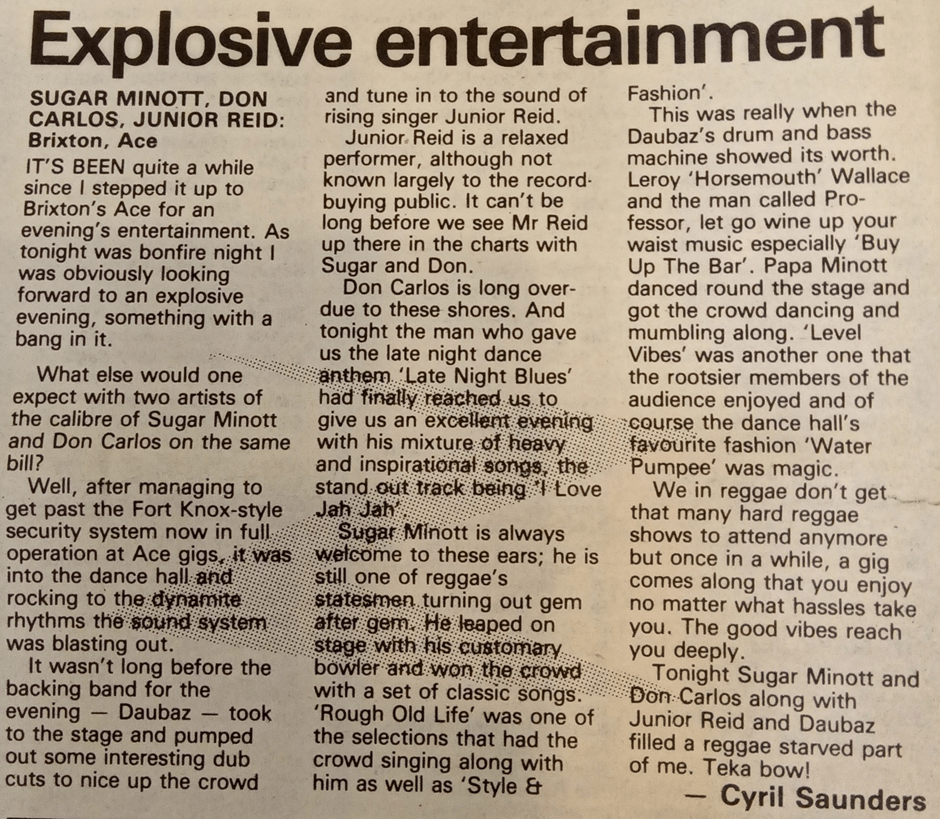
Sugar Minott, Don Carlos and Junior Reid played despite reported problems with gaining visas.
Black Echoes reported that soul DJ Steve Walsh had started a new Sunday night residency at The Ace, beginning on the 6th November.
Level 42 played a special gig on the 21st November, which was filmed for the BBC’s Old Grey Whistle Test:
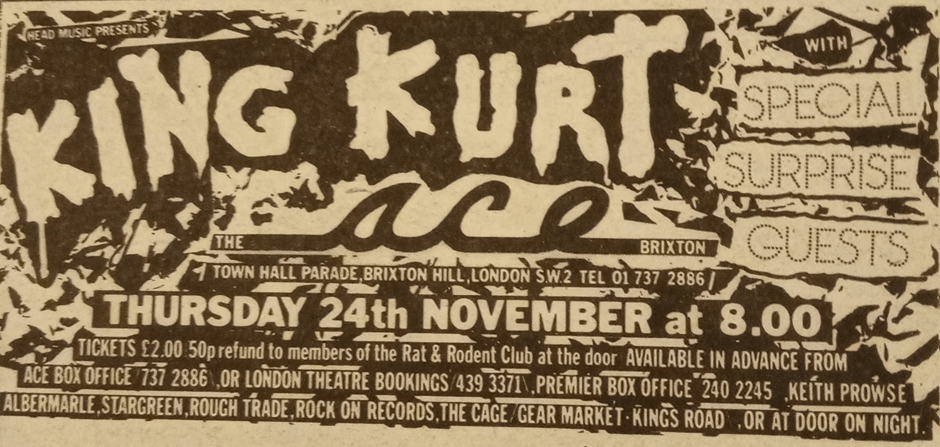
King Kurt had a gig advertised in Sounds.
Lloyd Coxsone hosted a soundclash on the 26th November:
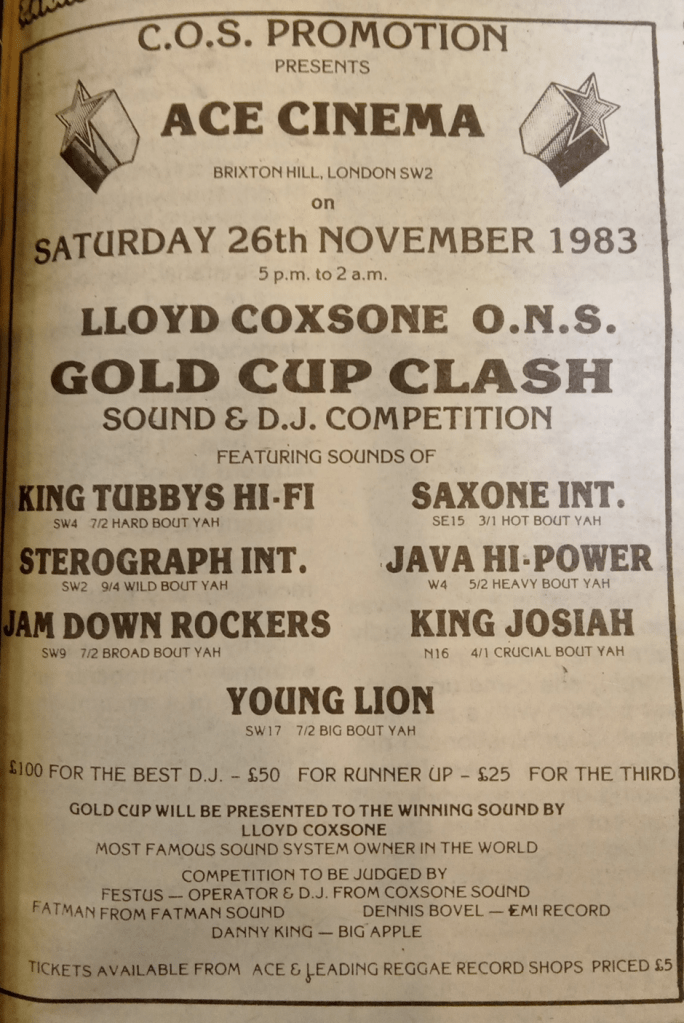
Young Lion’s set is captured on Mixcloud: https://www.mixcloud.com/MikeyGlamourAudio/young-lion-soundgold-cup-clashace-cinema-brixton-london-uk-26111983/
December
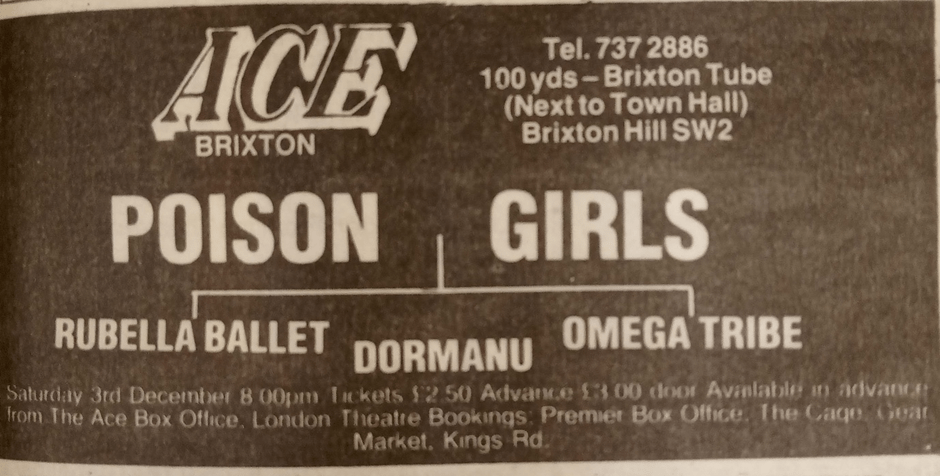
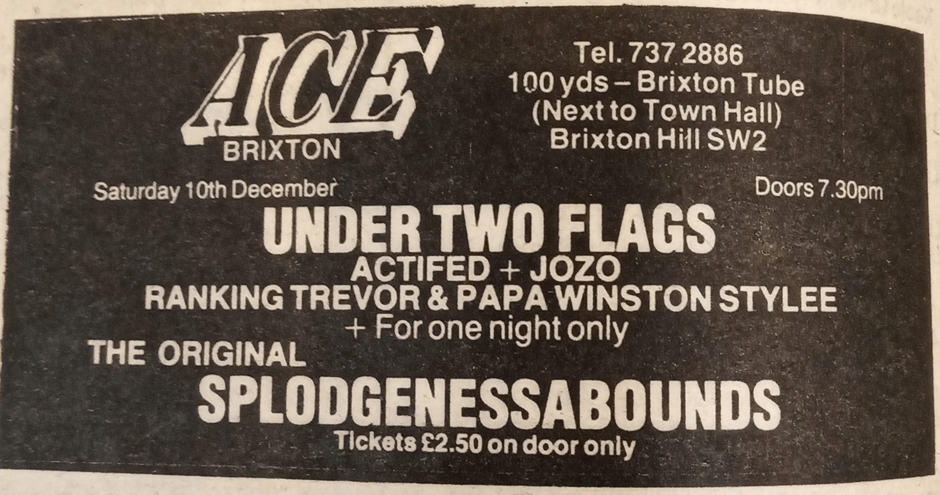
December started with a gig by the anarcho punks Poison Girls and local goth band Under Two Flags.
Black Echoes announced that Cornell Campbell would be playing on the 9th. Whether this happened or not is open to debate as he also played as a support act to Eastwood and Saint on the 27th December.
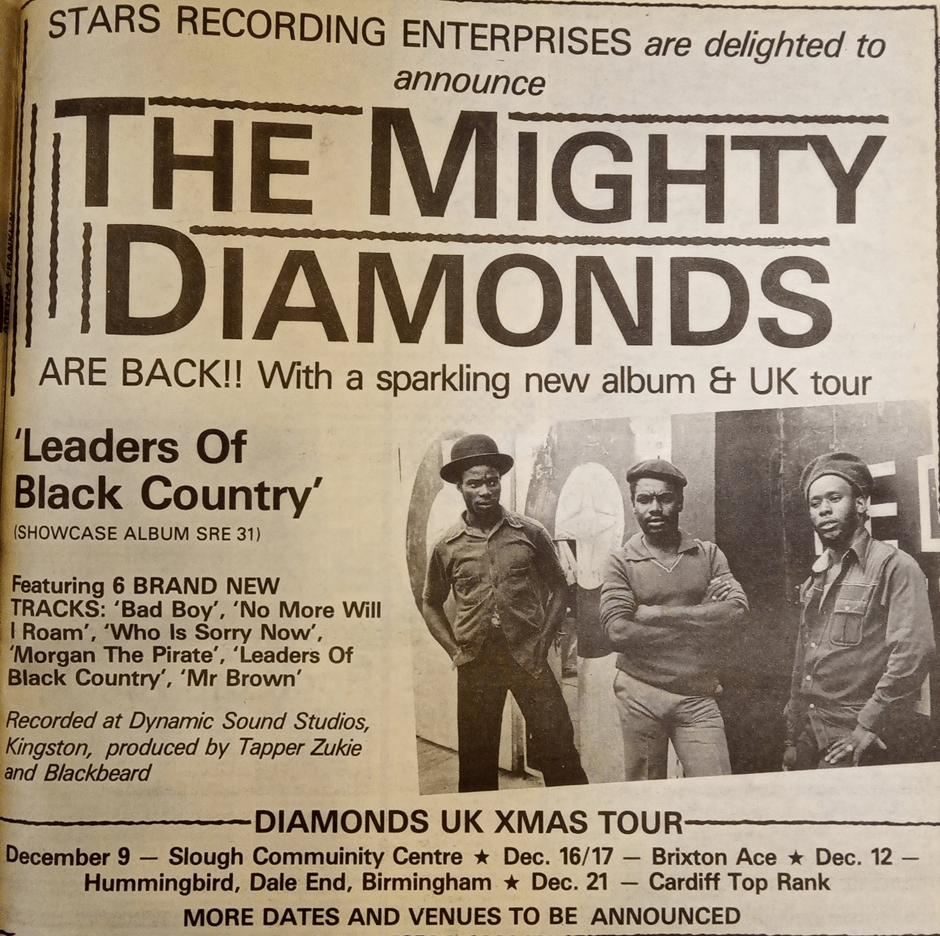
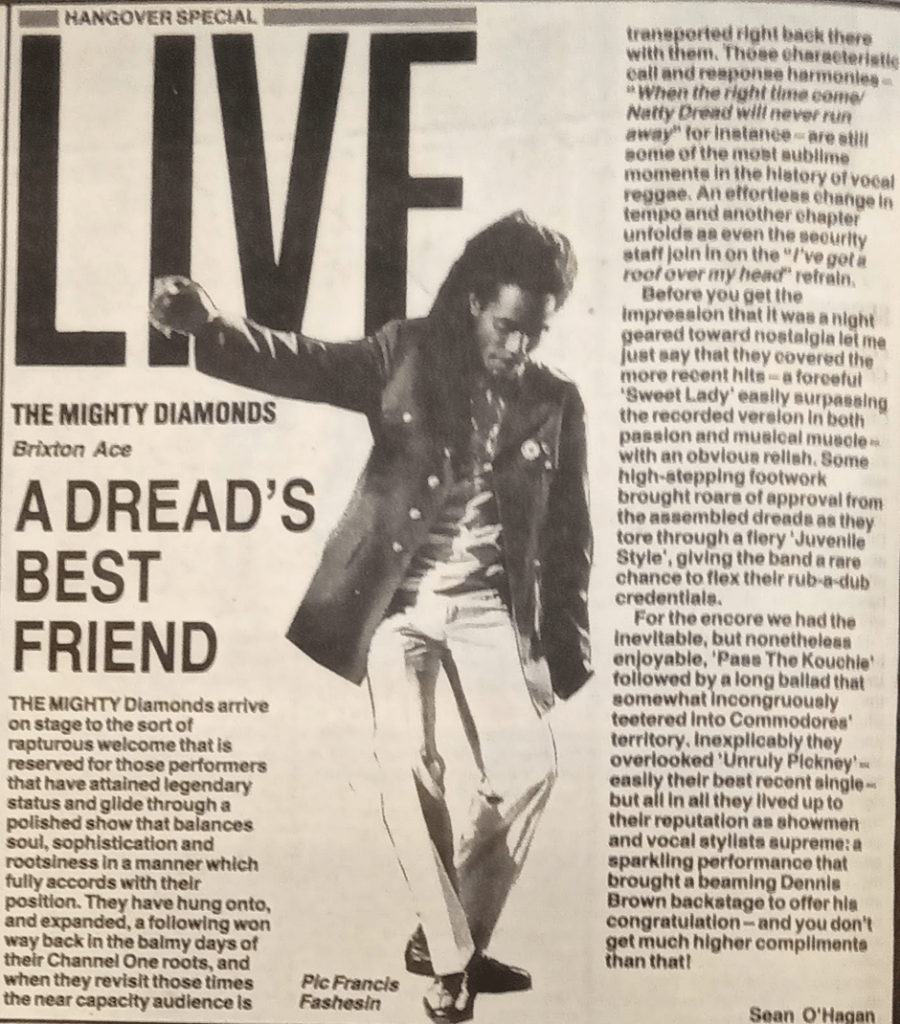
The Might Diamonds definitely did play.
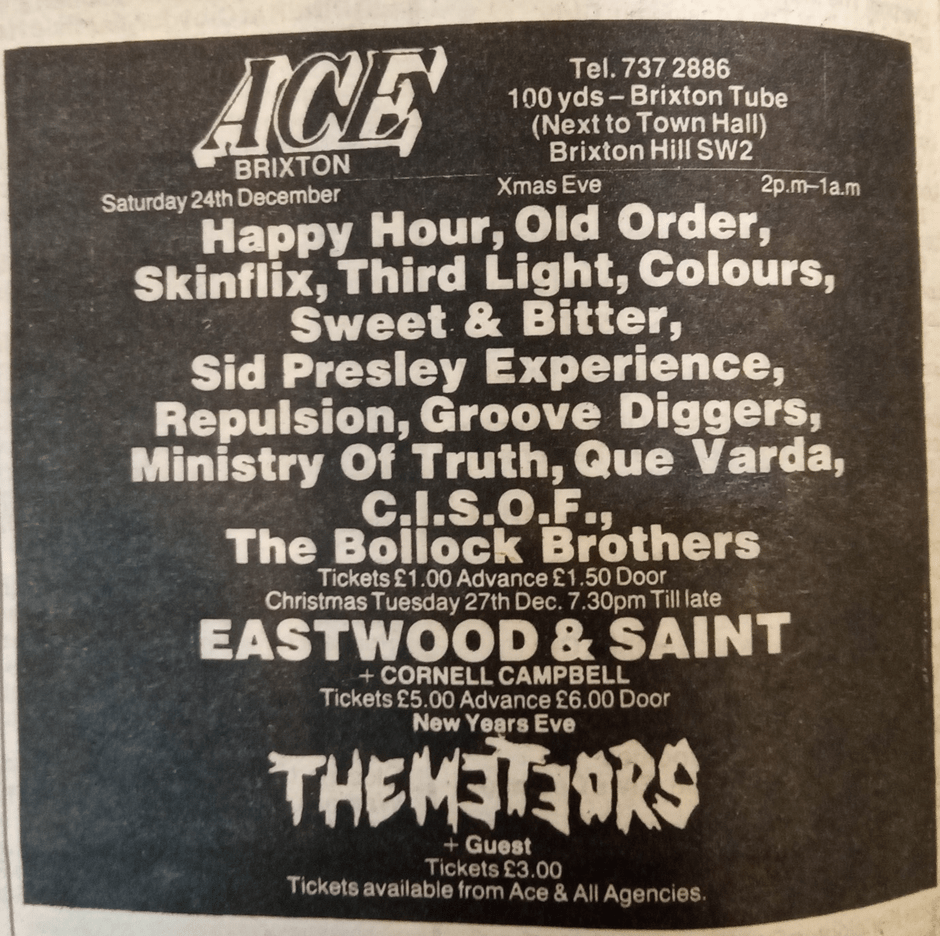
The year finished with a flourish (or was that the last hurrah?), with a Christmas Eve punk extravaganza, reggae from Eastwood and Saint and Cornell Campbell and New Years Eve psychobilly from The Meteors.
1984
The Ace limped on into 1984 putting on occasional gigs.
Black Echoes reported the previous December that Tim Westood had regained control of the roller disco and that it would be starting again on January 12th. Judging by this advert it didn’t start again until February. Black Echoes reported that the obligatory Kung Fu movies followed after midnight.
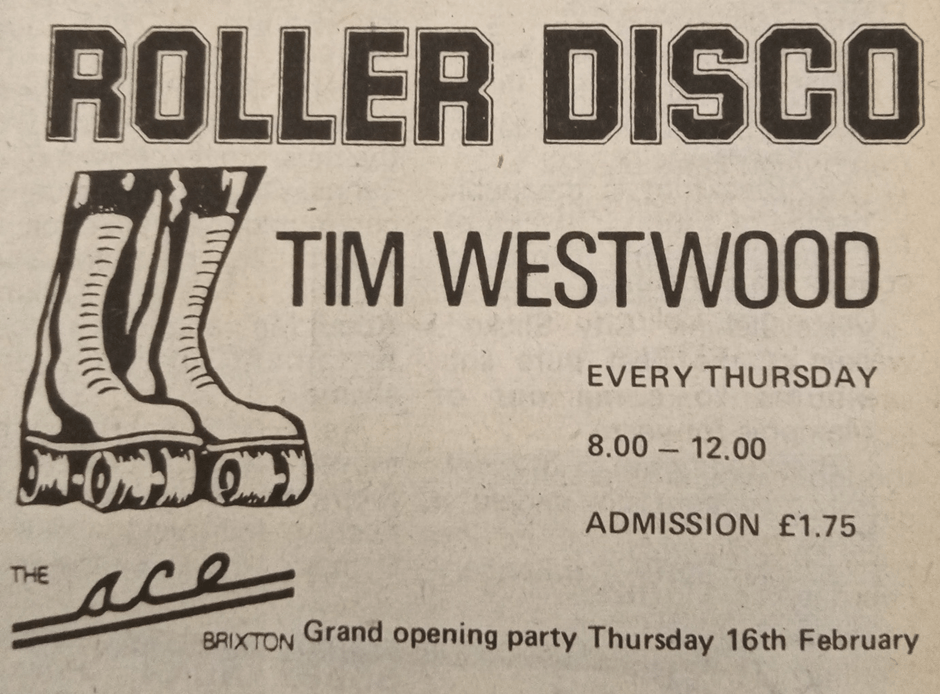
According to Black Echoes an Italian film crew was planning to film the Westwood night on the 22nd March as part of a documentary on British youth culture.
Black Echoes also announced that Jack Ruby Hi-Power sound system, featuring Brigadier Jerry, Fat Jaw and General Tree, was scheduled to play on the 9th March. According to Time Out they were also due to play on the 31st March, although it is doubtful whether this happened.
The 9th March set was captured on Mixcloud: https://www.mixcloud.com/MikeyGlamourAudio/jack-ruby-hi-fi-ace-cinema-brixton-hill-london-uk-931984/
We found the occasional gig in the listings of the music press, including Heavy Pettin’ on the 23rd March, Conflict on the 30th March (a benefit for those fined during the “Stop the City” protests). Mutabaruka was due to finish off his European tour on the 6th April. However, it is unlikely that any of these gigs went ahead.
There was a fire, apparently caused by an electrical fault, at the end of March which damaged the balcony and roof. Black Echoes reported that Tim Westwood’s roller disco, the Coxsone Sunday session, the 6th April Mutabaruka gig and the 28th April London heat of the International Body Popping heat were all cancelled. The Brixton Ace’s owners put out a statement hoping that the proposed gigs by King Kurt on the 11th and 12th of May would go ahead but it is doubtful if these ever happened.
In April the Ace put out a statement in the press that they strongly resented the suggestion by Stiff Records that King Kurt’s projected gigs in May had been cancelled due to the mess that King Kurt gigs made (food fights were all part of a night out with King Kurt): “We were very happy to have the band here and tickets were selling so well that we were thinking of putting on a third night. But the fire changed all that and we simply shan’t be ready in time.”
The revised dates never came and the fire proved to be the death knell of The Ace. Fortunately, the recently displaced Fridge club was waiting in the wings to save the venue for decades to come. That chapter in the venue’s life is the subject of an entire book.
 brixtonmusicmemories