This is very much a work in progress as there have been so many festivals over the years. We have lots more still to be published.
We would love to hear from people who attended the reggae festivals in 1966, 1973, 1974 and 1975.
1975-Reggae Festival
Sadly the 1975 reggae festival was to be the last of the reggae festivals in the 70s due to crowd trouble.
Held on the Whitsun Bank Holiday Monday, the festival attracted a crowd of 4,000.
Down at the bottom of the bill were the 20th Century Steel Sound. After reaching the finals of the New Faces talent show in 1975 and releasing two albums in 1975 and 1976 they probably though that their 15 minutes of fame was over. However, they have now reached a completely new audience, having been sampled by the like of Kanye West, Jennifer Lopez and Lauryn Hill. We hope they got paid their royalties.
The event featured some stalwarts from the Ram Jam Club. Headlining was Tito Simon, who had previously played at the Ram Jam under the moniker of Sugar Simone.
Compere and DJ on the day was Mr Superbad, who was known as Freddie Mack when he played at the Ram Jam.
Delroy Williams, (another ex Ram Jam act) who was also a member of the organising committee, played. According to the South London Press he was injured by flying bottles whilst trying to calm the crowd down.
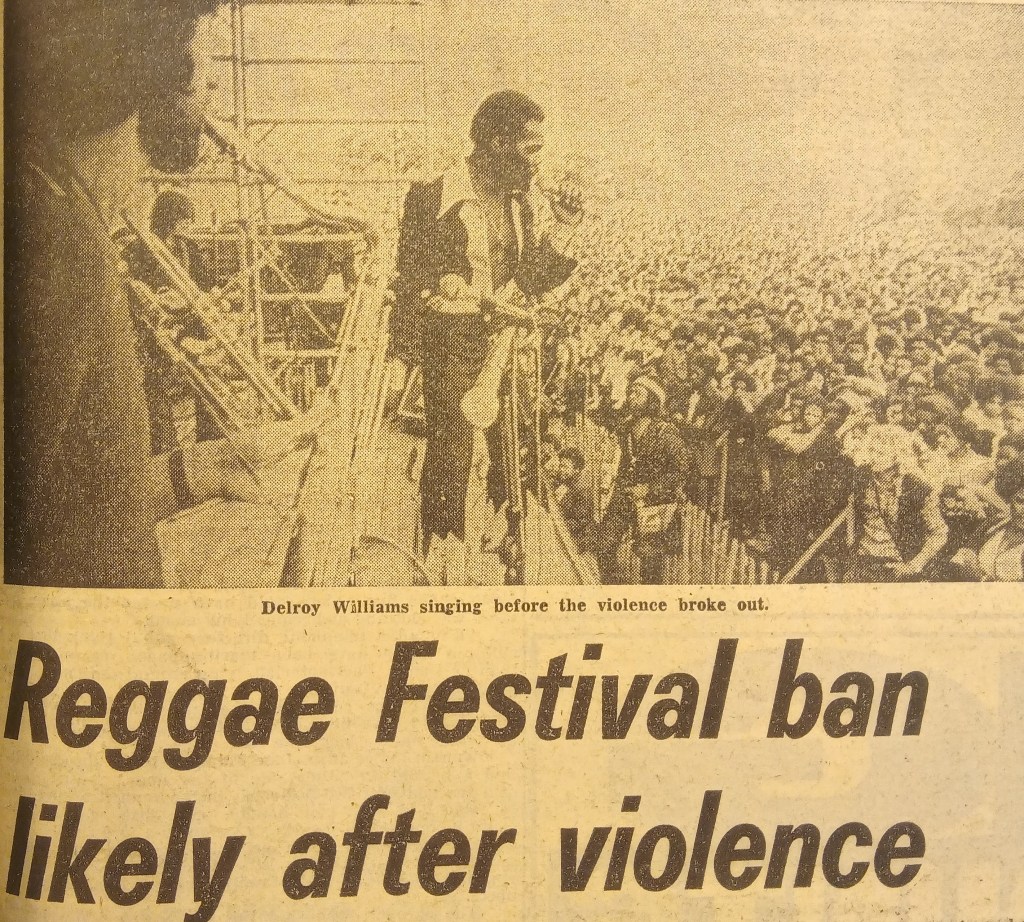
According to press reports, the trouble broke out half an hour from the end of the 7 hour event when a fight broke out between two youths. The press reported that after the police gave chase, several hundred people chased after them and prevented the police from making an arrest. Attacks also took place against two other officers and a police van. The police only had a team of 24 and a superintendent on duty on the day.
The event had been organised by Lambeth Amenities. Chair of the Amenities Committee, Councillor George Smith told the SLP “We cannot risk this happening again. It’s a shame because a lot of people, including whole families, were clearly enjoying themselves until the trouble started.
1978-The Rock Against Racism Carnival
In the late 70s the spectre of racial hatred had reached its peak. Fascist groups such as the National Front and British Movement would openly march through areas with relatively high minority ethnic populations. In the 1977 Greater London Council elections the National Front finished 4th, receiving over 5% of the vote, a massive increase on their showing in 1973.
Against this backdrop Rock against Racism (RAR) was born in 1976. Its aim was simple-to harness the power of music against racism. Highly recommended as a primer is Reminiscences of RAR Rocking against racism. It should never be forgotten that pitched battles were fought with the Nazis in areas such as Shoreditch, which are now considered hipster hangouts, but back then were National Front strongholds. The National Front’s offices were located at 73 Great Eastern Street in the heart of Shoreditch, which ironically now houses the London School of Languages and a Peruvian restaurant.
Very quickly RAR groups sprung up around the UK, which started to put on gigs around the country. The most famous of these was the April 1978 RAR Carnival in Victoria Park in Hackney. The event was a pivotal moment. 80,000 people marched from Trafalgar Square to Hackney, sending out the strongest message possible that fascism wouldn’t be tolerated. According to Time Out magazine the movement put on no less than 43 anti racist carnivals across the UK throughout the summer of 1978.
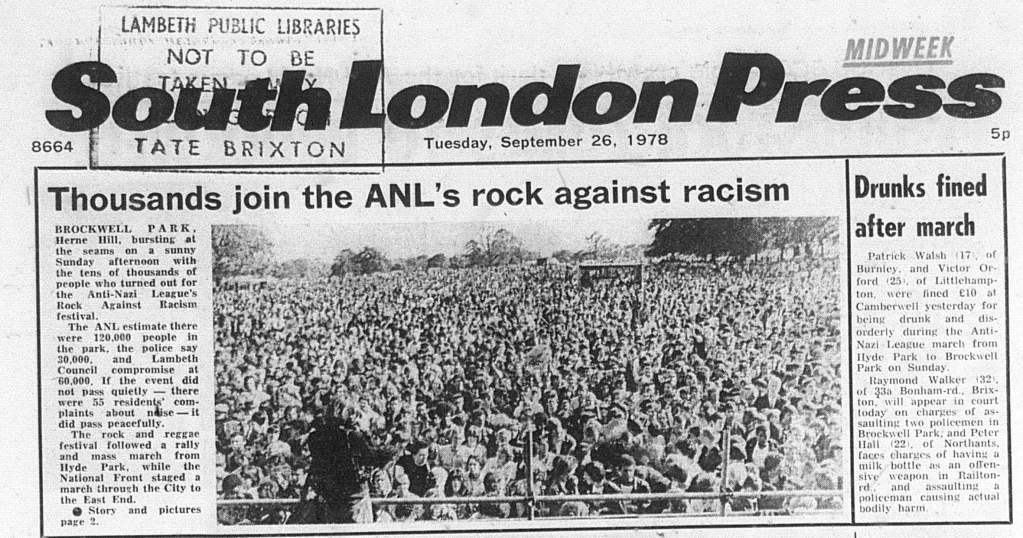
Billed as Carnival 2, the next RAR rally and concert in London took place in Brockwell Park in September 1978.
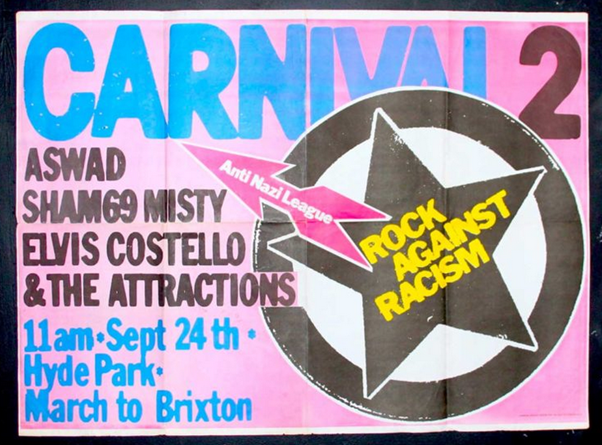
An opinion piece in the South London Press (SLP) hoped that the event would be peaceful but expressed concerns that previous events in Brockwell Park had ended in violence. These included clashes between revellers and police in 1973, which lead to the imprisonment of the Brockwell 3, and two subsequent Lambeth council sponsored reggae festivals which turned violent. The piece finished by saying “Brixton has had more than its fair share of racial trauma in recent years and its people have emerged with a remarkably cohesive spirit of multiracialism, despite occasional provocations from the National Front. Sunday’s carnival organisers have a heavy responsibility to ensure that the community spirit prevails.”
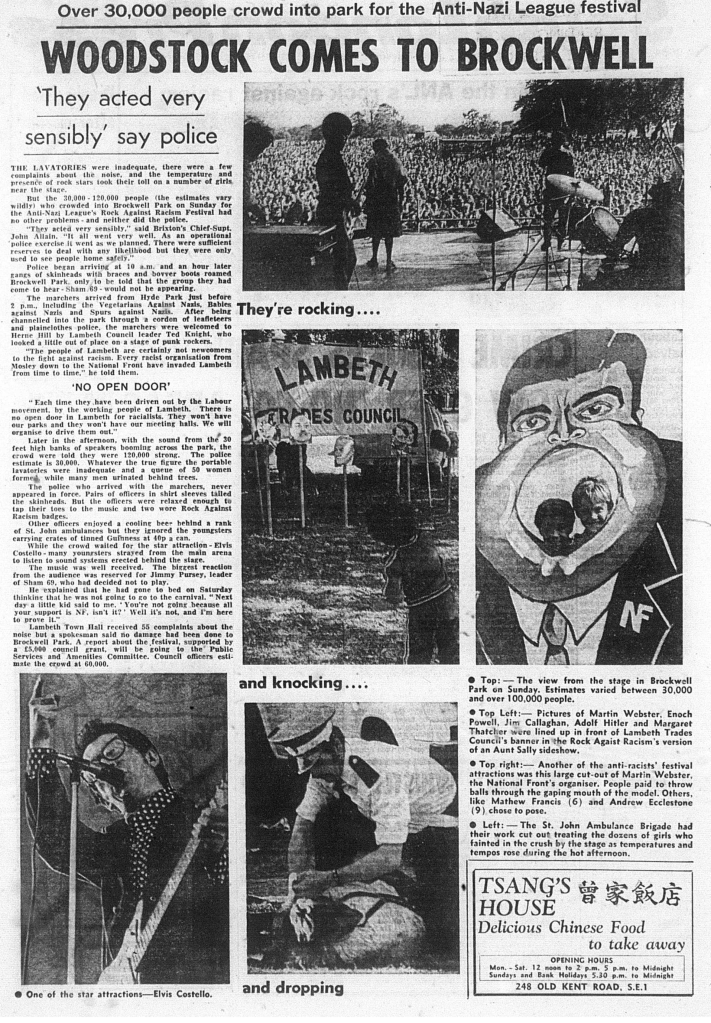
In the week preceding the gig Sham 69 withdrew from the bill. Their gigs were being increasingly disrupted by violence and National Front skinheads. In a statement lead singer Jimmy Pursey said “As our name has recently been linked with trouble we don’t want our being there in any way to jeopardise the success of the day and the cause of Rock Against Racism. Those who know us realise that all our gigs stand for rock against racism and rock against politics, but in future we will only be playing gigs and not political rallies. Sham 69 are about having fun, not riots.”
Sham 69’s decision not to appear wasn’t universally welcomed, with some feeling that it sent out the wrong message. RAR commented “RAR believe that his decision not to come to the carnival is a mistake…but we know that Sham 69, like Jimmy himself, is anti-racist and supports RAR/ANL.”
Debate rages about Sham 69’s troubled relationship with elements of their audience. Some argued that they were too late in taking a stand against the National Front element of their audience, as this history of the band shows. Early supporter of RAR, Tom Robinson, disagreed. In the 30th September 1978 edition of the Melody Maker he is quoted as saying “The great thing about Jimmy is that he’s actually communicating with people the Left finds hardest to reach- The Other Side…..It forces him into constant compromises, contradictions and a stance that is often ambiguous, but then he’s treading an incredibly difficult path. The British Movement has no doubt at all about which side he’s on and it’s very important that people on OUR side should give him all the support we can.
All of the major music press (Sounds, NME, Melody Maker and Record Mirror) gave extensive coverage to the event, with the Melody Maker devoting three full pages to the event.
As is always the case with large demonstrations, estimates of the number of attendees varied widely. Numbers varied from the BBC’s figure of 30,000 all the way through to Lambeth council’s estimate of 150,000. Coaches and trains had brought people from around the country to attend.
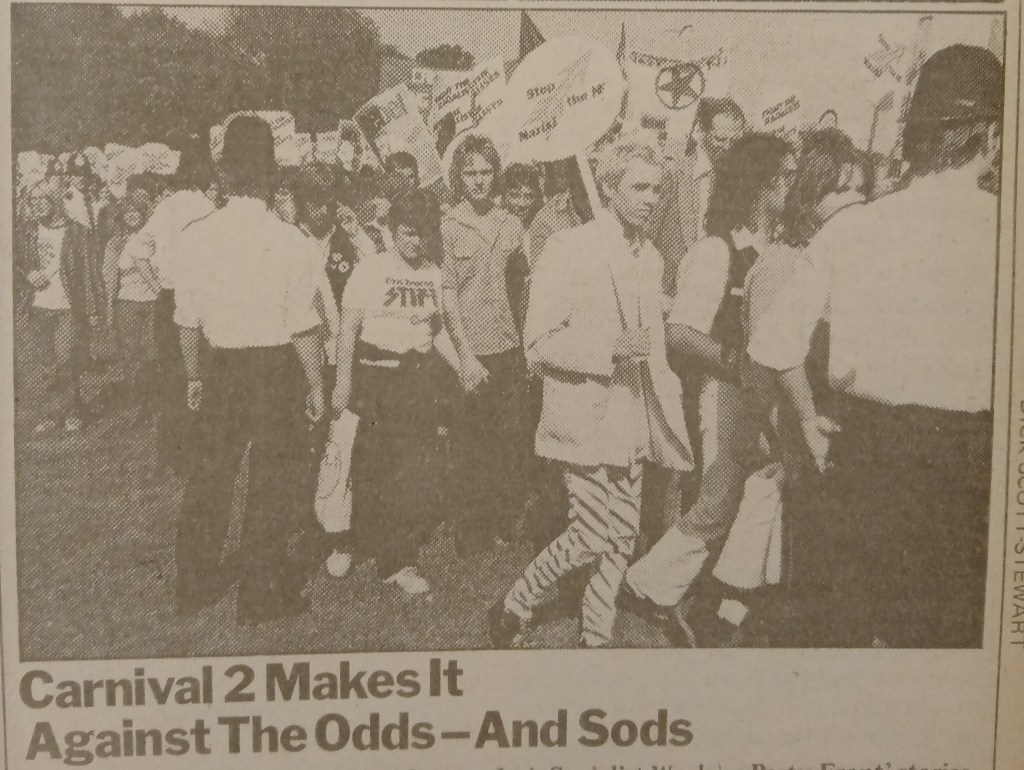
The day started with a rally at Hyde Park. Speakers included Tony Benn MP and future nemesis of Margaret Thatcher, Arthur Scargill, president of the National Union of Miners. Judging by the press coverage, the political speeches didn’t go down so well. The co-organisers of the Carnival, the Anti Nazi League (ANL) had received criticism from the mainstream press for its links to the Socialist Workers Party (SWP), which led some to view RAR as being a political battle rather than a moral one. The Melody Maker’s Simon Frith summed up the cause thus: “To sneer at Sunday’s Carnival…is to misunderstand why Sunday mattered-not as a political event but as a simple celebration of decency.”
No surprise then that the best received speech was from musician Tom Robinson: “The most important work is to be done not here at the Carnival but by you when you go home-at school, at work, in the pubs by talking to people. Don’t come on like Joan of Arc and bore them shitless but talk to them, keep up a dialogue because racism thrives on ignorance.”
Reports at the time mention the huge variety of different groups and causes that came on the march: SKAN (School kids against the Nazis), Vegetarians against the Nazis, Dykes against the Nazis and Hippies against the Nazis to name but a few. Favourite placards and slogans from the day need some context to explain-“Pogo on a Nazi” read one placard, The Pogo being the punk’s dance which involved jumping up and down. “1, 2, 3 and a bit, the Nazis are a load of shit” was one of the chants, “1,2,3,4” being the call to arms that heralded the start of many a punk song.
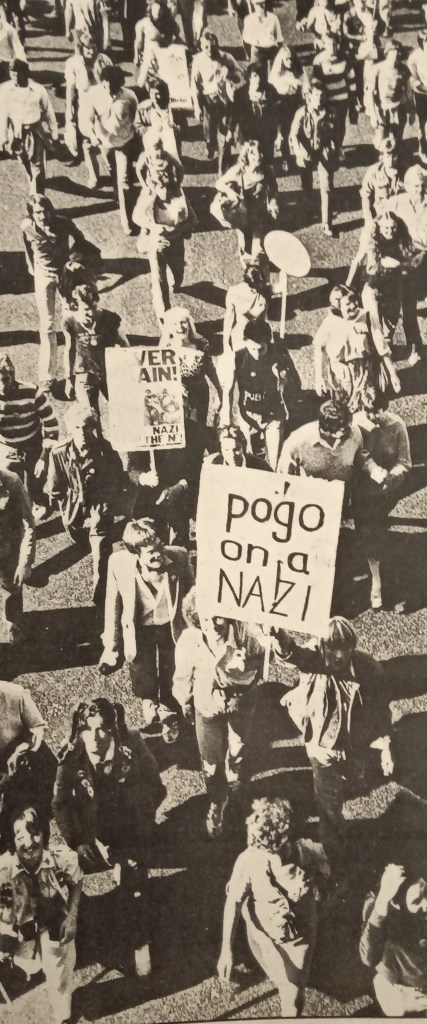
The march set off from Hyde Park, accompanied by several bands who played on floats; some lesser known , such as Crisis, Charge, Eclipse and the Boots and Braces bands, through to well known new wave bands The Ruts and The Members. China Street also played, whose single “Rock against Racism” celebrated the movement. Also taking part were trad jazz bands, steel bands, the Crisis and Roots sound systems and Indian Bhangra band Kala Preet. You can see some silent footage of the march and snippets of performances here:
The Brixton welcoming committee for the marchers did itself proud. Crowds lined the streets and applauded the marchers. Lambeth town hall was decorated with a banner which read “Council Workers against The Nazis” and The Ritzy cinema (known as the “Little Bit Ritzy” in those days, which had only opened as a music venue itself two days before the Carnival) displayed a sign saying “Ritzy against the Nazis – Have a Nice Day”
The Melody Maker’s Chris Brazier described the scene as Brixton’s gay community welcomed the marchers:
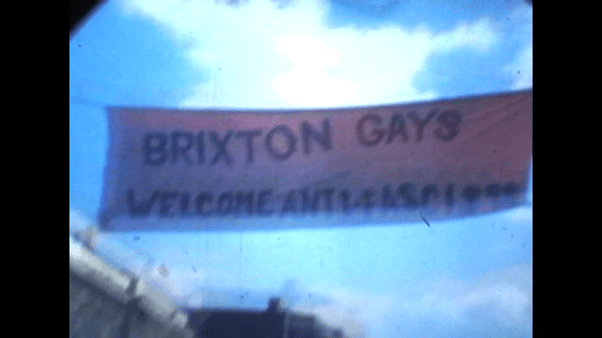
“spilling out of every floor of a house underneath were male gays cheering uninhibitedly, drawing attention to their wildly extravagant appearance, their riotously colourful clothes and make up….On the first floor balcony were a couple pretending, not very regally, to be the Queen and a ludicrously camp Prince Philip….the gays’ message was perfect “This Queen Says Smash The National Front”.
Popular music at the time had a complex relationship with race. Punk icons Sid Vicious, Siouxsie Sioux and Jordan had all worn swastikas for their shock value. Similarly The Clash’s manager and The Slits are recorded as having used racist language. It has been suggested that popular youth culture could have taken a very different turn if it were not for RAR.
Many within the RAR movement and journalists who reported on the event were starting to join the dots and make the connection that the RAR movement that there was no point campaigning against racism whilst still tolerating other types of discrimination. The Melody Maker’s Chris Brazier summed up this feeling as follows: “the movement needs to encompass not only the fight against something but also the fight for liberation of all races, gays and women.” Simon Frith concurred: “to change the current gesture (laughing at blacks is out, man) is not enough as you can tell from the way in which ANL supporters (in the music press for instance) continue to be comfortably sexist, making demeaning and degrading jokes, sharing oppressive assumptions about women.”
Simon Frith, who enjoyed the Indian music which was heard on the march the most, also pondered whether there was also a gap in RAR’s ideology: “It has always been a RAR weakness that in promoting the punk/reggae connection they’ve confirmed old youth trends (the skinheads like reggae too) without denying their evil side (skinheads were the first paki-bashers). There’s nothing in most RAR gigs to contradict the insidious notion that West Indians and whites can be cool together but those fucking pakis are stupid aren’t they? I don’t know what would happen if a Bengal drumming group came on between Misty and Sham 69 one night but it’s important to find out”.
When the march reached Brockwell Park they were greeted by “a political bazaar”, a village that represented the “views, culture and food of local community and campaigning organisations.” Performing at the bazaar that day were the Brixton Arts Theatre, who performed their play “There is another one behind”. The author of the play Lee Davis explained to the SLP that the play had “no message in it whatsoever. It just explores people’s attitudes with an eye for humour”.
Stiff Little Fingers, who were late replacements for Sham 69, started proceedings although it seems many people were on the march and missed their set. RAR had asked John Lydon’s Public Image to appear instead of Sham 69, knowing that this would be a long shot.
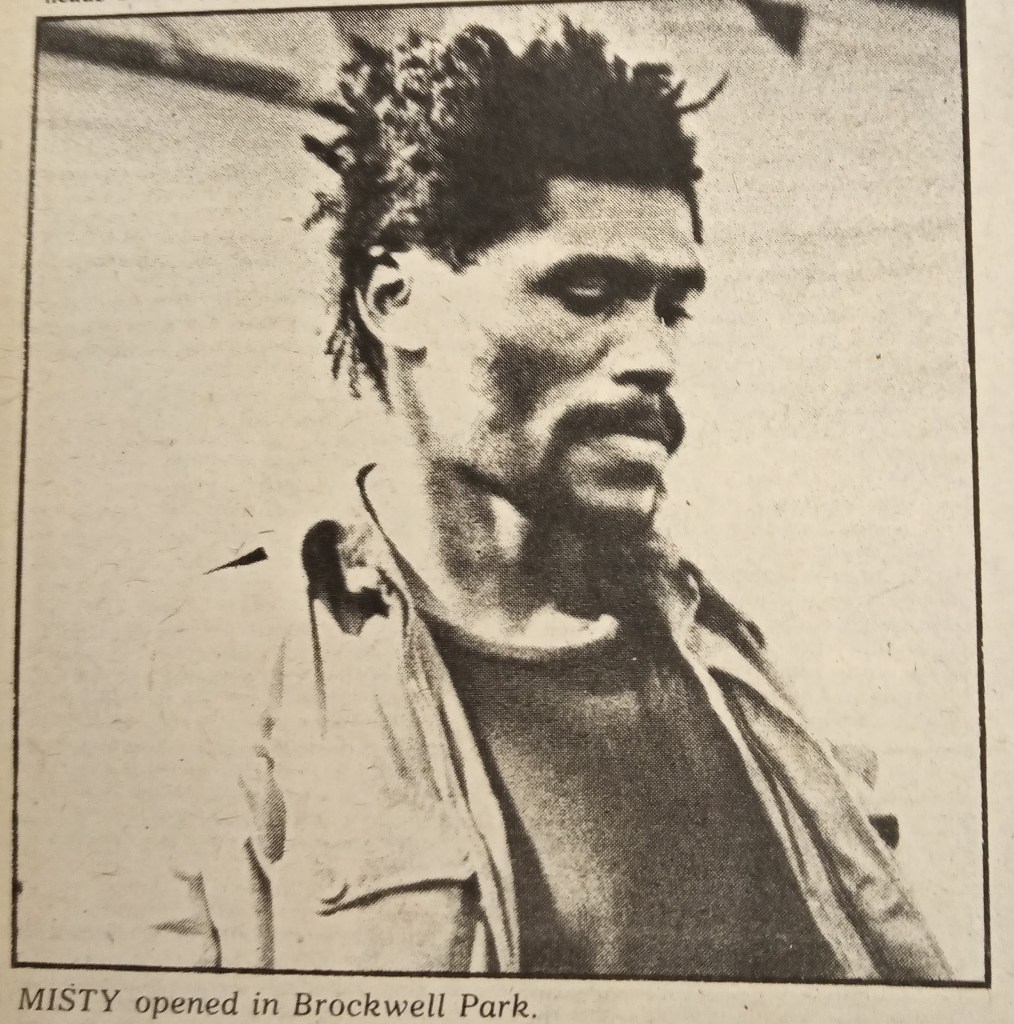
Next up were Misty in Roots, stalwarts of the RAR movement. All the music weeklies gave hight praise to Misty, with the exception of the NME, who objected to them on the basis of their Rastafarian religion. Having said that the NME writer seemed to have a reason to find fault with most of the day for one reason or another, principally for not being radical enough. Misty didn’t seem to drawn much applause from the audience however until it was announced from the stage that “without Misty RAR wouldn’t be in as many places as it is – they’ve done more gigs for us than just about anybody”.
Sham 69’s Jimmy Pursey took to the stage after Misty and explained in an emotional speech why he was there: “All this week you’ve probably read a lot in papers about Jimmy Pursey and Sham 69…well lemme tell you this, you’ve also read a lot that’s untrue. We’ve been dictated to by everyone around us. I decided in bed last night that I wasn’t gonna come today, but this morning I met this kid who said ‘Why ain’t you doing it? You ain’t doing it ‘cos all your fans are National Front.’ And I thought ‘That’s just what everyone will think if I don’t turn up.’ WELL I’M HERE! I’m here because I believe in that (points upwards to the Rock against Racism sign)…and on one’s gonna tell me what I should and shouldn’t do”.
Pursey’s appearance was followed by an appearance by punk poet John Cooper Clarke, who would later be a Brixton resident for a while. An announcer from the stage also urged people to get themselves over to Brick Lane to swell the ANL numbers. Between 1,000 and 2,000 National Front members had staged a counter demonstration march from the Embankment to Brick Lane. They were easily outnumbered by a reported 2,000 ANL members and 1,500 police.
Elvis Costello and the Attractions belted out a 16 song set, including two of his anti fascist songs “Night Rally” and “Less than Zero”. Less than Zero was written in reaction to an infamous interview that Oswald Mosley, ex leader of the British Union of Fascists, gave to Thames TV in 1975.

Whilst short on between song banter, Elvis did (presumably ironically) quip “Welcome to the Black and White Minstrel show. How about jumping up and down against racism”.
The set also included new single “Radio Radio” and a preview of his biggest ever hit, “Oliver’s Army”, which would be released in February 1979. The set concluded appropriately with Elvis’ version of “What’s so funny about peace love and understanding?”


The crowd started to disperse after Elvis Costello, leaving Aswad to finish off proceedings with a well received set. “Why are we here today?” shouted lead singer Brinsley Forde, as he led the crowd in the chant of “One aim, one love, one destiny”, as they joined hands and raised them in the air.
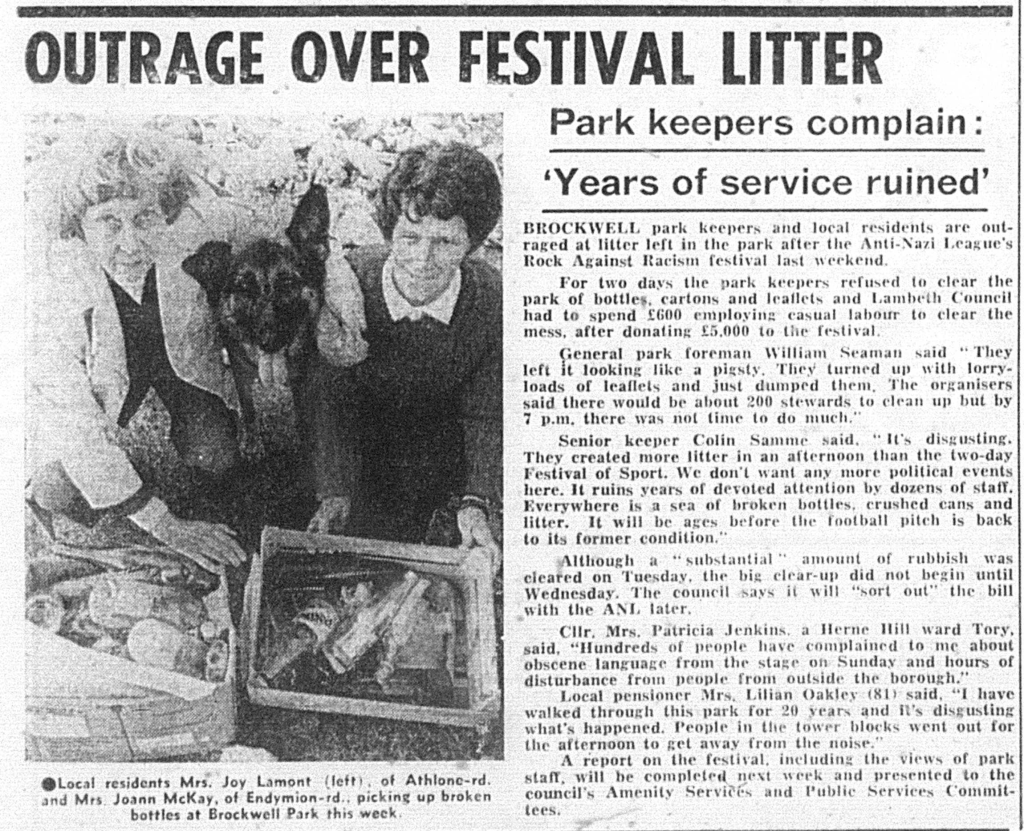
Some locals weren’t so impressed with the aftermath. The park foreman is quoted in the SLP: “They left it looking like a pigsty”.
1979-Brixton Carnival Against Racism
Following the success of the RAR Carnival 2 in 1978, the Brixton Carnival against Racism was jointly organised by Lambeth council, the Joseph Rowntree Trust and the Commission for Racial Equality.
There were two stages; one featuring steel bands, theatre groups and Asian dance troupes, whilst the other stage featured rock and reggae bands: local reggae band The Cool Notes, Ox Eyes, Spoil Sports and Stiff Little Fingers, who headlined this time.
There was limited music press coverage of the event. Maybe this was because, with the exception of Stiff Little Fingers, the bands on the bill didn’t really appeal to the music press’ demographic. The crowd was estimated to be between 7,000 and 8,000, much smaller than the previous year’s event.
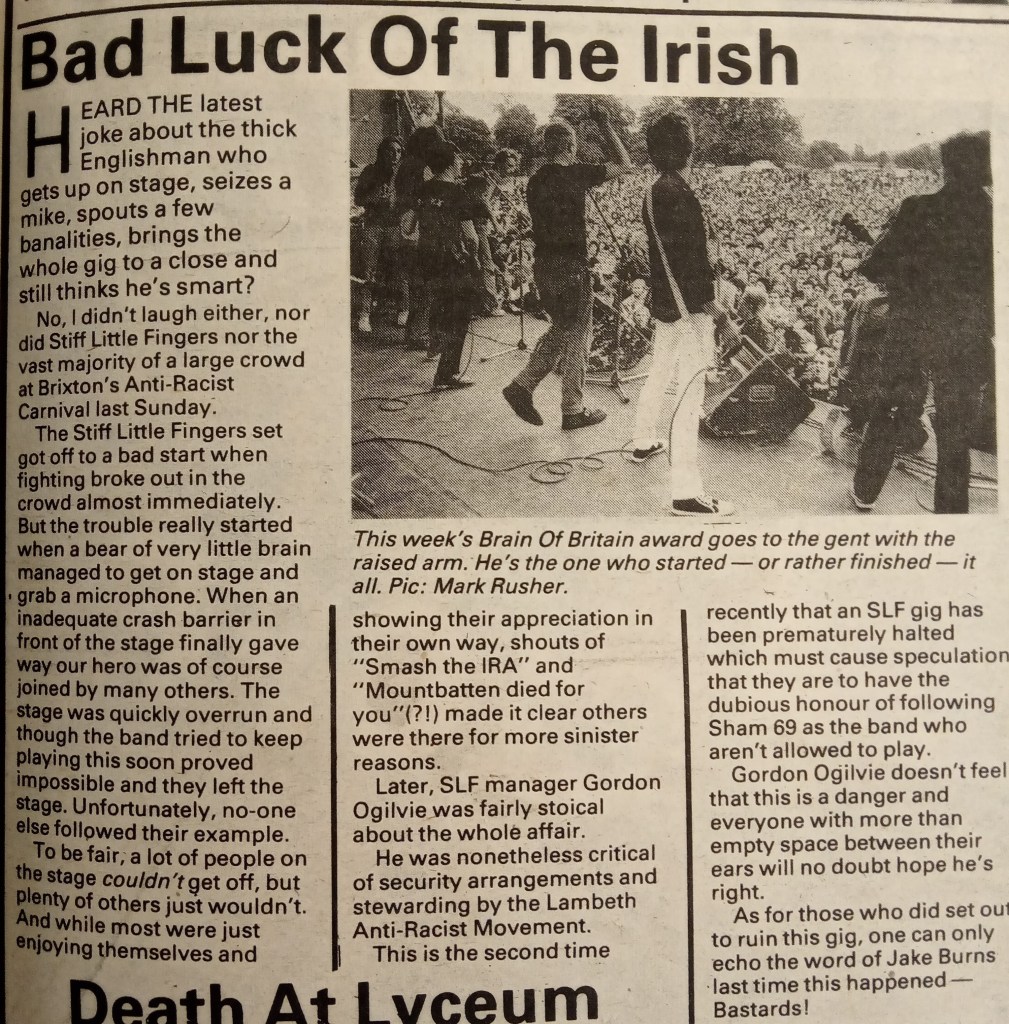
A film crew was on hand to record Stiff Little Fingers set for the “Rough Cut and Ready Dubbed” documentary:
Sadly, the coverage of the event was for all the wrong reasons. Violence had erupted earlier in the crowd. The music press claimed that the the gig had to be abandoned after the stage was invaded by a mixture of punks and British Movement supporters, who chanted “Smash the IRA” and “Mountbatten died for you”. Lord Mountbatten had been killed the week before the carnival by the IRA.
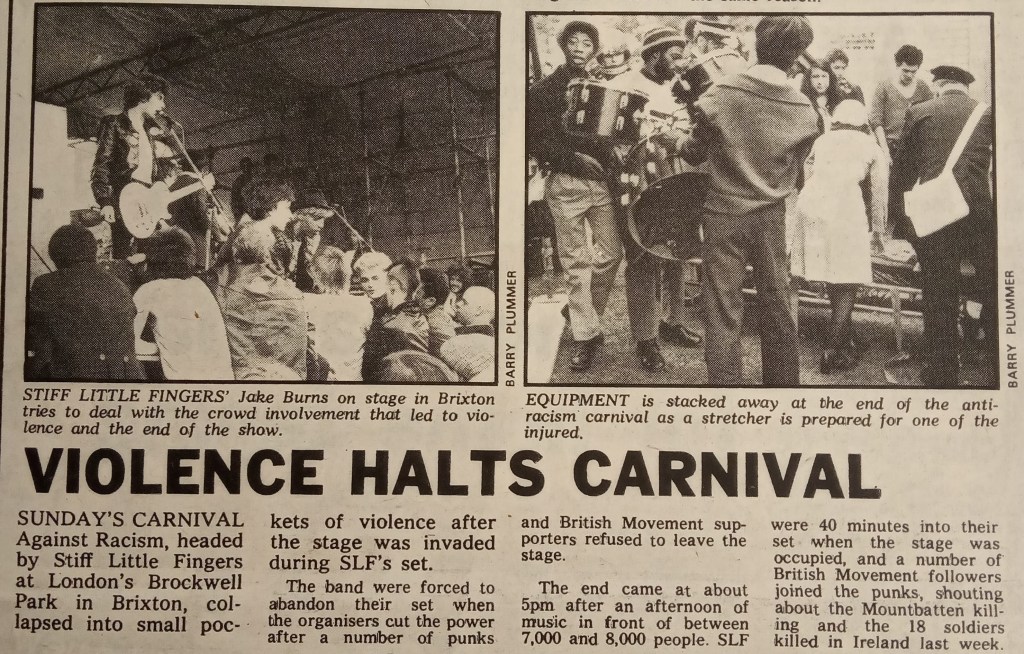
The SLP put a different spin on events, claiming that the gig was merely halted for half an hour before Misty in Roots (who weren’t even mentioned in the music press) played their headline spot.
1981-Rock For Jobs
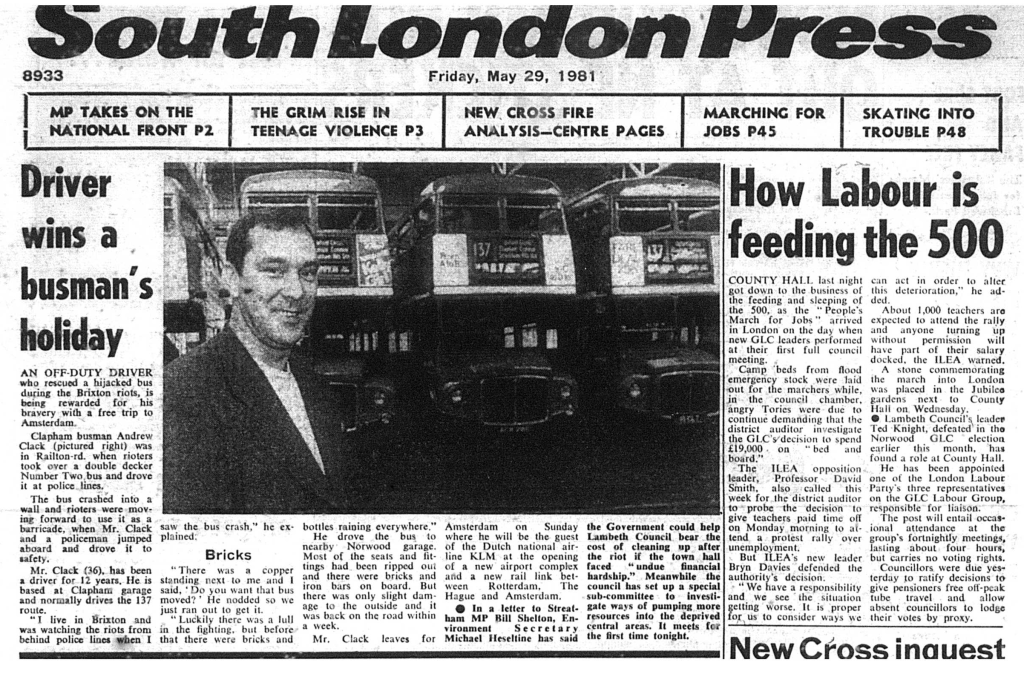
1981 was a pivotal moment in British politics and for Brixton in particular. The Thatcher government had been in power for two years and had wrought huge changes in society. Unemployment had ballooned from 1.5 million in 1979 to 2.5 million in 1981. In April Brixton had erupted into the well documented Brixton uprising in protest at police racism. Many other cities would follow suit during the summer.
Against this backdrop, The People’s March for Jobs was organised as a protest against the high level of unemployment.

In an echo of the Jarrow March of 1936, 280 marchers set off from Liverpool on a one month march to London to protest at the high levels of unemployment. Their numbers eventually swelled to 500 by the time the march reached London.
The march commenced on the 1st May 1981. Sporting the dark green colour of the Chartist movement, the marchers averaged 12 miles a day, staying overnight with whoever would put them up. The march reached London at the end of May, culminating in the Rock for Jobs festival in Brockwell Park on the 30th May, followed on the 31st May by a rally in Trafalgar Square and finishing with a petition with 250,000 signatures on it being handed in to 10 Downing Street on the 1st June.
In scenes which would be unthinkable today, the Greater London Council (GLC) provided bed and board for the marchers and GLC staff and teachers were offered paid time off to attend a rally. The offer was swiftly rescinded after opposition Tories demanded that the district auditor investigate. A stone commemorating the march was also laid in the Jubilee Gardens next to County Hall.
Starting proceedings on the main stage was poet Martin Bessermen, a regular at Poets Corner and future comedy club promoter. Sounds magazine said that he had been involved in several dubious publicity stunts which almost led to him getting arrested at 10 Downing Street.
Next up was all female group Tour de Force.

Their set was well received by the music press. Guitarist Deidre Cartwright would go on to receive national attention as one of the presenters on the BBC Two series Rock School.
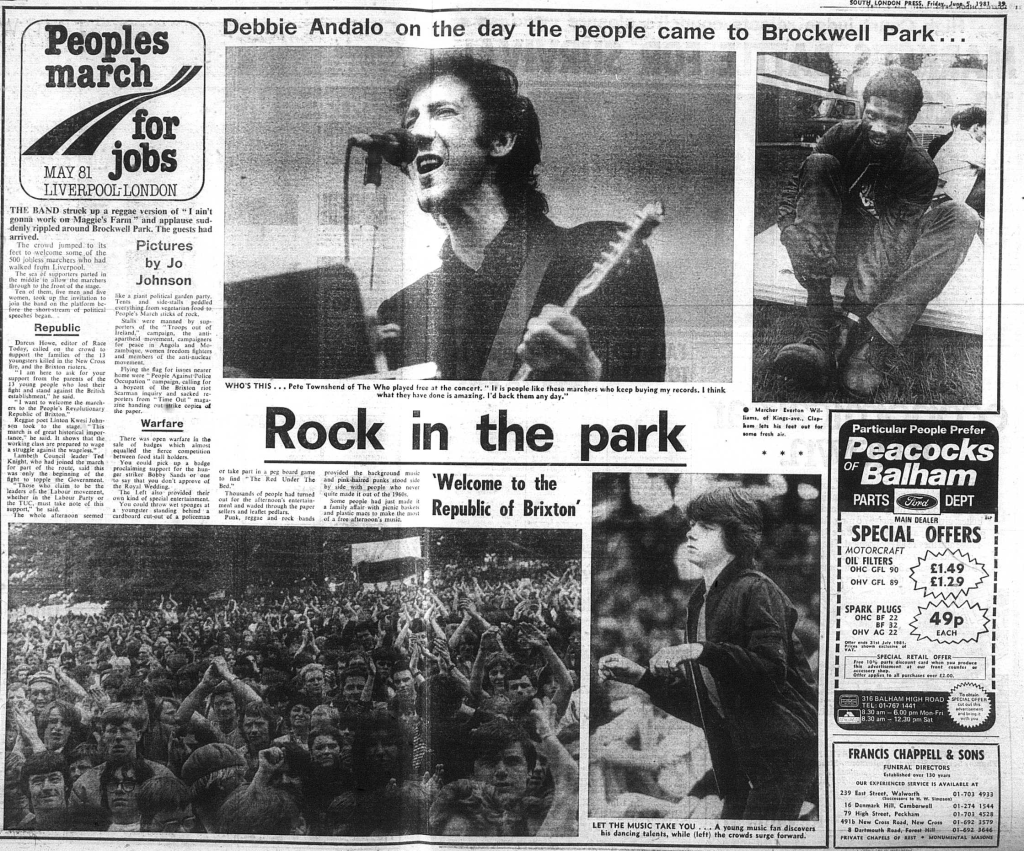
As the Barry Ford Band struck up their reggae version of Bob Dylan’s “I ain’t going to work on Maggie’s farm no more” (with Tom Robinson on backing vocals), the jobless marchers entered the park as revellers punched the air. In the words of the Melody Maker “Nothing else came near that moment”.
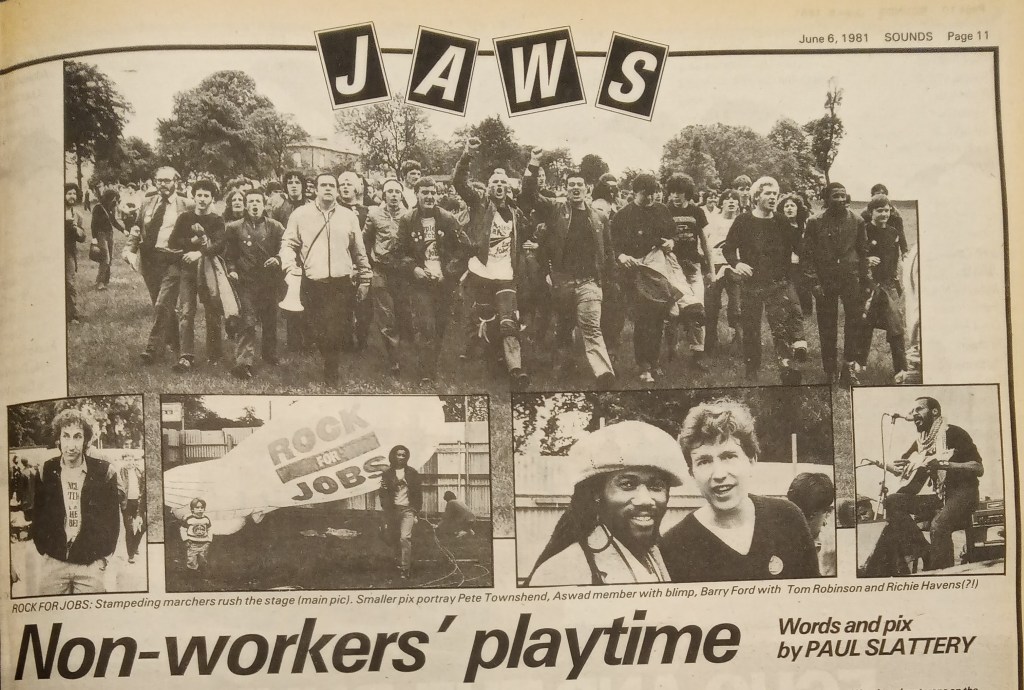
Speeches followed the well received set by Barry Ford. Leader of Lambeth council Ted Knight spoke as did Darcus Howe who welcomed people to “The People’s Revolutionary Republic of Brixton”. Linton Kwesi Johnson recited his poem “All Wi Doin Is Defendin”.
A special mention has to go to The Quads, who had marched every day (and played every evening) of the march. All the music press were united in their praise for them, with the NME giving over space to interview them.
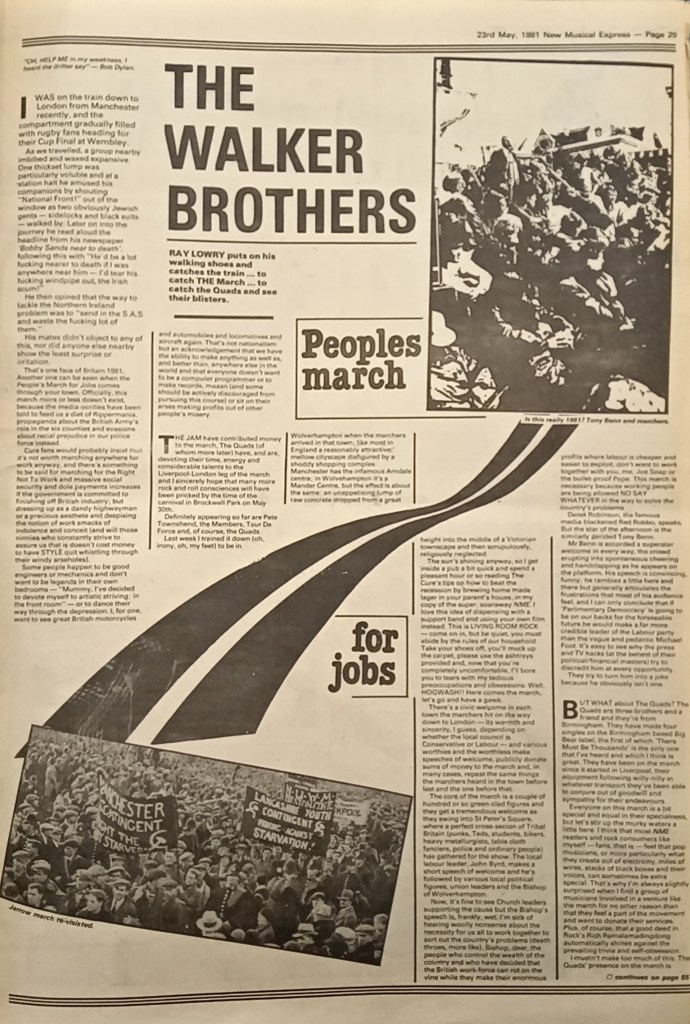
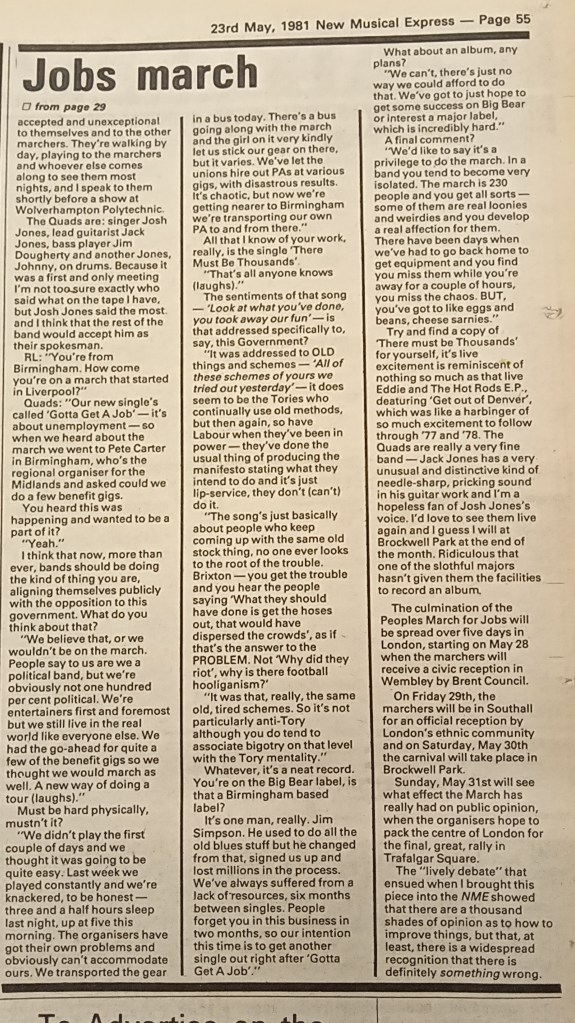
The Quads’ new single was aptly titled “Gotta get a job”. Lead singer Josh Jones would go on to become a vicar. You can read more about him and his time with the Quads here.
The Members were up next, augmented by a new horn section. “The sound of the suburbs never sounded so good” proclaimed Sounds.
The mainstream music press didn’t give much coverage to what was happening away from the main stage. All we can glean from them is that the jazz stage featured Dick Hekstall Smith. George Melly was a no show on the day.
The organisers promised surprise guests on the day. Led Zeppelin’s Jimmy Page was rumoured to be appearing but was a no show. The Melody Maker claimed “So many bands offered their services that the organisers had to turn them away. Springsteen came to check it out, and would have played had everything not been running late.”
Now there’s a thought-Bruce Springsteen playing for free in Brockwell Park! Springsteen was in town for a six date residency at Wembley arena at the time, so it is entirely possible he could have been lined up. A spokeswoman for the march told the NME the week before the march “There’ll be a number of surprise guests, including some who have London concerts over the weekend and therefore don’t want their names mentioned in advance.” Looking at the gig listings for that weekend, the only other band of any stature who was playing that weekend was Squeeze.
Killing Joke were due to perform but pulled out citing “internal politics between the TUC, One Parent Families and other organisers of the event”, adding that they would have liked to play at the event “but it is completely out of our hands”. The TUC put a rather different spin on matters, claiming that Killing Joke had been removed from the bill for criticising the march.
One surprise guest who did turn up was Richie Havens, veteran of the Woodstock festival. Havens was in town playing a week long residency at Ronnie Scott’s club. He was the first act to receive an encore on the day. Sounds magazine described him as “truly a masterful performer”.

After the Year Zero of punk, music journalists were decidedly sniffy about anything with a whiff of hippy about it. So ex Traffic member Jim Capaldi was always going to get a rough ride from the press. The NME savaged him: “Jim (“I’m living in Brazil now, man”) Capaldi….made the kind of relentless, self-promoting noise that everyone got tired of ten years ago. And he should have stayed in Brazil.” Sounds magazine was somewhat kinder; “The funky set by Jim Capaldi got some movement going in the crowd and seemed to take the crowd’s mind off the light drizzle that was starting to fall.”
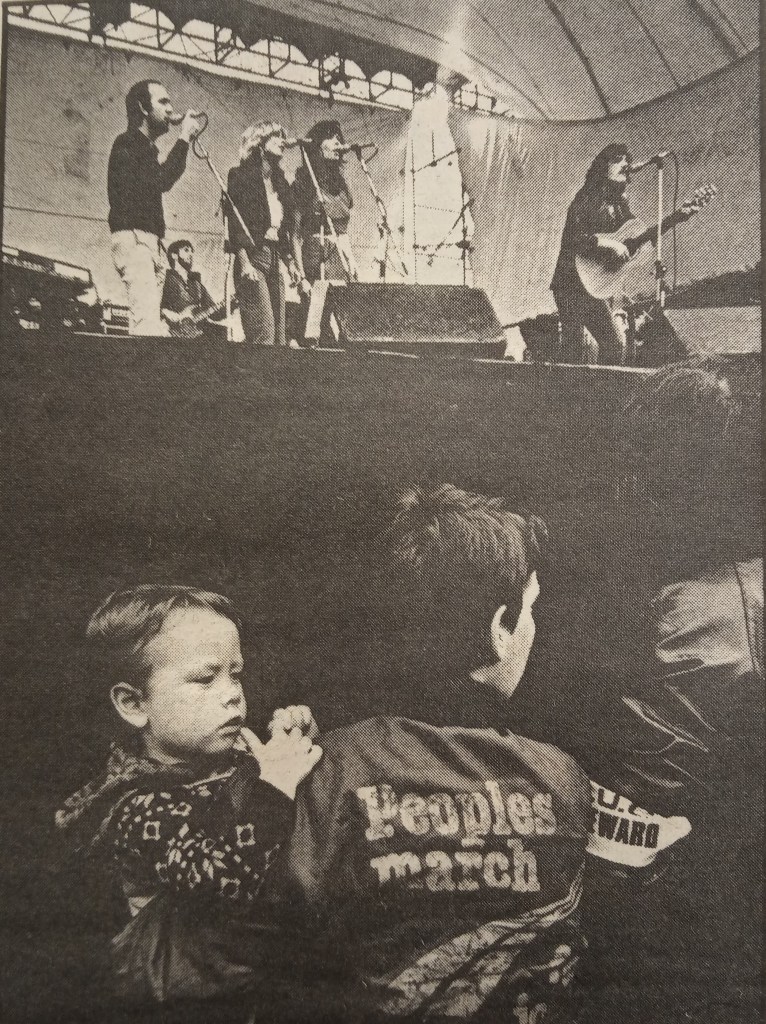
Topping the bill was Pete Townshend of the Who, backed by a band that include Mark Brzezicki and Tony Butler, who would soon find fame as the rhythm section of Big Country. In fact the gig would be pivotal to the formation of Big Country. Big Country’s manager, Ian Grant, also managed The Members, who were playing on the bill. Grant used the occasion to approach Brzezicki and Butler and encourage them to join the fledgling Big Country. Chart success beckoned.
Brzezicki has posted some nice photos of the gig here and here. Audio of the full gig can be found here:
Townshend wasn’t in the best shape and was seen swigging a bottle of brandy on stage.

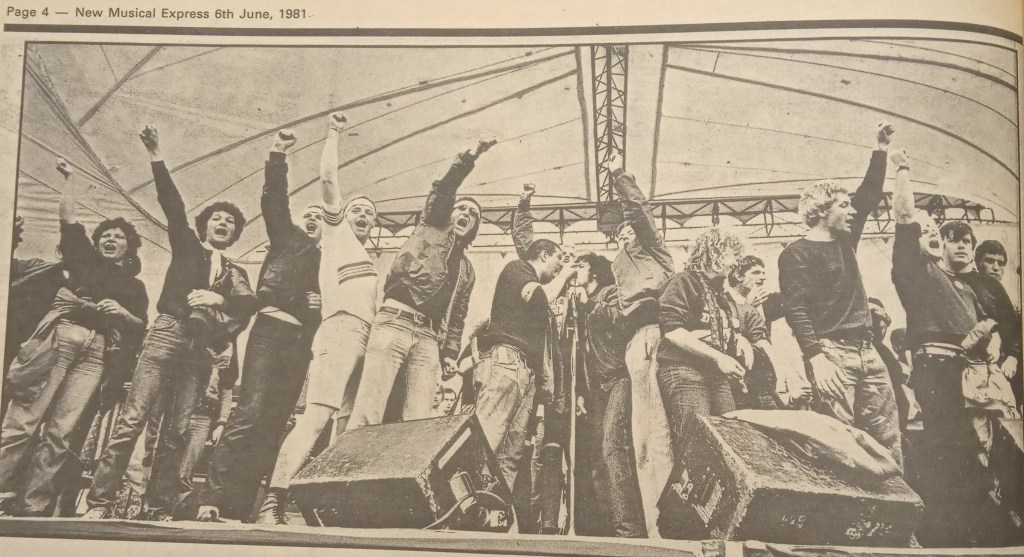
The crowd started to thin out after Towshend’s set finished, leaving Aswad to finish proceedings before going on to play a benefit at Lambeth Town Hall for the Brixton Defence Fund.
1982-Cultural Herb Festival
We would love to know more about this festival. We have this report from UK Rock Festivals which shows that Jah Shaka, Coxsone, King Sounds and the Dread Broadcasting Corporation played. The Ekome dance troop also appeared but their performance was cancelled after the stage collapsed.
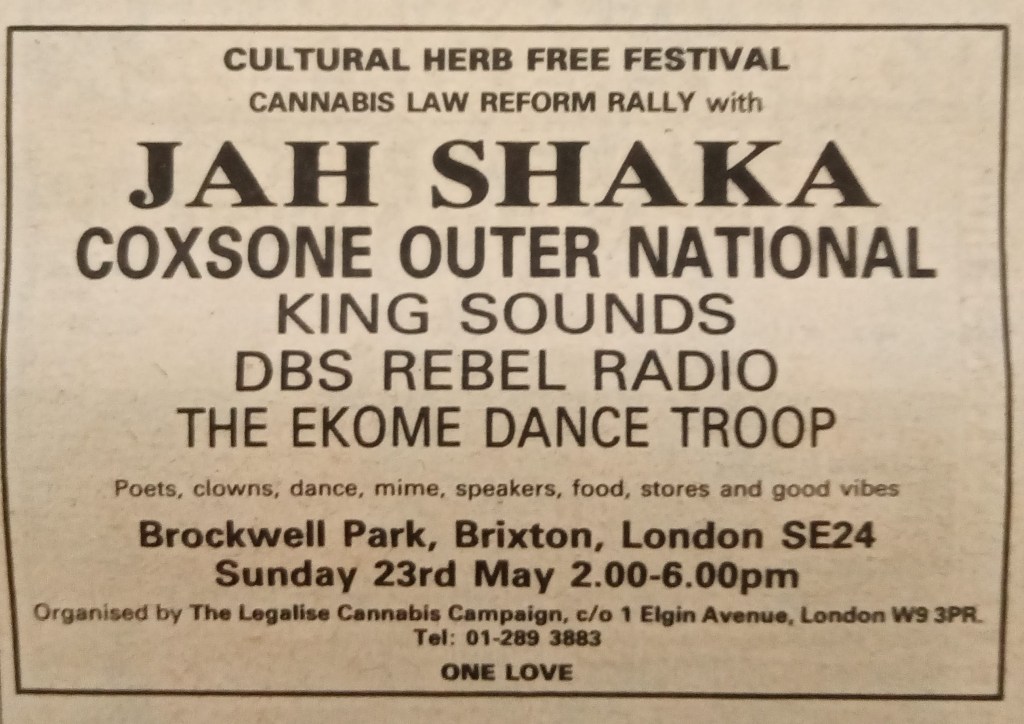
Also appearing were the Tibetan Ukranian Mountain Troupe, a bunch of merry pranksters who were stalwarts of the free party scene in the 80s. You can see some photos of them in Brockwell Park here.
The NME also stated that Linton Kwesi Johnson would be appearing, although it was confirmed a week later that he wouldn’t appear.
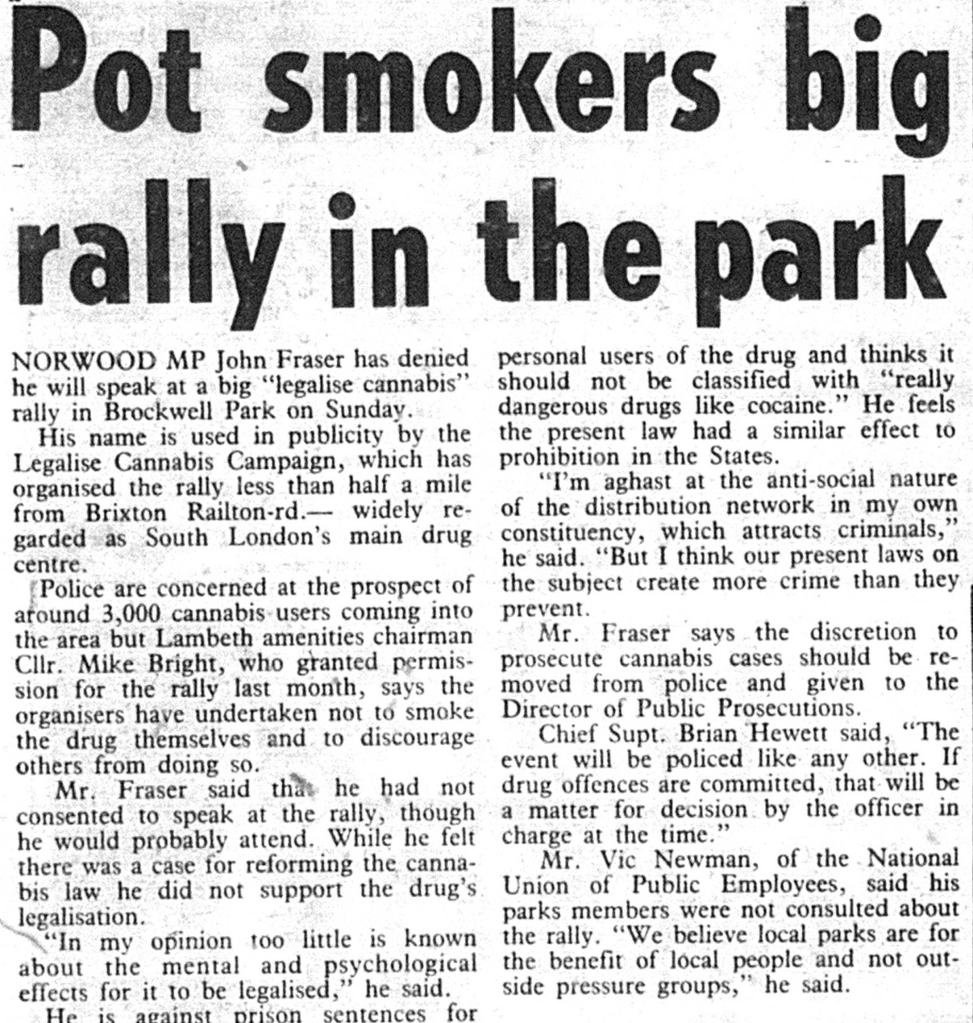
The South London Press at the time reported that the police were concerned that 3,000 people would be attending. Lambeth councillor Mike Bright tried to reassure the police by telling them that the organisers had undertaken not to smoke and that they would discourage others from doing so. So that’s alright then…..
Local MP John Fraser denied that he would be speaking at the event, as the organisers had publicised, but did admit that he would probably attend the event. Whilst not in favour of legalisation he did feel that there was need for reform: “I think our present laws on the subject create more crime than they prevent.”
1982-Reggae Festival of Arts and Culture
Not much to go on with this event, other than a brief mention in Black Echoes magazine.
Promoted by Cosmic Ray, the event was held at the end of August and promised live bands Sons of Man in Roots, Sensational Salem and The Lanzel Dancers. Sound systems included Stereograph and Kenny. This sound system page has a set from Sterograph at Brockwell Park in 1982 but we are unsure if this is from the same event.
1983-Festival For Peace
It is ironic that an event which was supposed to be about peace has been chiefly remembered due to its violence.
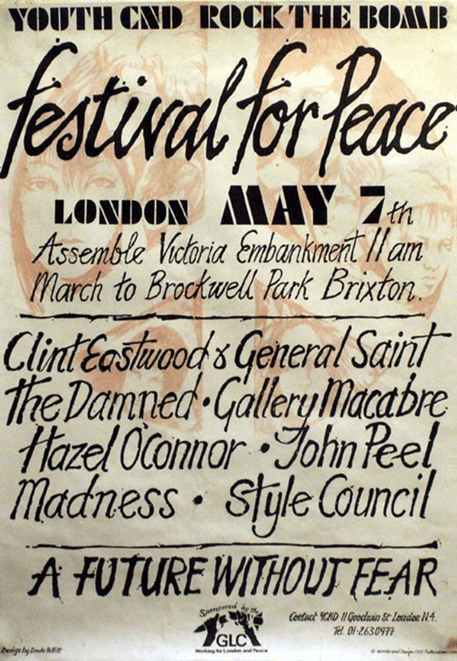
The Record Mirror summed up the situation best: “You’d never have guessed that this was a (CND) peace festival. Everyone seemed more intent on warring with their neighbour at every opportunity. The trouble started when the 25,000 plus crowd arrived to find that doyens of punk The Damned had been and gone. The spiky headed, leather jacketed hordes were clearly disgruntled. Their first action was to dismantle the barriers between them and the stage during Hazel O’Connor’s set. Missiles were thrown, along with mud, cans and bottles.”
Sounds was even more vituperative: “OK. Let’s be objective and hand it in large to a small minority of this afternoon’s audience – fucking shit brains…An emotional response to the slug-ugly antics perpetrated by various BM/NF skins and super-glued-maggot-minded punks would be: Round them up, shop them to the Falklands with permanently piped Meatloaf music for maximum suffering, then nuke the bastards”.
You can find further reminiscences, photos and flyers on the ukrockfestivals website.
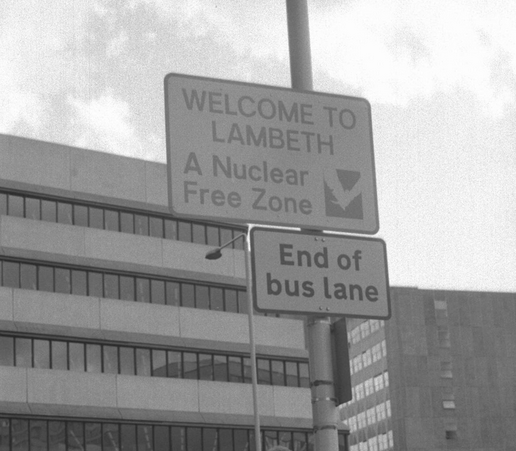
The GLC provided funding of £21,000 for the event. However, the South London Press reported that Lambeth Council, despite declaring itself a “Nuclear Free Zone” (remember that?) earlier in the year, had washed its hands of the event and decided that it no longer supported the aims and activities of the Campaign for Nuclear Disarmament.
The event was initially billed in the February 5th edition of Black Echoes magazine as a benefit gig that was hoping to raise £20,000 for CND. Acts promised (who never made the final bill) included The Clash, Fun Boy Three, Linton Kwesi Johnson and Musical Youth. Somewhere along the line the benefit element got dropped.
A few other artists were due to appear on the day: Tracey, The Questions and Vaughan Toulouse, were all on Paul Weller’s Respond record label. They appeared in the music press listings for the event but didn’t perform on the day.
It is ironic that probably one of the most politically switched on bands on the bill, The Damned, should have attracted the most intolerant followers. The Damned gave their reasons for playing at the event in this TV interview, which also gives a fairly good view of how rowdy the event got:
According to this forum The Damned offered to play a second set to placate the fans but the organisers would not let them.
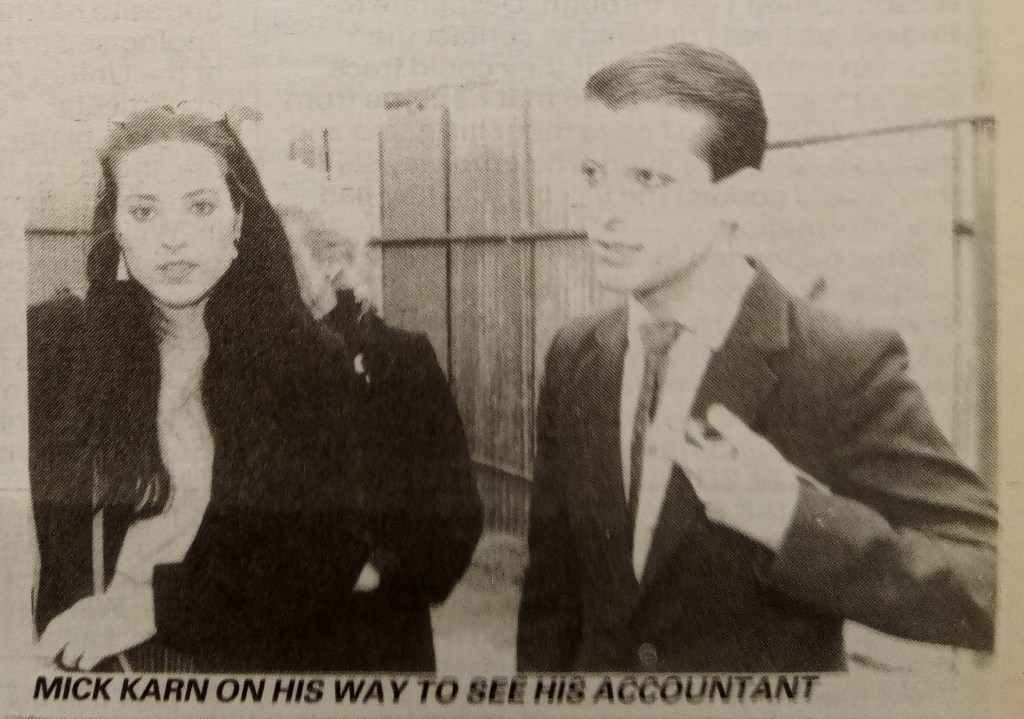
Hazel O’Connor was always going to find it hard following on from The Damned. The NME reported on her set: “The words-and also the tunes-of her dramatic set were obscured by an iffy sound system, and continual interruption from a selection of missiles, which…irritated Hazel sufficiently for her to punctuate each number with long-suffering requests for a cease-fire. It was never achieved.” Her chances can’t have been improved by the appearance of a besuited Mick Karn on saxophone, which would have been a red-rag to the assembled punk hordes.
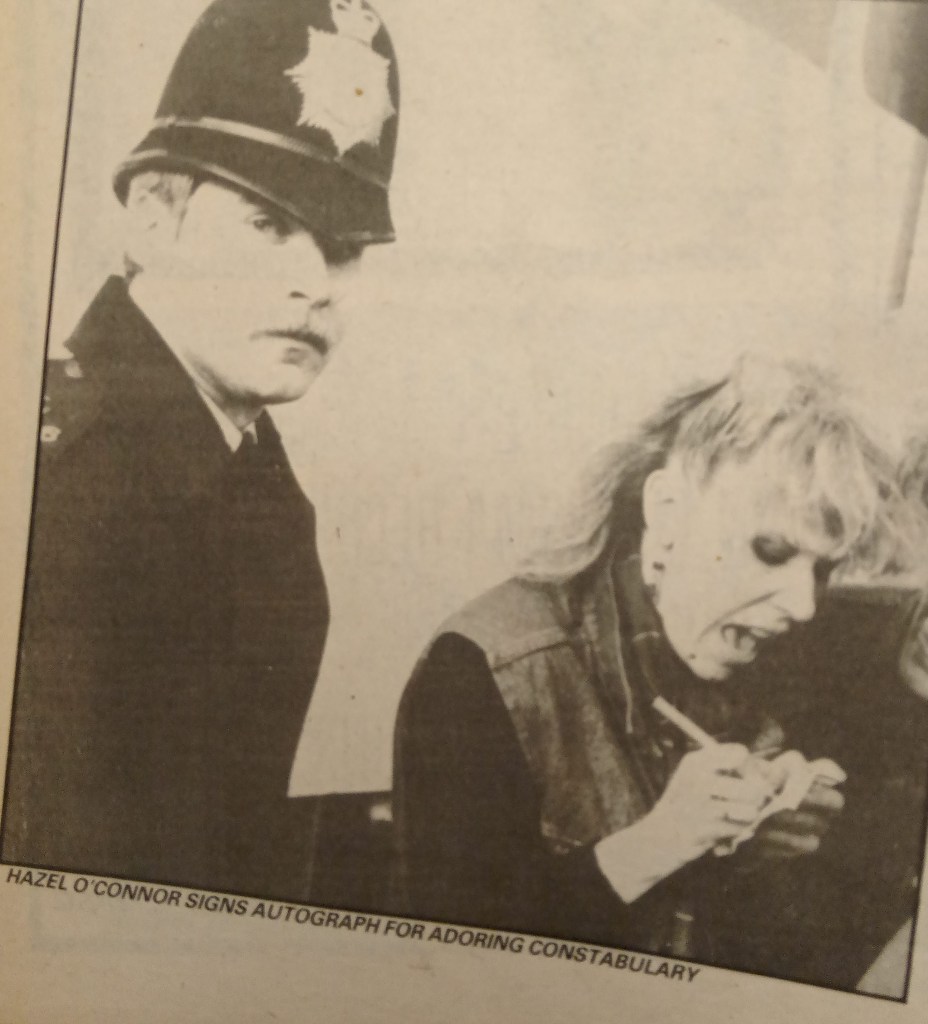
The police were brought in, after Hazel O’Connor had “beaten a hasty, but noble retreat”, to try to restore order.
Clint Eastwood and General Saint (with a young Courtney Pine on saxophone) received good reviews. They “bounded on stage for a sparkling set” according to the SLP.
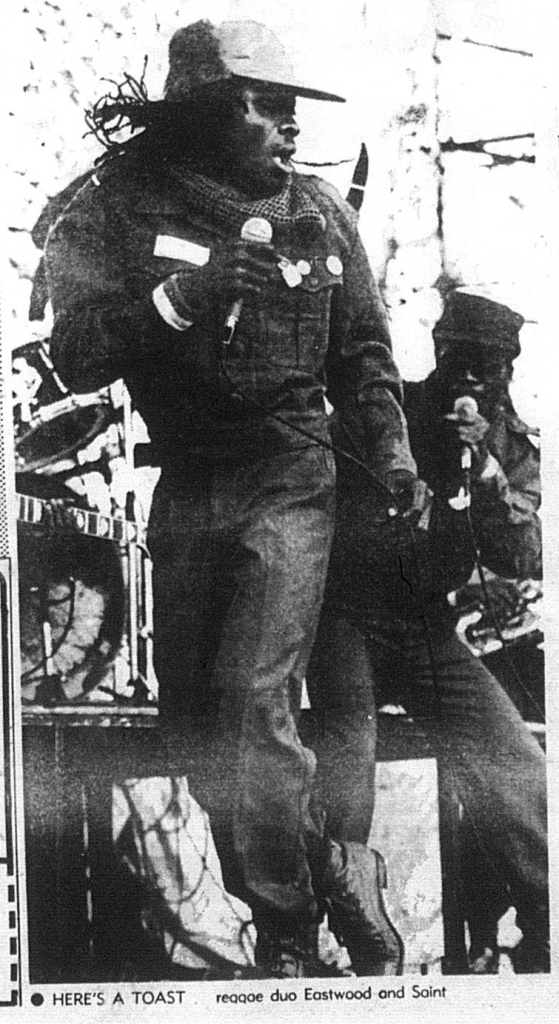
The Record Mirror hinted at the problem with the crowd: “While the idiots waved their flags at reggae duo Clint Eastwood And General, the pair took the day by the scruff of the neck and fired the crowd into showing some enthusiasm”. Sounds made explicit the problem with the audience: “a loathsome bunch of Nazis are winging abuse at the two baad DJs”.
You can listen to how the duo got the audience onside from 16:30 of this interview with General Saint:
The newly formed Style Council were always going to be in for a rough ride. Many people had not forgiven Paul Weller for splitting up the Jam just six months beforehand. This was only the Style Council’s second gig, the first gig being just the week before, when the group performed just four songs to a backing tape. Their Brockwell Park appearance lasted only two songs, “Speak like a child” and “Money go round” (captured on film here, interspersed with footage from the march and brief performances from Hazel O’Connor and Clint Eastwood and General Saint):
The Melody Maker described the scene: “Suddenly, as grim faced as everyone assumes he is and sucking a fag as if it might be his last, Weller strode by surrounded security men and briskly climbed the steep walkway to the stage. The mutterings were that the Style Council had been prepared to play five numbers in conjunction with Tracie and the Questions, but the disorganisation had worried Weller into cutting short his set” (apparently the band had been besieged by a mob whilst trying to get to the gig) “it took one mud missile that threatened to disturb Weller’s increasingly preposterous coiffure for the Council to reach an immediate, unanimous decision. They got the hell out-straight down the ramp, into the waiting van and gone.”
Worse was to come for the women from the Greenham Common Peace camp, who followed the Style Council. The SLP reported that “their brief appearance was greeted with a hail of bottles and they left the stage in bewilderment and tears.” The Melody Maker continued: “Hester had arrived in Brockwell Park, South London, around midday with several sisters from the Greenham Common Peace Movement, to lend moral, vocal and numerical support to Saturday’s CND rally. She..expected, indeed had been invited by the organisers, to address the assembled crowd…Right now, though, none of this seemed quite such a good idea. “We’ve had to fight to get on this stage” she bellowed at the crowd. This, in truth, was a considerable understatement. During the day, the various pop personalities largely responsible for drawing the 10,000 crowd had themselves, struggled to entertain the restless throng and the organisers, in their panicked wisdom, had decided that speakers, irrespective of stature or sway, would be better off lending silent support. The sisters were having none of this. They’d been invited to speak and speak they were going to…The crowd, singularly unimpressed with such sanity, showered them with mud.”
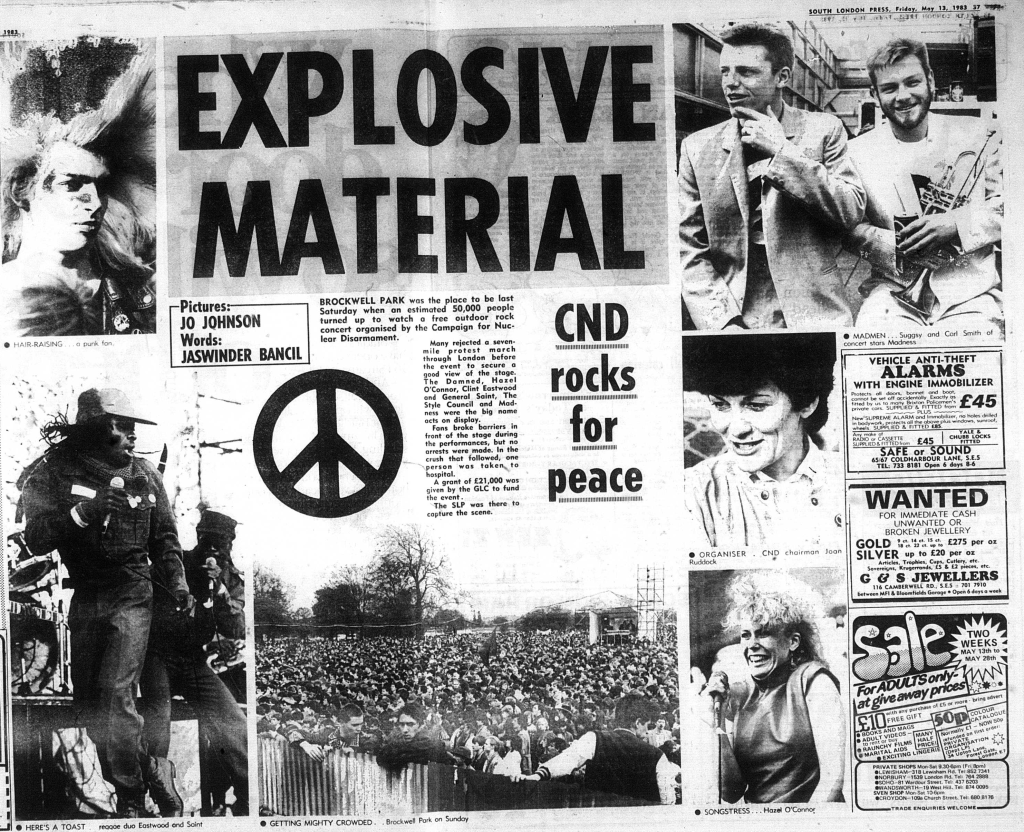
It seems no one was spared the missiles. Everyone’s favourite alternative DJ, John Peel, was compering on the day. He was hit by a beer can and refused to go on.
Other comperes on the day were humourist Neil Innes and actor David Rappaport, who was captured on film on the day (having a pee!) and berating the British Movement element of the crowd prior to Madness’ encore.
It was left to Madness to save the day. The Melody Maker reported “Then Madness took the stage, the crowd and the event. Trust them to save the day. No messing, no message, no patronisation, just two hundred CND tee-shirts tossed into the crowd and straight into “House of Fun”….Whoever doubts the greatness of Madness should have been there to feel their infectious humour spread…should have seen the Maddies take their pelting graciously, giving back as good as they got”. The whole performance has been captured on tape here:
Their encore is also captured on film:
The festival was followed by an after show at the Brixton Ace, featuring Roman Holiday, the Marine Girls and Amazulu.
1983-Reggae Festival of Arts and Culture
As the 1982 festival, this was again promoted by Cosmic Ray as a festival of arts and culture on the August Bank Holiday weekend. Bands include The Ramblers, Brixton Underworld Band, The Leopards, Cynthia Williams, Muphys Law Disco Dancers, The Osisi-Iku African dancers and Markus Jahn again.
Sound systems on the day were Stereograph and Saxon International.
1984-Legalise Cannabis/Sensimilla Rally
A one page listing in City Limits stated that this event would include bands but gave no details and stated “This is all that we have, man”. So nit sure if this happened or not.
1984-Lambeth Country Show
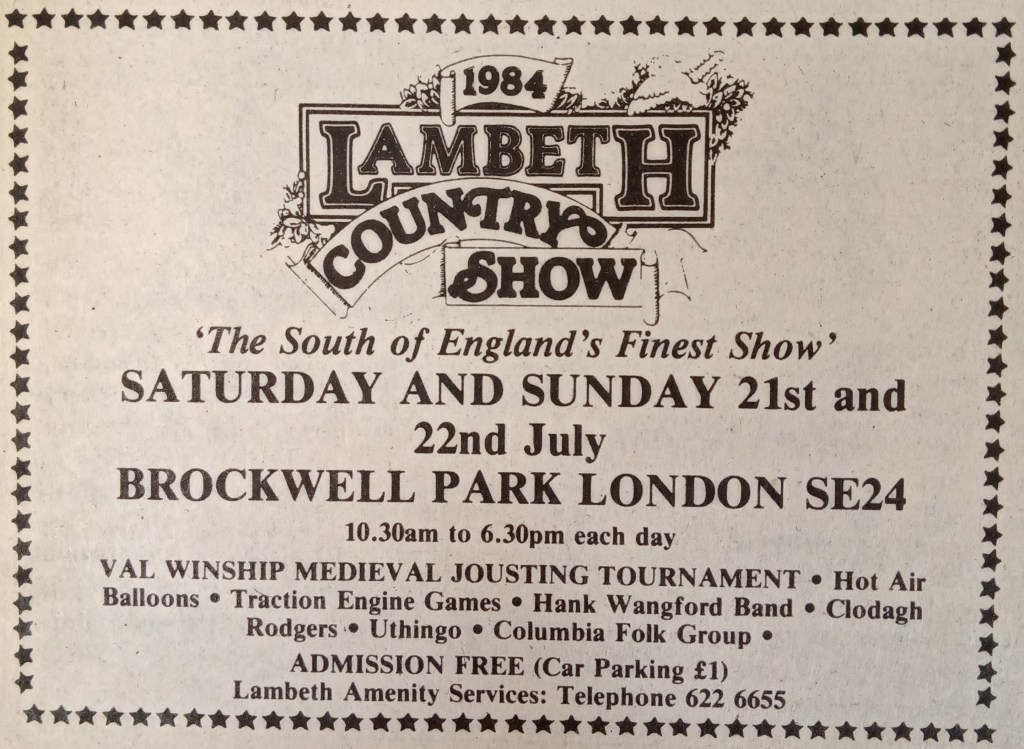
Just to show readers how different the Lambeth Country show looked back in the 80s, here is an advert from the time, featuring…Clodagh Rogers:
1984-Festival of Reggae Music
Held on the 29th July, this free event included live performances from Aquizim, Mad Professor, The Graffiti Band, Seany T and Freddie Notes as well as a performance from The Lanzel Dancers. MC on the day was Jah Derrick. Sound systems playing were Hawkeye International and Jah Revelation. There was also a small carnival for kids, with arts and crafts, clowns, jugglers and stilt walkers.
1984-Save The GLC
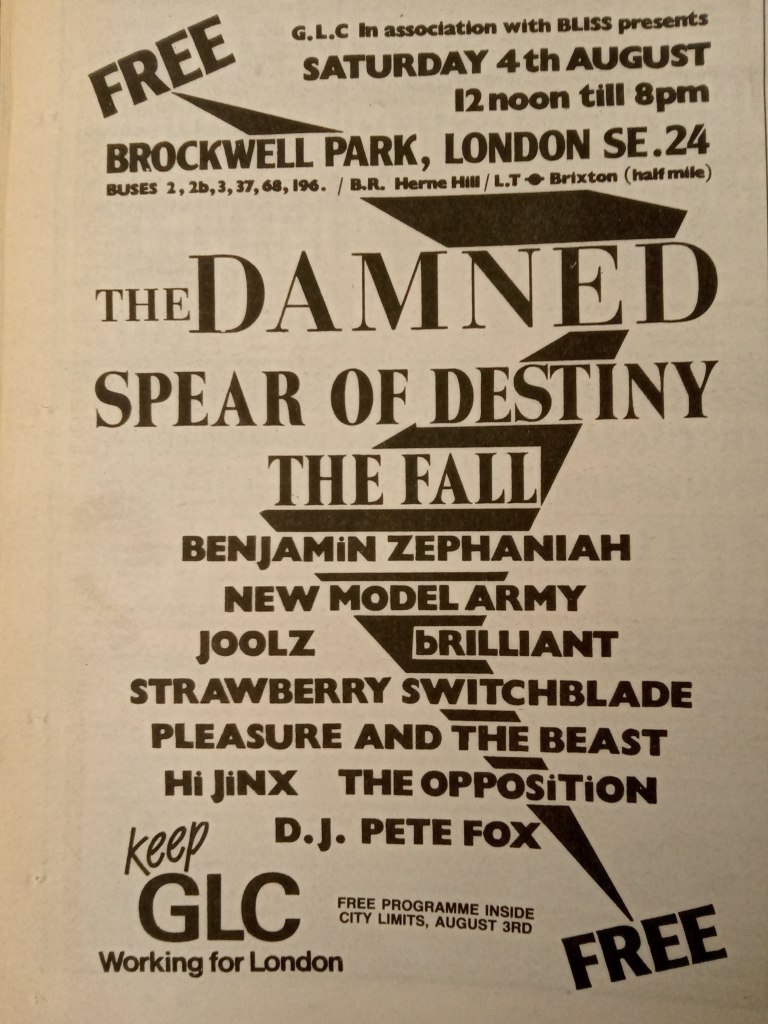
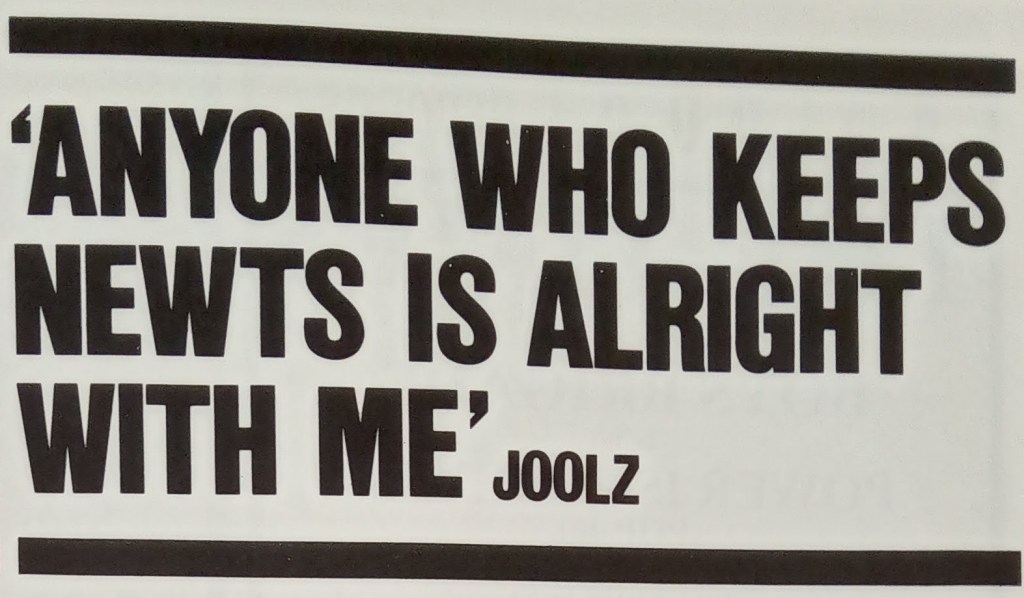
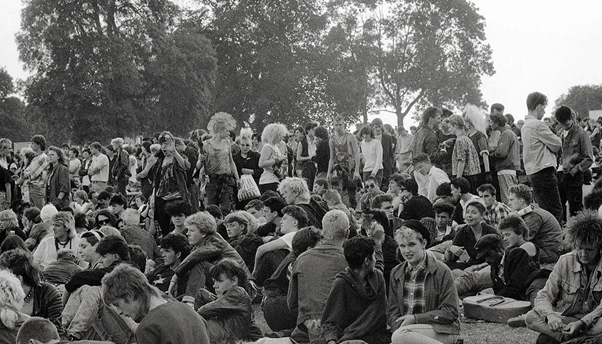
The violence of the previous year’s CND festival hadn’t been forgotten by the time the Save the GLC festival came round. A perennial thorn in the side of the Thatcher government, the GLC was fighting for its survival (and would ultimately be abolished in 1986).
Sounds labelled the event as “The second annual Bottle and Beer Can throwing competition…The GLC had thoughtfully arranged for some musical accompaniment for today’s match, which also provided competitors with some necessary moving targets.”
The South London Press reported that there were no serious incidents but that 18 people had been arrested for offences including criminal damage, threatening behaviour and possessing drugs.
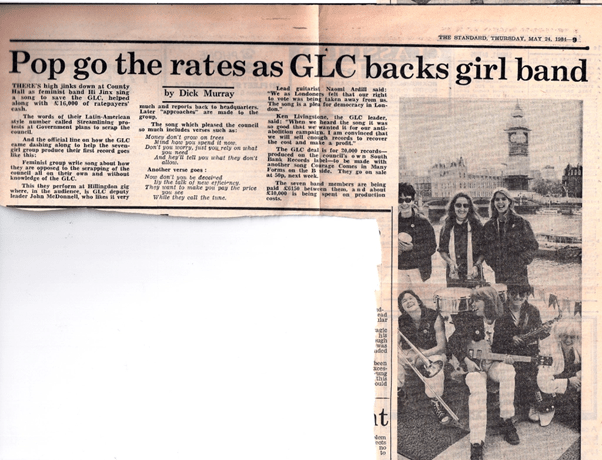
Sounds was the only music weekly to review any of the bands lower down the bill, which featured The Opposition (“I’m told they were very good…Just my luck, then, to miss them”), Pleasure and The Beast (“the man is still a prat. He has a Meatloaf-type relationship (on-stage anyway) with LA Richards, the singing blonde, which is rather putrid to watch…he was crawling all over her, and much to my disappointment she didn’t beat him senseless with her mike-stand but actually encouraged him”) and Hi Jinx (“Whoever put Hi Jinx on the bill did the all-girl band a serious dis-service. Nobody really wanted to hear their self-conscious blend of calypso and socialism”).
The Hi Jinx had no doubt been put on the bill as their song “The Streamlining Song” (which protested at the abolition of the GLC), had so impressed the upper echelons of the GLC that they had paid the band £16,000 to press up 20,000 copies of the single, which was then released on the GLC’s newly formed record label, Southbank records. Cue howls of outrage from the Evening Standard:
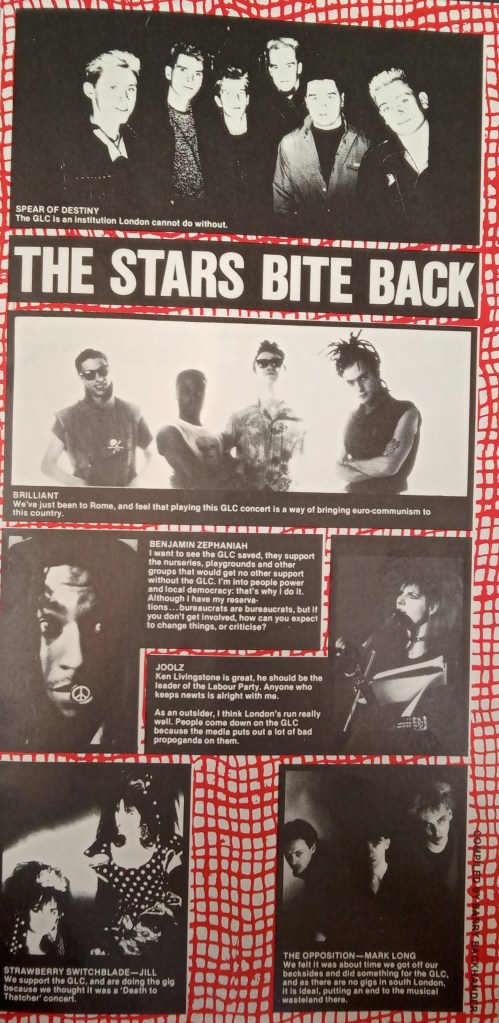
Brilliant, the new band of one time Killing Joke bassist Youth, were very different to his previous band. Their electro pop wouldn’t have gone down well with the mass of fans there to see The Damned. The fact that they were quite low on the bill spared them, as Sounds put it: “at least it was the safe half of the afternoon-the first division bottle tossers were still in the pub. The worst they had to contend with was the shouts of ‘Get on with it you long-haired bastard’.”
No such mercy was shown to the poet Joolz, who was more than capable of holding her own. Sounds reported “I’ve long admired Joolz and my opinion of her rocketed after her Performance Under Fire. Before she had even begun, the first flat green missile clunked at her feet and she snapped into action. “I tell you this, wanker, and I tell you this now” she bellowed at the perpetrator “if you’re such a coward you have to hide in a crowd and chuck cans, you ain’t no man”. An enormous roar of applause went up at this, the hail of beer cans slowed to an uncertain trickle and the moron quotient contented itself with trying to shout her down. Fat chance”.

New Model Army received rave reviews. “The undoubted highlight of the sun-kissed afternoon was the blistering performance of this year’s New Model Army. The metamorphosis in this band’s progress, from just another name on a million leather jackets, to their current position of great white hopes has been little short of remarkable.” Raved the Melody Maker. You can see their performance here:
Next up was The Fall. Their performance is captured here:
The Fall were darlings of the music press, who seemed incapable of ever having a negative word to say about the group, despite lead singer’s Mark E Smith curmudgeonly opinions. Asked about his attitude to the GLC benefit he is quoted as saying “People always presume what our politics are, which is why we’ve always been kicked off a lot of benefits. You get these GLC types arguing among themselves, debating whether we’re fascists or socialists. We did the GLC benefit just for the money – we needed it.”
It is telling that every act on the bill provided a quote in support of the GLC, bar one-The Fall.
Melody Maker summed their performance up thus:
“The other bitter men down from t’North for the day were Mister Mark Smith and The Fall. It was still dry when they took to the stage around four o’clock, a situation which was soon to change, courtesy of a hail of half-empty beer tins, a sprinkling of cider, and, believe it or not, some vintage gobbing. What is it about such a seemingly harmless bunch of individuals that provokes this incredibly bitter response?
Naturally enough, The Fall play on regardless, with Smith, dressed in his usual horrendous shirt and cords, crooning songs about such things as the price of a bottle of scotch. During the entire time he was on stage, he spoke to no one, acknowledged nothing, and seemed generally oblivious to the world outside. It has, of course, been said many times before, but this is truly the stuff of which legends are made”.
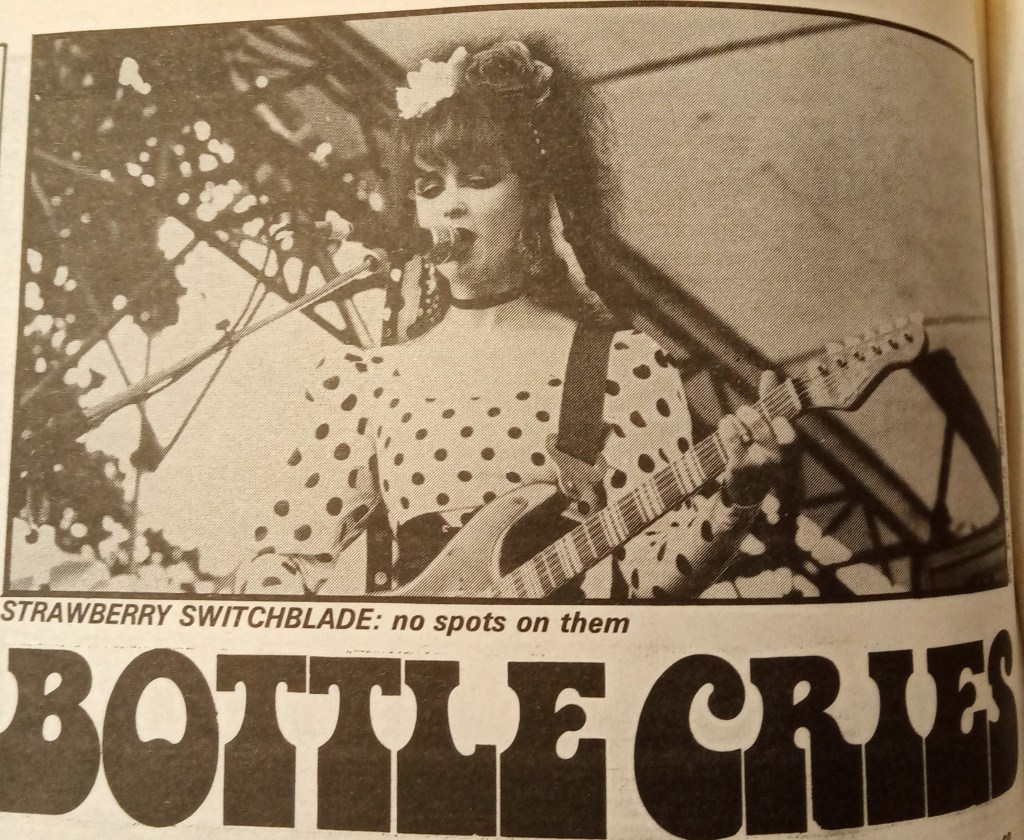
Strawberry Switchblade were always likely to be in for a rough ride from the audience given how out of sync their music was with the other bands at the top of the bill. “They way they dressed inspired the gonzoid faction to sexist chanting of the most monosyllabic variety, but unlike Joolz they didn’t have the thick skins to brush it off” reported Sounds “Initial sound problems, and the fact that the two girls aren’t the most accomplished of musicians…added to their ordeal….Today, I just felt truly sorry for them.”
Spear of Destiny’s set was recorded on the day:
Melody Maker captured the carnage when they hot the stage: “up went the PA, and the all blond Spear of Destiny bounced on stage to the strains of Match Of The Day. Unfortunately-that’s precisely what it turned out to be. The marksmen in the crowd, had, it seemed merely been limbering up all afternoon, and now they scored their first direct hit. Kirk got a can in the face, a cut eyebrow, and from then on, things got decidedly nasty.
Bodies that couldn’t take any more were thrown over the barrier to safety every few minutes.” The band got good reviews from the music press, as much for their stoicism in the face of the missiles as for the music.
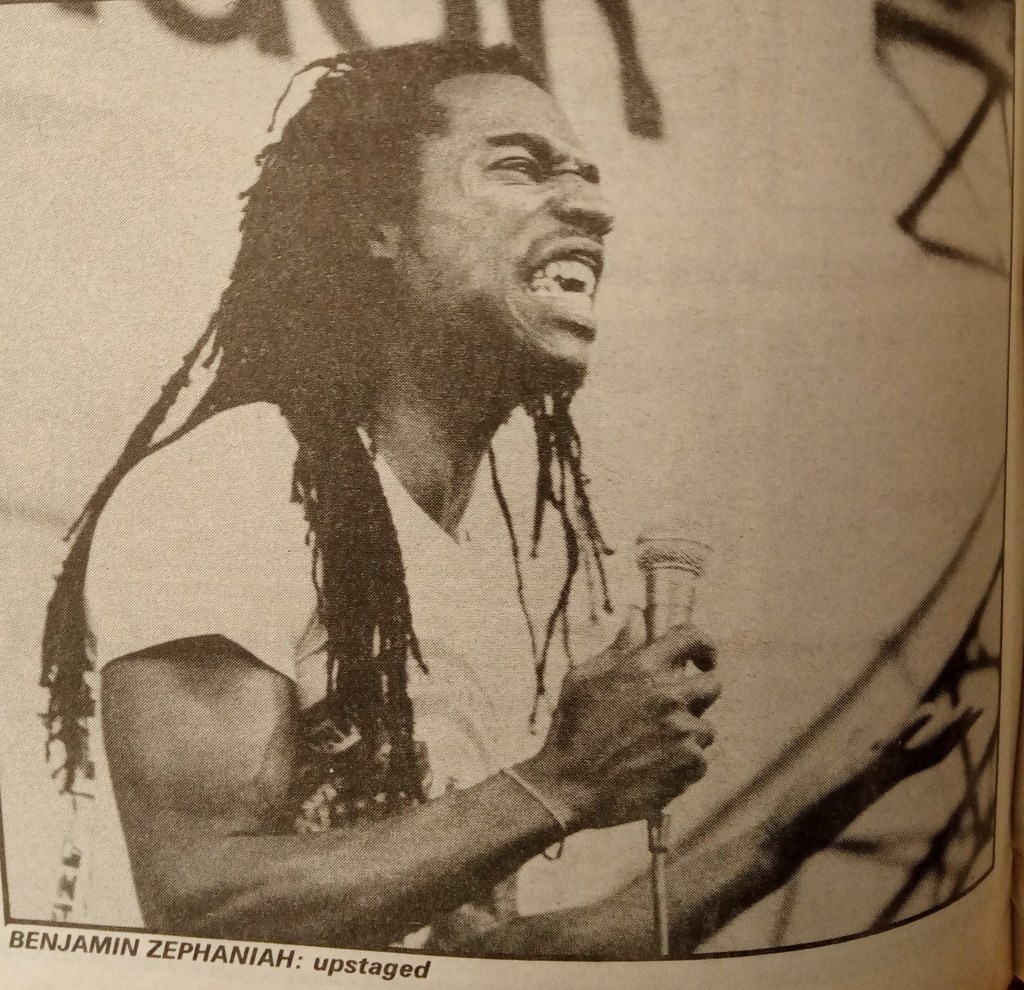
“With his cry of “Are you feelin’ militant” Benjamin Zephaniah pressed all the right buttons to get this crowd on his side” according to Sounds. “His poem about being beaten up by the police was right up their street…His stuff is biting without being cruel-he’s a grinner not a ranter”.
Having invoked the wrath of the fans who missed their set at the previous year’s CND festival as a result of the band being at the bottom of the bill, The Damned were elevated to headliners this year. The band were introduced onto the stage by the Doctor of Doctor and the Medics fame. The full set is captured in grainy footage here:
Within less than 15 minutes the band were having to plead with fans to calm down to stop people being crushed at the front
The gig was to be their last with Captain Sensible, who left the band shortly afterwards (did he jump or was he pushed?). If you ever want a reminder of how times have changed, just check out this politically incorrect article featuring the Captain in the Melody Maker:
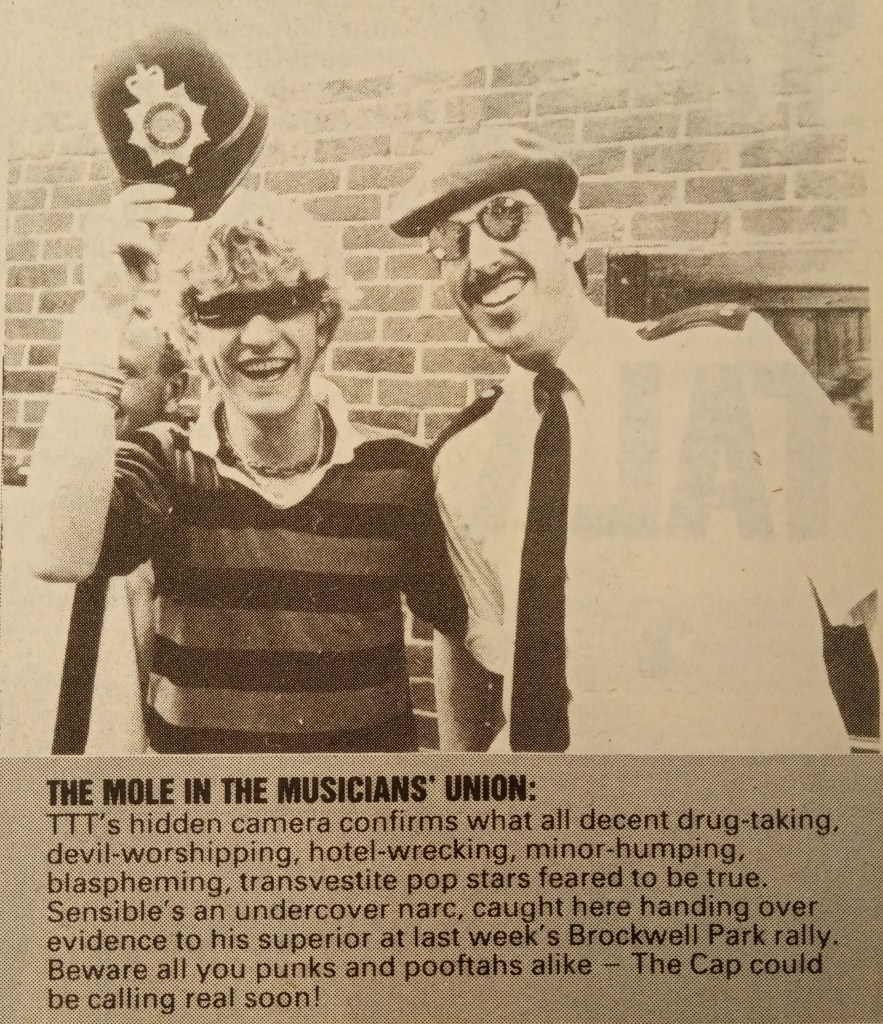
The music press were not impressed with The Damned. It was a long-held tradition of the music press that they were always on the look out for the next big thing. So a band that was eight years old was unlikely to impress them. The NME gave them a three sentence review: “The Damned plodded on. It pissed it down. I went home.” Sounds: “The best part of The Damned’s appearance was their manic intro by Clive of Dr And The Medics…But glass was shattering all around and I headed for cover. I radioed Frantically to Not David Coleman but he’d already gone home out of the rain. “Just say they were brilliant”, the boy on the bus told me later.”
Melody Maker were equally down on The Damned: “And then the rain came, just as The Damned were running on stage, giving everyone the truly memorable sight of Sensible in a very silly and increasingly wet pair of convict’s pyjamas. That The Damned have the nerve to appear in public seven years after they really should have packed their bags is strange enough, but weirder still is the obvious love and devotion which Rat and the chaps still command. Such heartwarming loyalty to the cause is tendered as a sentimental smokescreen for the band’s tragic descent into the realms of the bastard heavy metal.”
Watching the live footage we think the music press let snobbery get the better of them. The Damned played a fine set that day.
1986-Reggae Rock Concert
Held on the 27th July 1986.
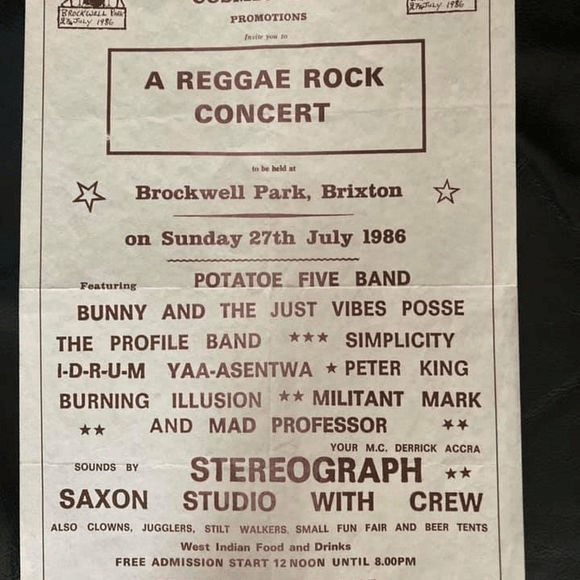
Sound tapes exist of Saxon and Dread Diamond playing on the day:
1988
Local band Harare Dread played on Sunday 14th August according to Echoes magazine. No more details on this yet.
1989-Reggae Jam
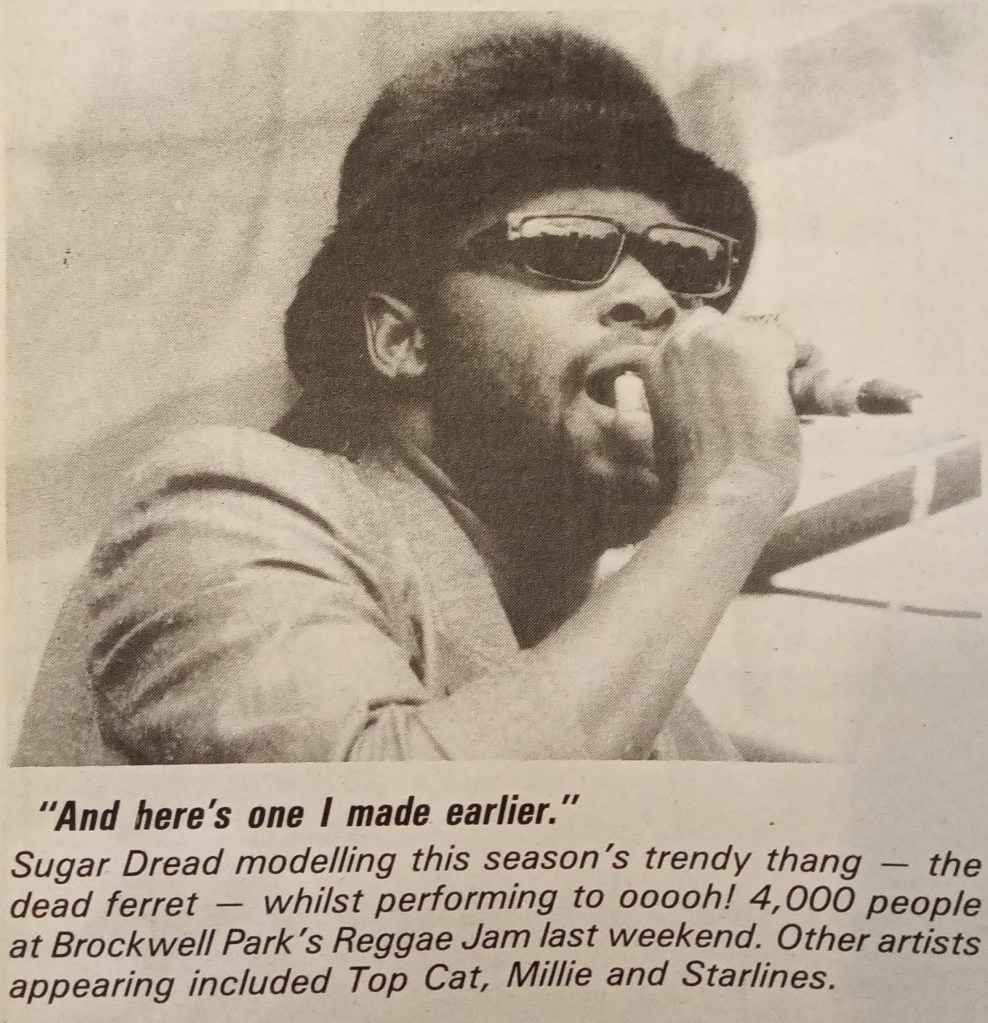
Held on the weekend of 19th August, the event attracted 4,000 punters according to Echoes magazine.
1990-Reggae Super Jam
Local band Harare Dread played on Sunday 12th August according to music weekly listings. No more details on this yet.
1991-Anti Apartheid Funday
A free concert featuring Ruby Turner, Well Oiled Sisters, Sir Lloyd Coxsone, Nasty Love and Sweetie Irie was held on Sunday 30th June.
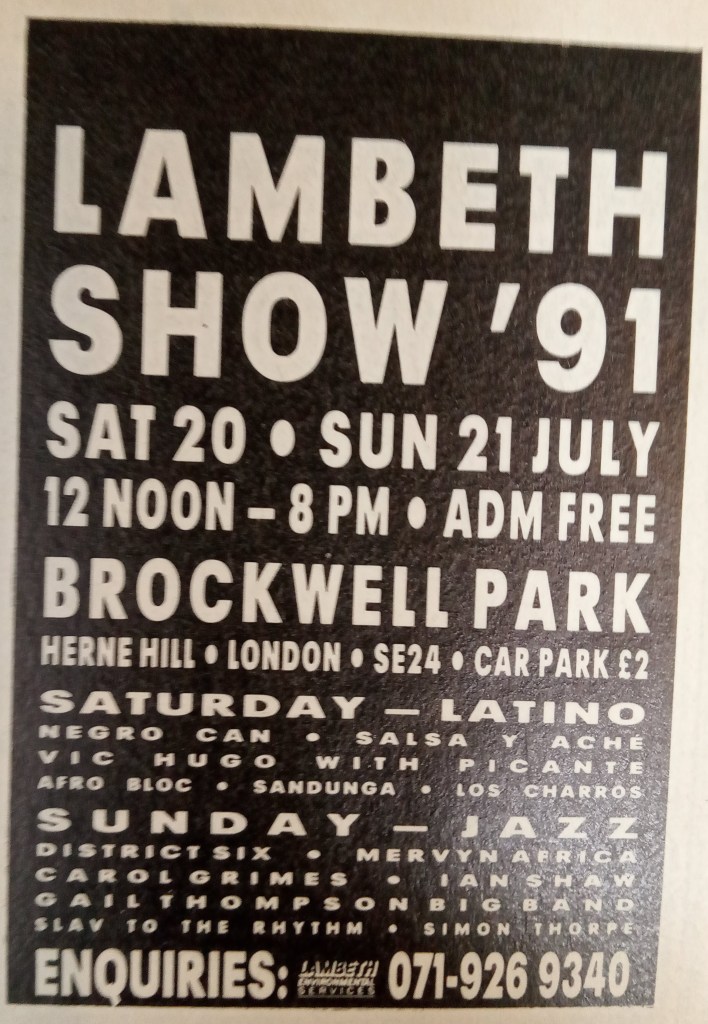
1991-Lambeth Country Show
A very different feel to current Country Shows.
1991-Reggae Super Jam
11th August-Reggae DJs, PAs, a carnival for children and live music from Zimbabwean reggae band Harare Dread.
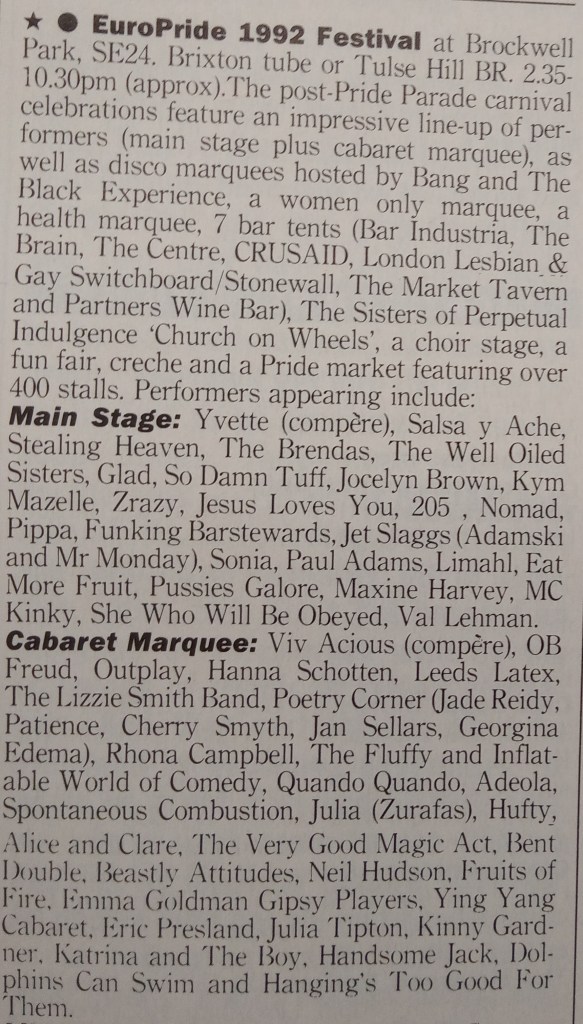
1992-Euro Pride
Held on 27th June. We have lots more research to do on this but are just putting down this listing as a starter:
1992-Rap Against Racism
The Anti Racist Alliance Rap Against Racism was held on the 1st August.

1994-Carnival Against the Nazis
The early 90s saw an alarming increase in far right groups and racist attacks in the UK. The racist murder of Stephen Lawrence in 1993 had shocked the nation. Further bad news arrived later in the year when far right political party the BNP won their first council seat in Tower Hamlets. BNP member Derek Beackon won by just seven votes but it was enough to send shockwaves through the establishment.
Against the backdrop the Anti Nazi League organised a march and carnival in Brockwell Park. Whilst the threat of right wing extremism was still very real, the crowd could at least celebrate the fact that Beackon had recently lost his seat in the May elections, a mere 8 months after he had taken office.
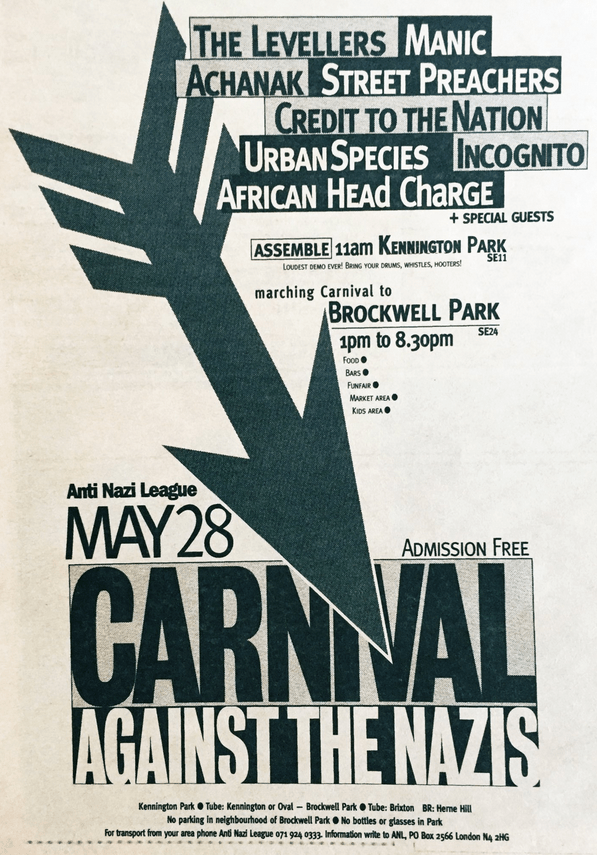
The week before the march far right sympathisers unsuccessfully tried to put a stop to proceedings by defacing posters for the carnival with the words “Cancelled”.
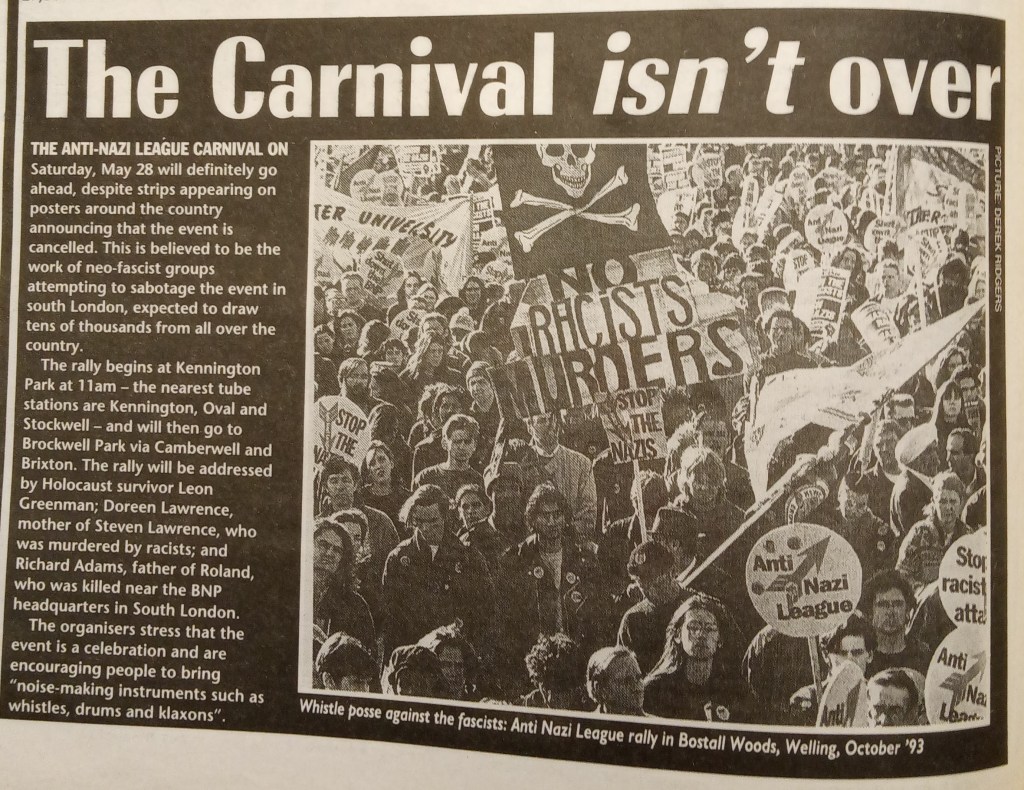
The march started at Kennington Park on a very sombre note as holocaust survivor Leon Greenman urged us to remember all those who died in each of the Nazi concentration camps. The march made its way (very slowly due to the estimated 100,000+ people attending) to Brockwell Park. Playing on the back of a truck were Billy Bragg and S*M*A*S*H, poster boys for “The New Wave of New Wave”, a short lived label created by the music press.

Some of the day’s action was captured on TV:
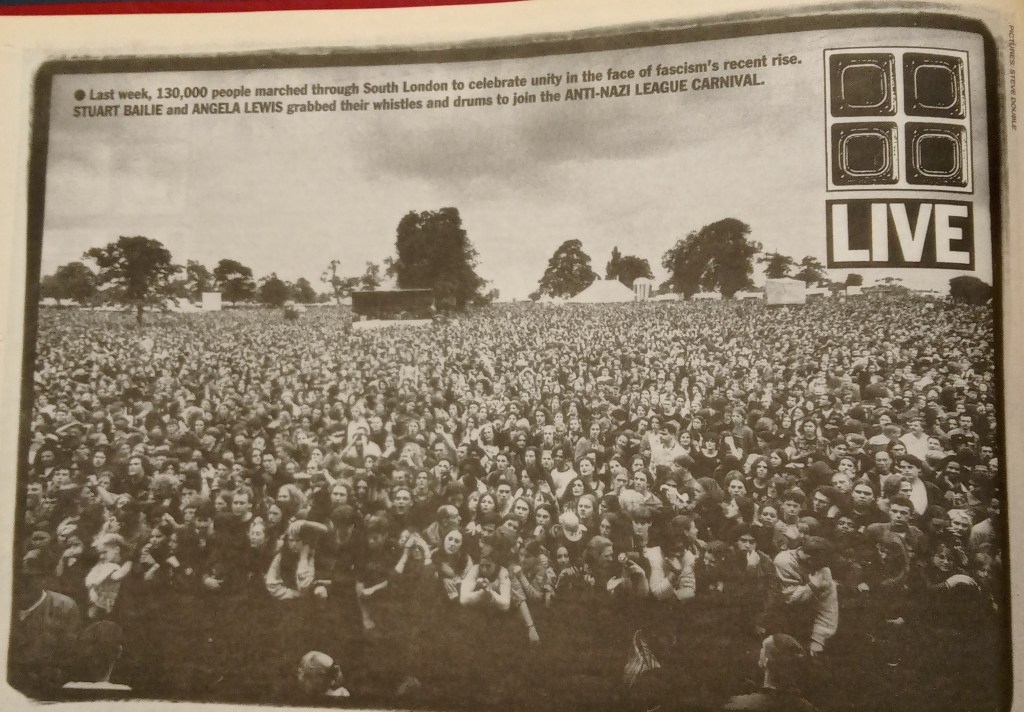
Although the footage doesn’t capture the absolute mud-bath that Brockwell Park became. According to the NME, Lambeth council has put pressure on the organisers to cancel the event two days before it was due to take place as the ground in the park wasn’t dry enough. The council backed down when faced with the prospect of 100,000 people turning up with nothing to do.
So huge was the crowd that most people missed opening acts, Bhangra group Achanak and African Head Charge.
Billy Bragg played an all too brief set, (including “Accident waiting to happen”) during which he railed against the British political establishment’s acceptance of the newly elected neo fascist MPs in Italy, which he described as an insult to all those who gave their lives to fighting fascism during the Second World War.
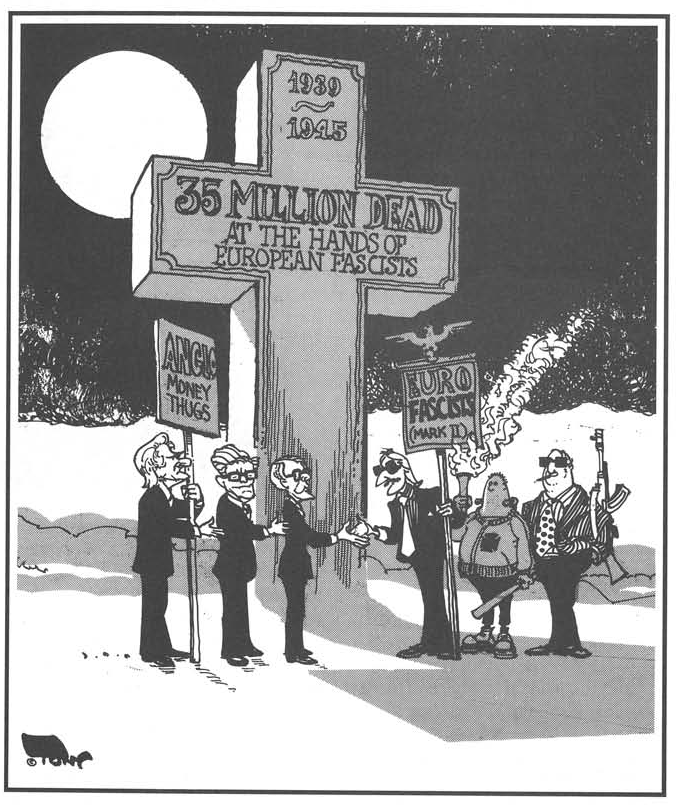
This June 1994 parliamentary Early Day Motion shows just how alarming the rise of fascism across Europe was at the time.
The acts were interspersed with speeches. The compere had to remind the audience that the Derek Beackon puppet that appeared on stage wasn’t the real Derek Beackon after it was roundly booed. He also read a quote from a BNP member deriding what he called “Jungle music”, not realising that this phrase had been reclaimed and was a bona fide genre, not an insult. Rock against Racism founder Red Saunders and the Specials Jerry Dammers also made appearances.

Credit to the Nation certainly used his platform to get his anti racist message across. A joint single with Chumbawumba the previous year “Enough is Enough”, inspired by the rise in racist attacks, was Nr 1 in John Peel’s Festive Fifty in 1993. “Sowing the Seeds of Hatred” was well received by the Melody Maker scribe: “I’ll spray beer on anyone who can convincingly ignore the kid’s pop wicked instincts and enthusiasm”.
The Manic Street Preachers, an avowedly apolitical and arch cynical band seemed a strange addition to the bill. However, in this interview with Radio 1 and an interview in the previous week’s Melody Maker, guitarist Richey Edwards explained that this was an issue that went beyond politics: “The idea that rock bands can change anything has been defunct for about two decades now, but just for us personally, it’s important to show where we stand…We just want to do this gig on a basic emotional level”
Incognito got no mention from the NME but a glowing review from the Melody Maker: “jazz funk vets Incognito sidle on and make it look easy. It’s like Saville Row with serious chops has just flown in: crisp, stylish clothes, three ludicrously over-talented singers, a horn section, “Pick Up The Pieces” “Talkin Loud”, a cooking “Giving it Up” and the truly inspirational “Someday We’ll All Be Free”
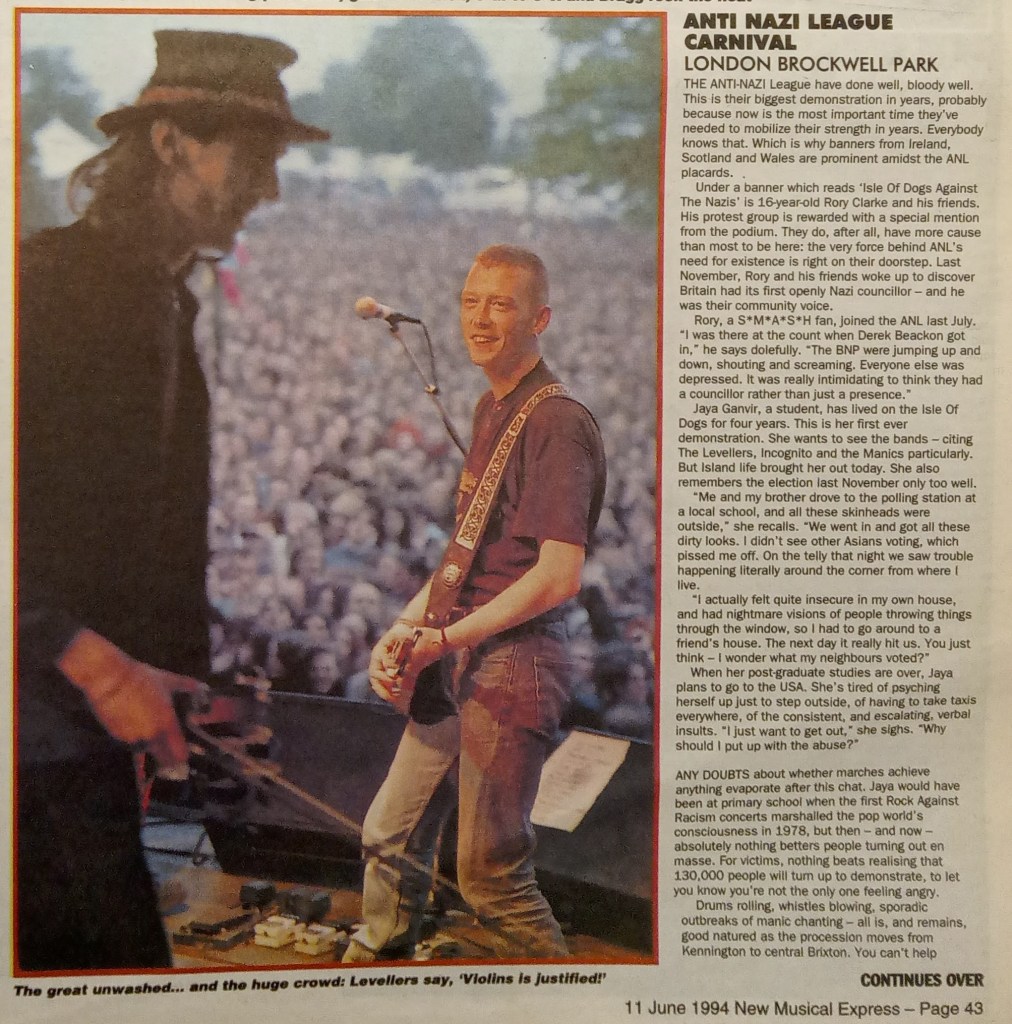
Finishing off proceedings were The Levellers, who the NME stated “have everyone eating out of their grubby paws…in ten years time we’ll remember them as a band that fought hard and strong all the way. They represent resistance like no other British act.” The Melody make were equally enthusiastic: “not only the perfect choice to end the show-I’d bet they are the reason a majority of people are here-but the only band here, or maybe anywhere, to truly meld political awareness and inspirational delight…..If you’re still feeling ironic or why-bother after all this, you should probably go back and start again.”
There is also a brief clip on the Levellers’ Facebook page: https://www.facebook.com/groups/levellers/posts/10165645808484453/
1998-Save Our World Festival
The Save Our World festival was held in June 1998 and 1999 on the solstice weekend.
The 1998 event was a very low key affair, with the organisers seemingly forgetting to do any publicity for the event. It didn’t make the listings in Time Out or the music press. The line-up for the day is lost in the mists of time on some long discarded flyer. In those pre-internet days flyers and word of mouth were the main means of communicating events.
The event was unusually held on the small patch of sunken lawn adjacent to Brockwell Hall. As a consequence of the lack of publicity it was sparsely attended and probably holds the record for being the only festival on record to have more toilets than people!
1999-Save Our World Festival

The 1999 Save Our World event was an altogether grander affair than its predecessor, with a main stage, funfair, dance arena, performance, films and debate. There were certainly a few thousand people in attendance. The acts advertised in Time Out The Egg, Mongolian throat singer Michael Ormiston and Mari Masri do not really give a representative view of the event, which was much more alternative than the listings suggest.
The listings do mention the Space Goats, a group which sprung up from the anti-roads protest movement of the 90s. There were several bands playing on the day who were part of the same anti-roads protest/free festival groups that proliferated in the 90s. It seems hard to believe now but nearly every weekend in the summer in the 90s there would be a free event in a park somewhere in London.
Regulars of the free party scene such as Tarantism and Kakatsitsi played on the day; as did global fusionists Glow. Their set was memorably augmented by a streaker-fairly usual on the free party scene back then.
Stay Up Forever and the Liberator DJs, stalwarts of the squat party scene ,provided the techno sounds for the day.
 brixtonmusicmemories